
This nylon injection molding services guide explains material selection, tooling review, tolerance planning, defect prevention, and RFQ details for custom molded PA6, PA66, and glass-filled nylon parts.
For the broader production workflow, tooling options and quality process, see our services de moulage par injection de plastique page.
What Are Nylon Injection Molding Services?
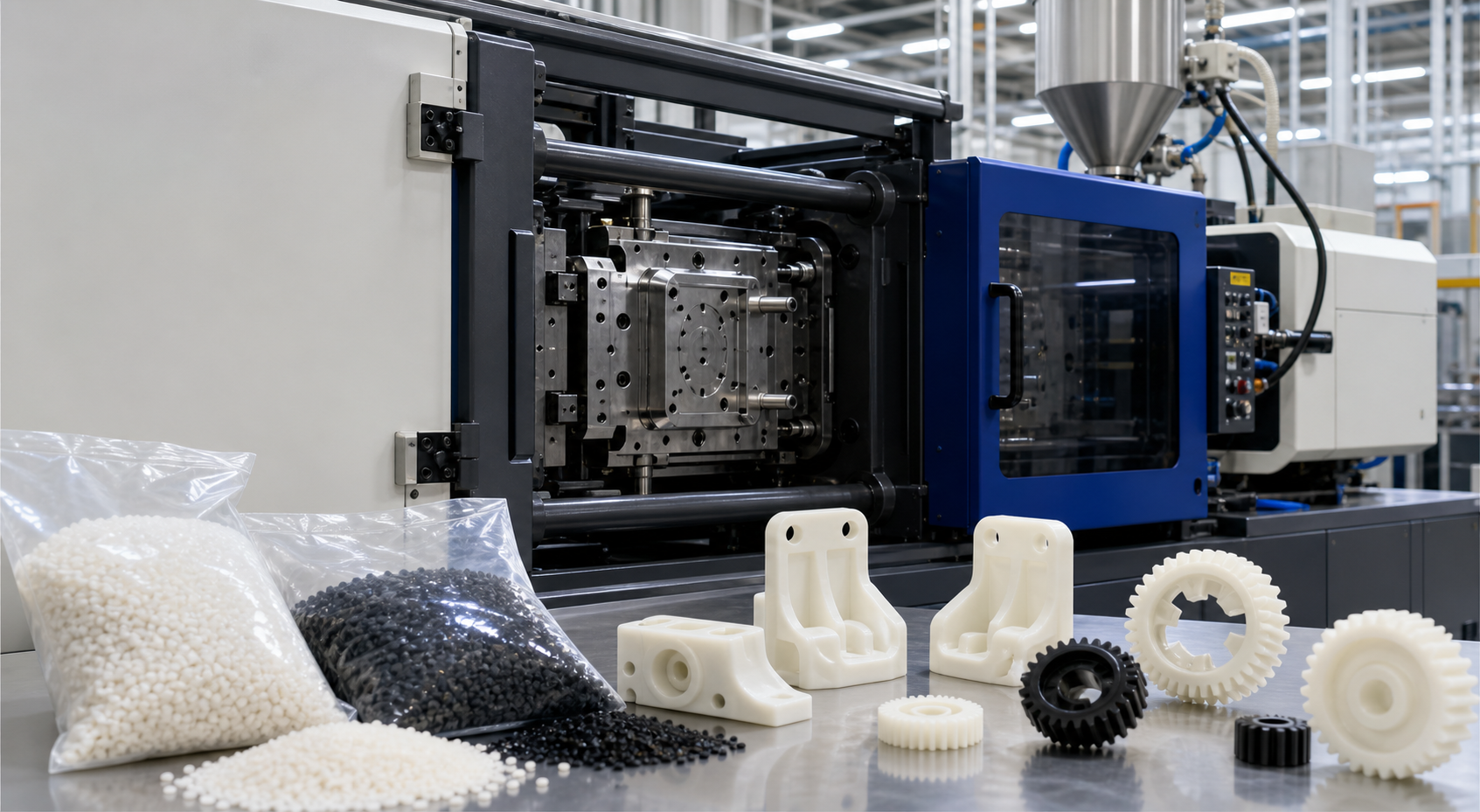
Nylon injection molding services turn PA6, PA66, glass-filled nylon and other engineering polyamides into custom production parts using precision molds. A qualified supplier should support material selection, DFM review, tooling strategy, drying control, molding trials, dimensional inspection and production delivery.
For buyers, the real question is not only whether nylon can be molded. The key question is whether the chosen nylon grade, mold design and process window will keep the part stable after moisture absorption, heat exposure, mechanical load and assembly.
At Nylon Plastic, nylon molding projects often start with a practical review of resin behavior, wall thickness, gate position, tolerance targets and expected production volume. That early review prevents many avoidable trial loops.
Nylon Injection Molding at a Glance
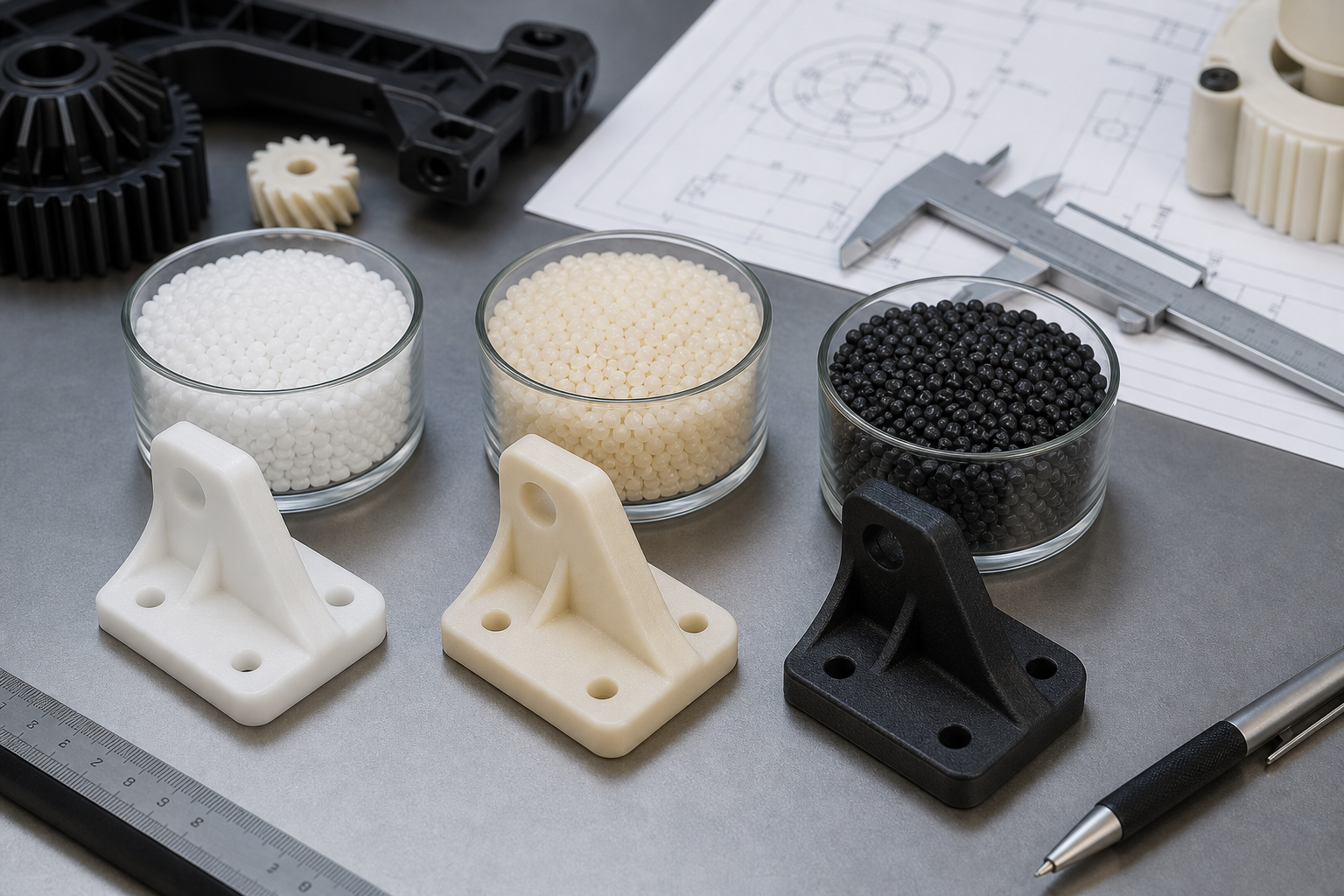
| Exigence | Common nylon choice | Pourquoi est-ce important ? |
|---|---|---|
| General tough molded parts | PA6 | Bonne ténacité et bonne aptitude à la mise en œuvre |
| Higher heat resistance | PA66 | Better thermal performance than PA6 in many applications |
| Stiff brackets or housings | PA6 GF30 or PA66 GF30 | Higher stiffness and lower shrinkage, but more fiber-orientation risk |
| Wear parts | PA6, PA66 or lubricated nylon | Useful for gears, bushings and sliding components |
| Moisture-sensitive dimensions | PA12 or reinforced nylon | Better dimensional planning for humid environments |
When Nylon Injection Molding Is a Good Fit
Nylon is a strong choice for parts that need toughness, fatigue resistance, wear resistance and lower friction than commodity plastics can provide. Typical molded nylon components include gears, bushings, brackets, clips, housings, connectors, pump parts, automotive parts and industrial machine components.
Choose nylon injection molding when the part needs repeatable production, a stable geometry and a material that can handle mechanical stress. If the volume is low or the design is still changing, CNC machining or 3D printing may be better for early validation before tooling.
PA6 for Tough and Cost-Effective Parts
PA6 is often used when impact resistance, processability and cost balance are important. It is a practical choice for many general mechanical parts, but its moisture absorption must be considered for tight fits.
PA66 for Heat and Stiffness
PA66 is often selected for higher temperature applications and stronger stiffness. It can be a better option for under-hood automotive components, electrical housings and load-bearing parts.
Glass-Filled Nylon for Structural Components
Glass-filled nylon improves stiffness and dimensional stability, but it also increases tool wear and directional shrinkage. Gate location and fiber orientation become more important as glass content increases.
Tooling Requirements for Nylon Parts
Nylon molds need careful gate design, venting, cooling and ejection planning. Poor gate placement can create weak weld lines, fiber-rich surfaces, visible flow marks or warpage. For glass-filled nylon, mold steel and gate wear must also be considered.
| Tooling factor | What to check | Risk if ignored |
|---|---|---|
| Emplacement du portail | Flow direction, weld line location, appearance | Weak weld lines or warpage |
| Évacuation | End-of-fill air traps and burn marks | Short shots or burned surfaces |
| Refroidissement | Uniform mold temperature | Differential shrinkage |
| Angle de tirage | Ejection force and surface texture | Scratches, drag marks or sticking |
| Steel choice | Glass-filled nylon abrasion | Premature gate/cavity wear |
Tolerances and Moisture Absorption
Nylon absorbs moisture, and moisture changes dimensions and mechanical behavior. This does not make nylon unreliable, but it means tolerances must be defined with the final use condition in mind.
For tight dimensions, define whether inspection happens dry-as-molded, after conditioning or after a humidity exposure target. If an assembly must fit after shipping or field use, the tolerance plan should reflect that real state instead of only first-article inspection.
Common Nylon Molding Problems and Solutions
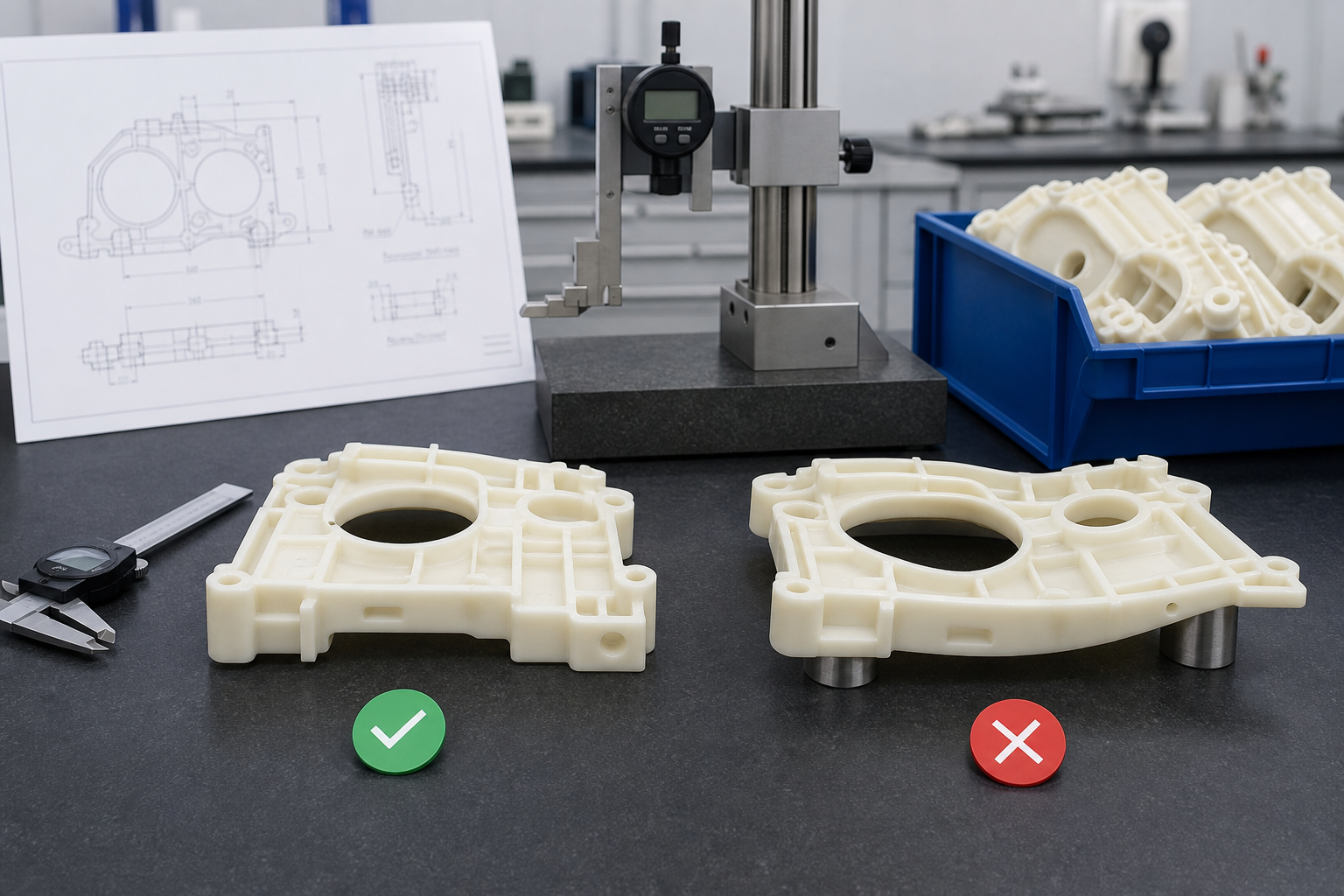
| Problème | Common cause | Practical solution |
|---|---|---|
| Splay or silver streaks | Wet resin, overheating or contamination | Dry resin properly and control material handling |
| Déformation | Uneven shrinkage, fiber orientation or poor cooling | Adjust gate location, wall balance and cooling |
| Tirs courts | Low pressure, poor venting or thin flow paths | Improve vents, melt flow and wall thickness |
| Sink marks | Thick sections and poor packing | Core out thick areas and tune packing |
| Lignes de soudure fragiles | Gate layout or low melt-front temperature | Move gates or improve melt and mold temperature |
Lire la suite
- Nylon Injection Molding Guide
- PA6 vs PA66 Material Selection
- Guide complet sur le nylon renforcé de fibre de verre
Questions fréquemment posées
Quel est le meilleur nylon pour le moulage par injection ?
Le PA6 est souvent un bon nylon polyvalent pour les pièces moulées résistantes, tandis que le PA66 est plus adapté lorsque la résistance à la chaleur et la rigidité sont des critères prioritaires. Le PA6 ou le PA66 renforcé de fibres de verre peut améliorer la résistance mécanique et la stabilité dimensionnelle, mais la conception du moule et de la pièce doit tenir compte de l'orientation des fibres.
Le moulage par injection de nylon est-il adapté aux pièces à tolérances serrées ?
Oui, mais le plan de tolérance doit tenir compte de l'absorption d'humidité et des conditions de mesure. Pour les cotes critiques, il convient de préciser si la pièce est contrôlée à l'état sec tel que moulé, après conditionnement ou après une exposition définie à l'humidité.
Le nylon renforcé de fibres de verre nécessite-t-il un outillage spécifique ?
Le nylon chargé de fibre de verre est plus abrasif que le nylon non chargé ; il convient donc d'examiner attentivement l'acier du moule, la conception de l'entrée de matière et les zones d'usure. Une teneur en fibre de verre plus élevée augmente généralement l'usure des outils et le risque de retrait directionnel.
Quelles informations dois-je fournir pour obtenir un devis de moulage de nylon ?
Veuillez nous envoyer les fichiers CAO, les plans, les spécifications des matériaux, le volume annuel, les tolérances requises, l'état de surface, la couleur, les exigences en matière d'essais ainsi que les conditions réelles d'utilisation. Si vous avez des doutes concernant le matériau, veuillez décrire la charge, la température, l'humidité et l'exposition aux produits chimiques.
Est-il possible de réaliser des prototypes de pièces en nylon avant le moulage par injection ?
Yes. CNC machining, SLS nylon 3D printing or prototype tooling can be used before production tooling. The best prototype method depends on geometry, quantity, tolerance and material requirements.
Can a nylon injection molding supplier support DFM review and material selection before tooling?
Yes. A capable supplier should review wall thickness, ribs, gates, draft, warpage risk and the operating environment before tooling starts. Early DFM and material guidance usually reduce mold changes, sampling delays and avoidable quality issues.
Can you provide inspection records, certificates or sample validation for nylon molded parts?
Yes, if those requirements are defined in the RFQ. Buyers commonly request material certifications, dimensional reports, first article inspection data, color references or sample approval before mass production, so the supplier should confirm that scope in advance.
Comparer en détail Propriétés du PA66 GF30 et choix de la nuance pour les différents niveaux de renforcement en fibre de verre (GF15, GF30 et GF60) dans notre guide dédié au nylon chargé de fibre de verre.
Request a Nylon Injection Molding Review
For a PA6, PA66 or reinforced-nylon production part, send the assembly and drawing revision, exact resin grade or permitted alternative, quantity by phase and service environment. Nylon Plastic can review grade, DFM, tooling, sampling and inspection before quotation.
Éléments à inclure dans votre demande
- 3D CAD files and 2D drawings.
- Target material or performance requirements.
- Annual volume and first order quantity.
- Critical dimensions and tolerance requirements.
- Surface finish, color and texture expectations.
- Assembly, insert molding or post-processing needs.
- Testing requirements such as heat aging, load testing or chemical exposure.
- Packaging and logistics requirements.
- State reinforcement, color and applicable flame/electrical or regulatory requirements against the exact grade.
- Define critical dimensions and whether sample and production inspection use dry-as-molded or agreed conditioned parts.
- Specify first-article records, functional approval, cavity identification, material traceability, destination and packaging.
Nylon Plastic focuses on functional nylon parts where the material choice, tooling plan and production process all affect service life. For nylon injection molding, we review the resin family, part geometry and operating environment before tooling starts, so the quote is based on real manufacturing risk instead of a generic PA6 or PA66 assumption.
- Material selection support: compare PA6, PA66, PA12, glass-filled nylon, flame-retardant grades and modified compounds against load, heat, moisture and chemical exposure.
- DFM before tooling: review wall thickness, ribs, bosses, snap fits, gates, draft, weld lines and warpage risk before the mold is cut.
- Tooling and sampling control: align mold steel, gate strategy, drying conditions, process window and T1 sample feedback with the target part function.
- Production documentation: support RFQs that require material certificates, dimensional inspection, sample approval, color matching or batch-level quality checks.
If the design is not ready for production tooling yet, we can also compare Usinage CNC du nylon ou impression 3D en nylon as prototype or low-volume routes before moving into injection molding.
Ask the quote to separate tooling, cavity count, samples, molded parts, inserts or assembly, any conditioning, inspection and packaging. Confirm tool ownership and which qualification tests are included or arranged separately. Use production-intent resin and mating parts for the agreed approval; a generic nylon datasheet does not approve a finished assembly.

