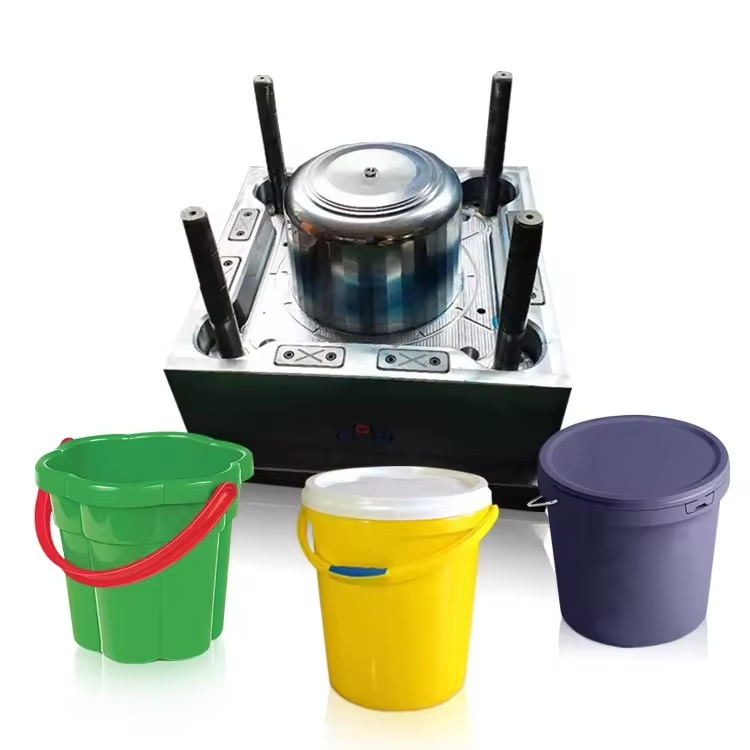

Plastic Injection Molding Automotive Parts are fundamental to modern vehicle design, enabling the production of lightweight, durable, and complex components that improve fuel efficiency, performance, and safety. From under-hood engine components and intricate electrical connectors to interior trim and exterior body panels, injection molding delivers the precision, repeatability, and material versatility the automotive industry demands. This guide explores how custom injection molding serves the automotive sector, the advanced materials used, and the manufacturing capabilities required to produce parts that meet stringent automotive standards.
If you need custom plastic parts for automotive injection molding, the usual early checks are material selection, wall thickness, tolerance stack-up, and whether rapid tooling for injection molding can shorten the path from prototype to production. For nylon-heavy programs, compare the résistance chimique du nylon guide, Tableau de compatibilité chimique du nylon, et nylon 6 vs nylon 66 before tooling starts.

The Automotive Advantage: Why Injection Molding Dominates
The automotive industry’s shift toward plastics is driven by the unique benefits injection molding offers for high-volume, high-precision part production.
- Perte de poids significative : Replacing metal components with engineered plastics reduces vehicle weight, directly contributing to improved fuel economy and lower emissions. Plastic parts are typically 30-50% lighter than their metal counterparts while offering excellent strength-to-weight ratios.
- Design Freedom for Complex Geometries: Injection molding allows for the creation of complex shapes, integrated features, and multi-functional components that would be impossible or prohibitively expensive to manufacture with metal. This consolidates parts, reduces assembly time, and enhances functionality.
- High-Volume Consistency and Repeatability: The automotive industry demands millions of identical parts. Injection molding, with precision-engineered molds, delivers exceptional repeatability, ensuring every component meets exact specifications, which is critical for safety and assembly line efficiency.
- Material Versatility and Performance: A vast range of engineering thermoplastics—from high-temperature resistant polymers to impact-modified alloys—allows designers to select materials with precisely the right mechanical, thermal, and chemical resistance for each specific application, from the engine bay to the passenger cabin.
- Cost-Effectiveness at Scale: While the initial tooling investment is significant, the per-part cost becomes highly economical at high volumes, making injection molding the most cost-effective production method for mass-produced automotive components.

Critical Automotive Applications for Injection Molded Parts
Injection molded plastics are used throughout the vehicle, serving functions that range from structural to aesthetic. The table below highlights key application areas.
| Domaine d'application | Common Parts | Key Material Requirements | Typical Materials Used |
|---|---|---|---|
| Sous le capot et groupe motopropulseur | Engine covers, intake manifolds, oil pans, thermostat housings, cooling fans, fluid reservoirs | High heat resistance, chemical resistance (oils, coolants), dimensional stability, creep resistance | PA66, PPA, PPS, PEEK, glass-reinforced nylons (PA66-GF30) |
| Systèmes électriques et électroniques | Connectors, sensor housings, fuse boxes, wire harness clips, ECU enclosures | Excellent electrical insulation, flame retardancy, precision tolerances, resistance to thermal cycling | PBT, PA66, PPA, PPS, PC/ABS |
| Interior Trim & Components | Dashboard components, door handles, trim panels, center consoles, cup holders, glove boxes | Aesthetic surface finish, scratch resistance, UV stability, good impact strength, colorability | ABS, PC/ABS, PP, TPE (for soft-touch overmolding) |
| Exterior Body Parts | Grilles, light housings, mirror housings, door handles, spoilers, trim strips | Weather resistance, UV stability, impact resistance (at low temperatures), Class A surface finish | ASA, PC, ABS, PBT, PC/PBT blends |
| Safety & Structural | Seat belt components, airbag housings, pedal systems, bumper mounts | High impact strength, energy absorption, stiffness, long-term durability | PA66, POM, PC, long-fiber reinforced thermoplastics |
| Fuel System Components | Fuel caps, filler necks, fuel pump housings, vapor canisters | Excellent fuel and chemical resistance, low permeability, dimensional stability | POM, PA12, PPS, HDPE |

Advanced Materials for Automotive Injection Molding
The selection of material is perhaps the most critical decision, directly impacting part performance and longevity. The reference material highlights several key resins used in automotive applications .
| Matériau | Propriétés principales | Applications automobiles courantes |
|---|---|---|
| PA66 (nylon 66) | High strength, stiffness, and heat resistance; excellent chemical and wear resistance. Often glass-reinforced (PA66-GF30/35). | Engine covers, intake manifolds, radiator end tanks, electrical connectors, cooling fans. |
| PEEK (polyétheréthercétone) | Ultra-high performance: exceptional temperature resistance (up to 260°C), chemical resistance, strength, and dimensional stability. | High-temperature electrical connectors, transmission components, seals, bushings in racing and heavy-duty applications. |
| PA (Nylon 6) | Good strength, toughness, and wear resistance; lower cost than PA66. | Under-hood components, gears, bushings, wire harness clips. |
| ABS (Acrylonitrile Butadiène Styrène) | Good impact strength, rigidity, and surface finish; easy to process and paint. | Interior trim parts, dashboard components, grilles, mirror housings. |
| PP (Polypropylène) | Lightweight, good chemical resistance, fatigue resistance (for living hinges), low cost. | Interior trim, door panels, air ducts, battery cases, fender liners. |
| PC (Polycarbonate) | High impact strength, optical clarity, heat resistance. Often alloyed with ABS. | Headlamp lenses, instrument clusters, interior and exterior trim (PC/ABS). |
| POM (Acetal / Polyoxymethylene) | High stiffness, low friction, excellent wear resistance, good dimensional stability. | Gears, bearings, fuel system components, seat belt mechanisms, window regulator parts. |
| PTFE (Polytetrafluoroethylene) | Extremely low friction, excellent chemical resistance, high temperature resistance. Often used as an additive. | Bushings, seals, bearings, and applications requiring non-stick or low-friction properties. |
| TPU (Thermoplastic Polyurethane) | Excellent flexibility, abrasion resistance, and toughness. | Grommets, seals, bushings, cable sheathing, overmolded soft-grip components. |
| PMMA (Acrylique) | Excellent optical clarity, weatherability, and scratch resistance. | Tail light lenses, interior decorative trim, instrument panels. |
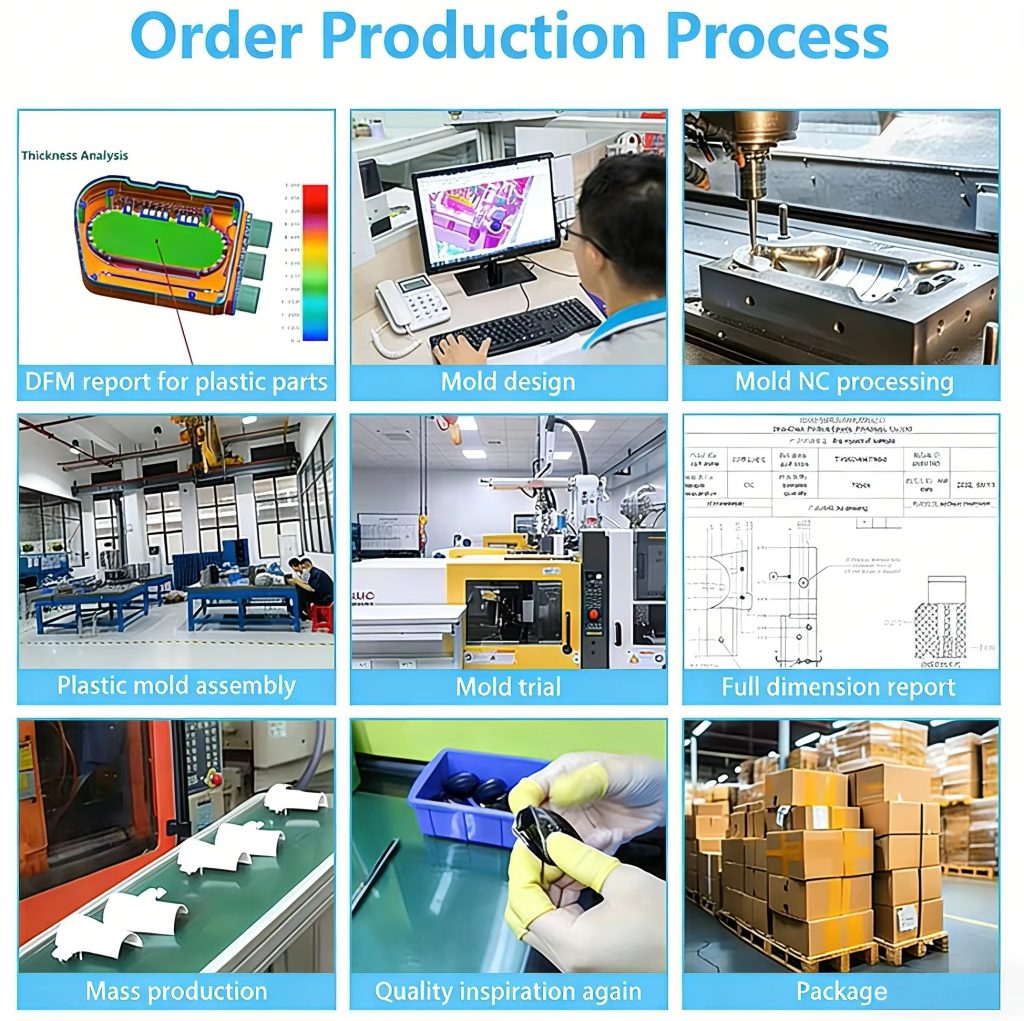
The Manufacturing Process: From Concept to Component
Producing high-quality automotive parts requires a seamless, end-to-end process, from design and material selection through precision molding and quality control. The reference material emphasizes OEM/ODM custom capabilities for this sector .
| Stade | Processus et technologie de base | Résultats en matière de qualité et de performance |
|---|---|---|
| 1. Conception et ingénierie des pièces | – Collaborative design based on customer specifications, drawings, or samples (OEM/ODM) . – Analyse DFM (Design for Manufacturability) visant à optimiser la conception des pièces en vue de leur moulage par injection. |
A part design optimized for function, manufacturability, and cost, meeting all application requirements. |
| 2. Material Selection & Sourcing | – Selection of the optimal engineering plastic based on performance needs (temperature, chemical, mechanical). – Sourcing of certified, traceable materials (e.g., PA66, PEEK, ABS) from qualified suppliers. |
Performances, homogénéité et conformité aux spécifications automobiles garanties pour les matériaux. |
| 3. Conception et fabrication de moules de précision | – Mold design using advanced CAD software, incorporating gating, cooling, and ejection systems. – Fabrication from high-grade tool steel (e.g., P20, 718, NAK80, S136, 2738, 2316) using high-precision CNC machining . – Tolerances held to 0.01–0.05mm for critical dimensions . |
Un outil robuste et de haute précision, capable de produire des millions de pièces homogènes et de grande qualité. |
| 4. Production par moulage par injection | – Des moules de précision montés sur des presses à injection à la pointe de la technologie. – Process parameters (temperature, pressure, cooling time) are strictly monitored and controlled. – Suitable for both prototyping/low-volume runs and high-volume mass production. |
Consistent, repeatable production of parts meeting tight dimensional and aesthetic specifications. |
| 5. Secondary Operations & Finishing | – Post-molding operations as required: trimming, vibration welding, ultrasonic welding, assembly. – Surface finishing: texturing, polishing, painting, plating, or laser marking. |
Fully finished, ready-to-assemble components with specified appearance and functionality. |
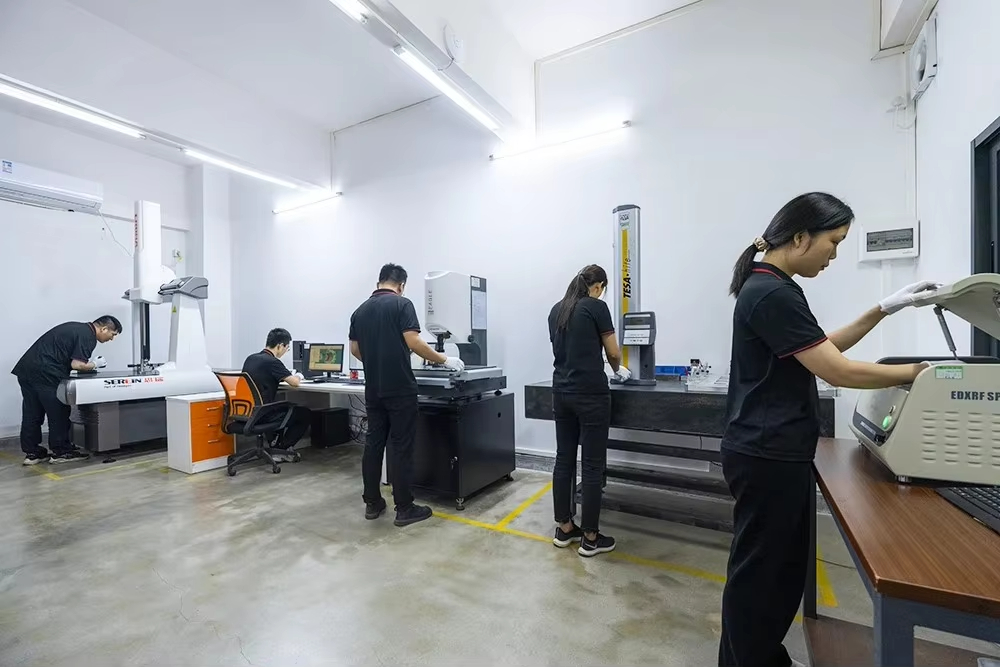
| 6. Quality Assurance & Testing | – In-process and final inspection using CMM (Coordinate Measuring Machines) for dimensional verification. – Functional testing as required (e.g., leak tests, thermal cycling, material validation). – Compliance with industry standards (ISO 9001, IATF 16949). |
Qualité des pièces garantie, traçabilité et conformité aux normes rigoureuses de l'industrie automobile. |
Why Precision Matters: Tolerances in Automotive Parts
The reference material specifies achievable tolerances of 0.01–0.05mm . This level of precision is critical for many automotive applications:
- Electrical Connectors: Ensures reliable pin fit and signal integrity, preventing intermittent connections.
- Fluid Sealing Surfaces: Guarantees leak-proof seals in cooling and fuel systems.
- Moving Parts (Gears, Bushings): Ensures proper clearances for smooth operation and long wear life.
- Assembly Interfaces: Guarantees that components fit together seamlessly on high-speed assembly lines.

FAQ: Plastic Injection Molding Automotive Parts
Q1 : Quelles certifications dans le secteur automobile possédez-vous ?
A : Reputable suppliers for the automotive industry typically hold IATF 16949 certification, the international standard for quality management systems in automotive production. They may also be ISO 9001 certified. Always verify a supplier’s certifications to ensure they meet industry requirements.
Q2: Can you produce parts for both prototyping and high-volume production?
R : Oui. Experienced automotive molders offer services ranging from prototyping and low-volume pilot runs to high-volume mass production. They can work with customer-provided designs or develop parts from concept (OEM/ODM) .
Q3: What are typical lead times for automotive injection molds and parts?
A : Lead times vary with complexity. Mold fabrication typically requires 6-10 weeks. Once the mold is approved, production lead times depend on order volume but are typically 3-6 weeks. Rush services may be available for critical programs.
Q4: How do you ensure parts meet stringent automotive quality standards?
A : Quality is ensured through a combination of fabrication de moules de précision (with tolerances down to 0.01mm ), strict process control during injection molding, and comprehensive inspection using CMM equipment. First Article Inspection (FAI) reports are typically provided for approval before mass production begins.
Q5: Can you work with my specific material requirements, including exotic resins like PEEK?
R : Absolument. Suppliers experienced in automotive parts have extensive knowledge of processing a wide range of materials, from common engineering plastics like PA66 and ABS to high-performance resins like PEEK, PPS, and PTFE . They can handle customer-specified materials and provide guidance on material selection .
Q6: What file formats do you need to provide a quote?
A : To provide an accurate quote and DFM feedback, suppliers typically need 3D CAD files in formats like STEP (.stp), IGES (.igs), Parasolid (.x_t), SolidWorks (.sldprt) ou Autodesk Inventor (.ipt) . 2D drawings (PDF/CAD) with critical tolerances and specifications are also very helpful .
Q7: Do you offer assistance with part design for manufacturability?
R : Oui. A key service offered by experienced molders is Analyse de la conception en vue de la fabricabilité (DFM). They review your design and suggest modifications that can improve part quality, reduce cycle time, lower tooling costs, or simplify production, while maintaining the required functionality.

Conclusion: Your Partner for Automotive Excellence
Plastic Injection Molding Automotive Parts is a specialized field requiring deep material knowledge, precision engineering, and a commitment to quality. Partnering with an experienced, certified manufacturer ensures your components meet the demanding performance, safety, and reliability standards of the modern automotive industry.
Prêt à vous lancer dans votre prochain projet automobile ? Nylon Plastic offers comprehensive injection molding services for automotive parts, from design support and precision mold making to high-volume production, backed by rigorous quality assurance.
Demande de devis | Contacter notre équipe d'ingénieurs
FAQ
When does Plastic Injection Molding Automotive Parts: Precision Engineering for the Modern Vehicle make sense?
Plastic Injection Molding Automotive Parts: Precision Engineering for the Modern Vehicle makes sense when the part volume, material choice, geometry, and repeatability needs justify mold design and tooling investment.
What design factors matter most for Plastic Injection Molding Automotive Parts: Precision Engineering for the Modern Vehicle?
L'épaisseur des parois, les nervures, les bossages, l'angle de dépouille, l'emplacement de l'entrée de matière, le retrait, la ligne de joint et l'éjection sont autant de facteurs qui influent sur la qualité des pièces moulées.
Quelles informations faut-il fournir avant la fabrication d'un moule ?
Le fournisseur doit confirmer le modèle 3D, le matériau, le volume annuel prévu, les exigences en matière d'aspect, les tolérances requises, ainsi que toute exigence relative à l'assemblage ou aux essais fonctionnels.
What is the biggest risk in Plastic Injection Molding Automotive Parts: Precision Engineering for the Modern Vehicle?
Le risque le plus important consiste à valider l'outillage avant d'avoir vérifié de manière exhaustive le comportement du matériau, le retrait, l'écoulement et le fonctionnement de la pièce dans le cadre de l'application réelle.
Lire la suite
- Pièces moulées par injection de plastique : Fabrication de précision pour chaque industrie
- Pièces moulées par injection : Fabrication de précision de composants en plastique sur mesure
- Pièces en plastique sur mesure pour le moulage par injection automobile : ingénierie de précision pour les composants intérieurs et extérieurs