Understanding Runner Systems
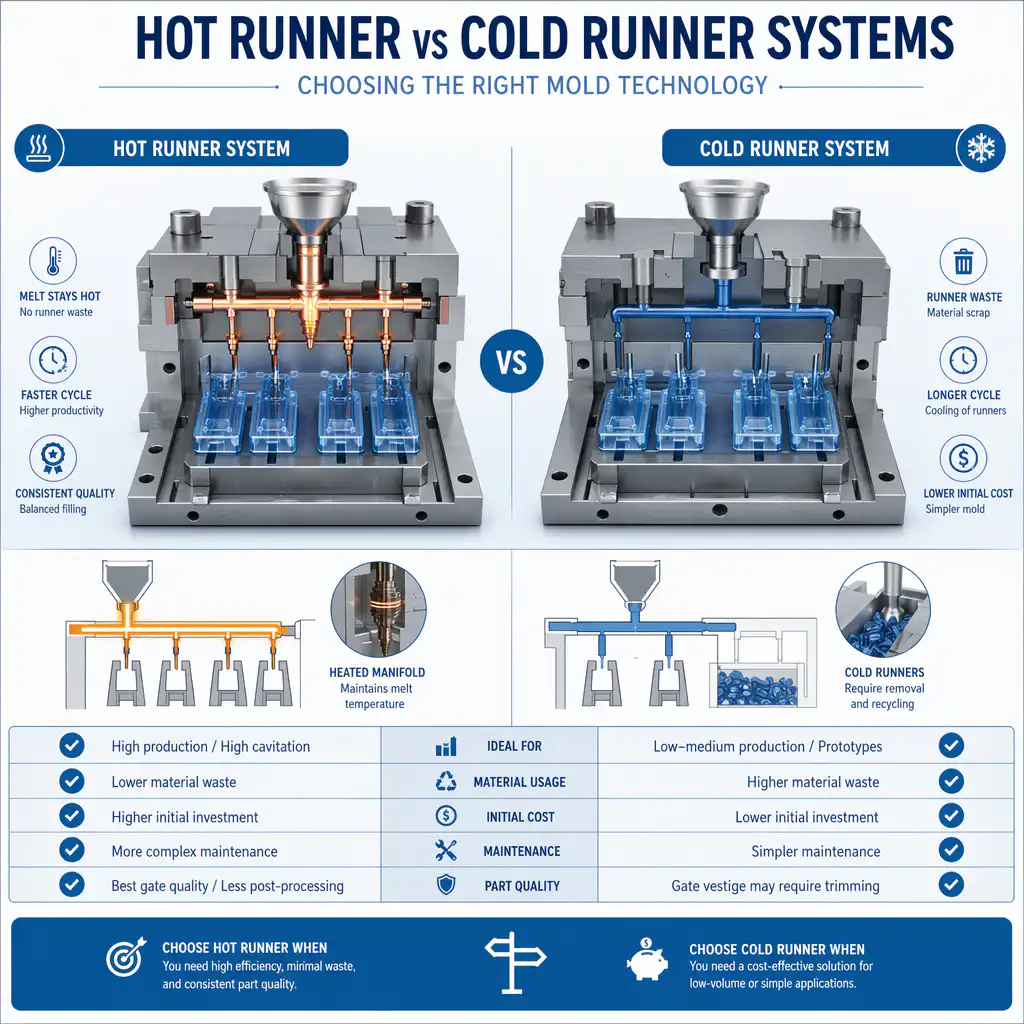
The runner system delivers molten plastic from the injection machine nozzle to the mold cavity. Choosing between hot runner and cold runner technology impacts part cost, quality, and production efficiency.
Cold Runner Systems
In cold runner molds, the runner channel is part of the mold cavity and solidifies with each cycle.
Avantages
- Lower mold cost and simpler design
- Suitable for a wide range of materials
- Easy color changes
- No heated components to maintain
- Better for small production volumes
Disadvantages
- Runner waste (sprue, runners, gates)
- Longer cycle times due to runner cooling
- Post-molding degating required
- Higher material cost over time
Les meilleures applications
- Low to medium volume production
- Multi-cavity molds with different part weights
- Materials sensitive to thermal degradation
- Frequent color changes
Systèmes à canaux chauds
Hot runner systems maintain the runner in a molten state, eliminating solidified runner waste.
Avantages
- No runner waste (material savings)
- Faster cycle times
- Lower injection pressure required
- Better for gate location flexibility
- Improved part quality at gates
Disadvantages
- Higher initial mold cost (30-50% more)
- More complex maintenance
- Potential for thermal degradation
- Not suitable for all materials
- Color change takes longer
Les meilleures applications
- High-volume production
- Expensive engineering materials
- Large multi-cavity molds
- Parts requiring gate vestige control
Comparaison des coûts
Selection Guidelines
Choisir Cold Runner when:
- Production volume is low
- Budget constraints exist
- Frequent color changes required
- Material is heat-sensitive
Choisir Hot Runner when:
- Production volume is high
- Material cost is significant
- Cycle time optimization needed
- Gate quality is critical
Conclusion
Both runner systems have valid applications. Evaluate total cost of ownership, production volume, and part requirements to make the optimal choice.
Ressources connexes
- Guide des plastiques de qualité alimentaire
- Traitement anti-humidité pour le nylon
- Effets de l'humidité sur le nylon
- Guide des températures d'impression du nylon
- Usinage CNC du nylon
Ressources connexes
- Guide des plastiques de qualité alimentaire
- Traitement anti-humidité pour le nylon
- Effets de l'humidité sur le nylon
- Guide des températures d'impression du nylon
- Usinage CNC du nylon
FAQ
When does Hot Runner vs Cold Runner Systems — Choosing the Right Mold Technology make sense?
Hot Runner vs Cold Runner Systems — Choosing the Right Mold Technology makes sense when the part volume, material choice, geometry, and repeatability needs justify mold design and tooling investment.
What design factors matter most for Hot Runner vs Cold Runner Systems — Choosing the Right Mold Technology?
L'épaisseur des parois, les nervures, les bossages, l'angle de dépouille, l'emplacement de l'entrée de matière, le retrait, la ligne de joint et l'éjection sont autant de facteurs qui influent sur la qualité des pièces moulées.
Quelles informations faut-il fournir avant la fabrication d'un moule ?
Le fournisseur doit confirmer le modèle 3D, le matériau, le volume annuel prévu, les exigences en matière d'aspect, les tolérances requises, ainsi que toute exigence relative à l'assemblage ou aux essais fonctionnels.
What is the biggest risk in Hot Runner vs Cold Runner Systems — Choosing the Right Mold Technology?
Le risque le plus important consiste à valider l'outillage avant d'avoir vérifié de manière exhaustive le comportement du matériau, le retrait, l'écoulement et le fonctionnement de la pièce dans le cadre de l'application réelle.