This cnc machining medical guide explains practical considerations for material selection, design review, manufacturing, and sourcing decisions.

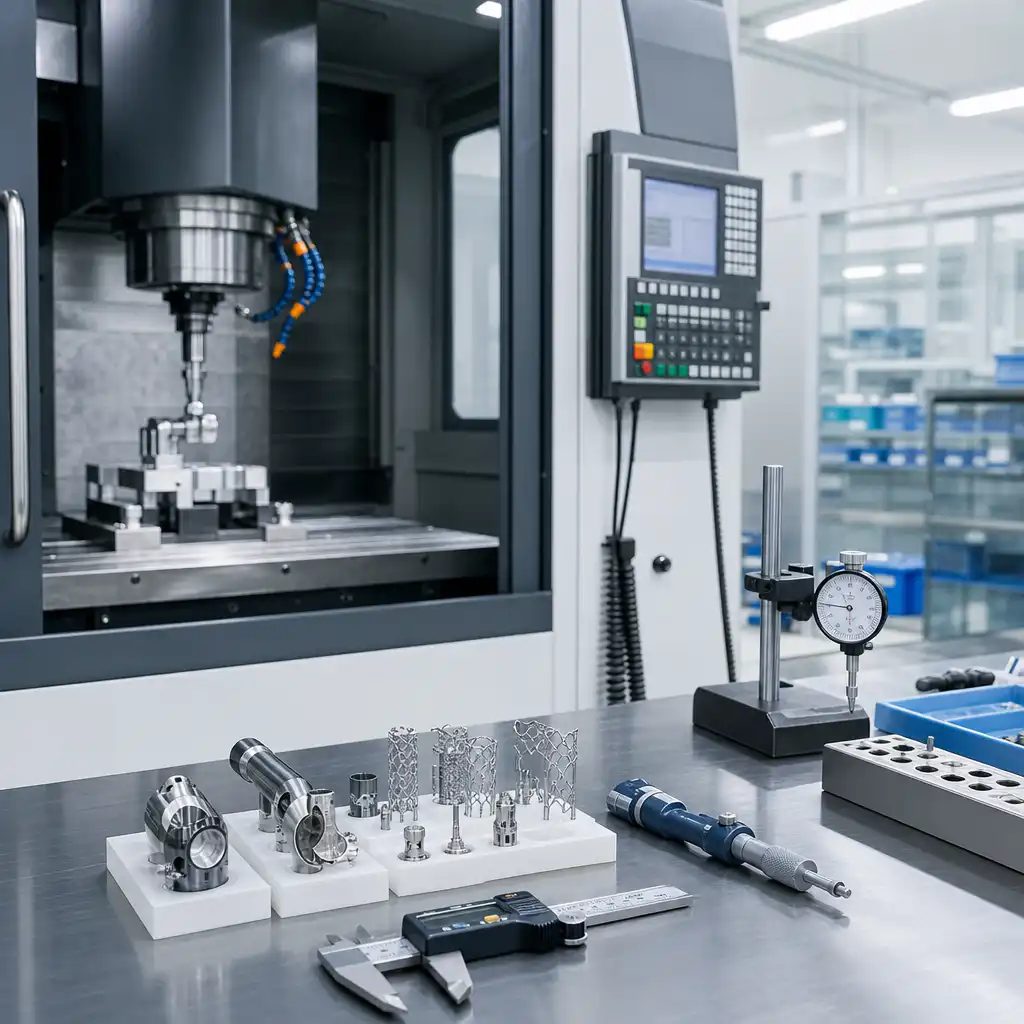
CNC machining is a cornerstone manufacturing process in the medical device industry. From surgical instruments and implantable devices to diagnostic equipment components and drug delivery systems, CNC-machined parts must meet the industry’s most stringent requirements for precision, biocompatibility, cleanliness, and regulatory traceability.
Why CNC Machining for Medical Devices?
Medical device manufacturing has unique requirements that align exceptionally well with CNC machining capabilities:
- Tolérances serrées: Implantable devices and surgical instruments routinely require ±0.0005 to ±0.0001 inch tolerances
- Biocompatible Materials: CNC machining handles medical-grade metals (Ti-6Al-4V, 316L SS, CoCr) and plastics (PEEK, PEI, medical-grade POM) without contaminating the material
- Finition de la surface: Implant surfaces must be free of microscopical defects that could harbor bacteria or cause tissue irritation — CNC-machined surfaces can achieve 8-16 Ra with proper tooling and strategy
- Traceability: Each machined batch can be linked to specific material lots, machine parameters, and records — essential for FDA compliance
- Low-to-Mid Volume: Many medical devices are produced in quantities of 100-10,000 annually — ideal for CNC machining rather than injection molding
Key Medical Device Applications
1. Orthopedic Implants
- Bone Screws and Plates: Titanium alloy (Ti-6Al-4V) machined with thread tolerances of ±0.0002 inches
- Joint Replacement Components: Femoral heads, acetabular cups, tibial trays — cobalt-chrome or titanium, with highly polished bearing surfaces
- Spinal Implants: Cages, rods, and screws requiring complex geometries and biocompatible surface finishes
2. Surgical Instruments
- Scalpel Handles, Forceps, Retractors: Stainless steel (316L, 420) with electropolished surfaces
- Drill Guides and Templates: PEEK or medical-grade POM with patient-specific geometries from CT/MRI data
- Minimally Invasive Surgery (MIS) Tools: Long, slender components with complex pivot mechanisms

3. Diagnostic and Imaging Equipment
- CT and MRI Components: Non-ferrous materials (aluminum, brass, PEEK) to avoid imaging artifacts
- Sample Handling: Autoclavable plastic components (PEEK, PEI) for reagent handling and sample processing
- Microfluidic Devices: Channels as small as 0.005 inches machined into biocompatible polymers
Materials for Medical CNC Machining
| Matériau | Candidature | Machining Considerations |
|---|---|---|
| Ti-6Al-4V (Grade 5) | Implants, surgical instruments | Low thermal conductivity; use coolant, sharp tools |
| 316L Stainless Steel | Instruments, housings | Work-hardens; positive rake angles |
| PEEK (medical grade) | Spinal cages, bone replacement | Excellent machinability; use coolant |
| CoCr (Cobalt Chrome) | Joint replacements | Very hard; use ceramic or CBN tools |
Regulatory Compliance: ISO 13485 and FDA Requirements
Medical device machining suppliers must comply with:
- ISO 13485:2016: Quality management systems for medical devices — more stringent than ISO 9001, with additional requirements for risk management, design control, and traceability
- FDA 21 CFR Part 820: Quality System Regulation for US market — design controls, document controls, corrective/preventive action (CAPA)
- Certifications matérielles: USP Class VI, ISO 10993 biocompatibility documentation for materials in patient contact
- Cleanroom Machining: For implantable devices, secondary operations (polishing, cleaning, packaging) must occur in certified cleanroom environments
FAQ
When is CNC Machining for Medical Devices: Precision and Regulatory Compliance the right choice?
CNC Machining for Medical Devices: Precision and Regulatory Compliance is the right choice when the part requires machined accuracy, controlled surfaces, repeatable features, and a material that can be cut reliably.
What should be confirmed before ordering CNC Machining for Medical Devices: Precision and Regulatory Compliance?
Confirmer la version du dessin, la qualité du matériau, les tolérances, la quantité, les dimensions critiques, l'état de surface et les exigences d'inspection avant de lancer la production.
What usually drives cost in CNC Machining for Medical Devices: Precision and Regulatory Compliance?
Le coût est généralement déterminé par les matériaux, le temps de préparation, le temps machine, les difficultés liées aux tolérances, la fixation, l'accès aux outils, la finition, l'inspection et la quantité commandée.
How can quality risk be reduced in CNC Machining for Medical Devices: Precision and Regulatory Compliance?
Le risque de qualité est réduit en marquant clairement les caractéristiques critiques, en évitant les tolérances trop étroites, en confirmant la fabricabilité à un stade précoce et en utilisant les données d'inspection pour les dimensions importantes.