
Material, process and quotation scope
What Determines Engineering Plastic Cost?
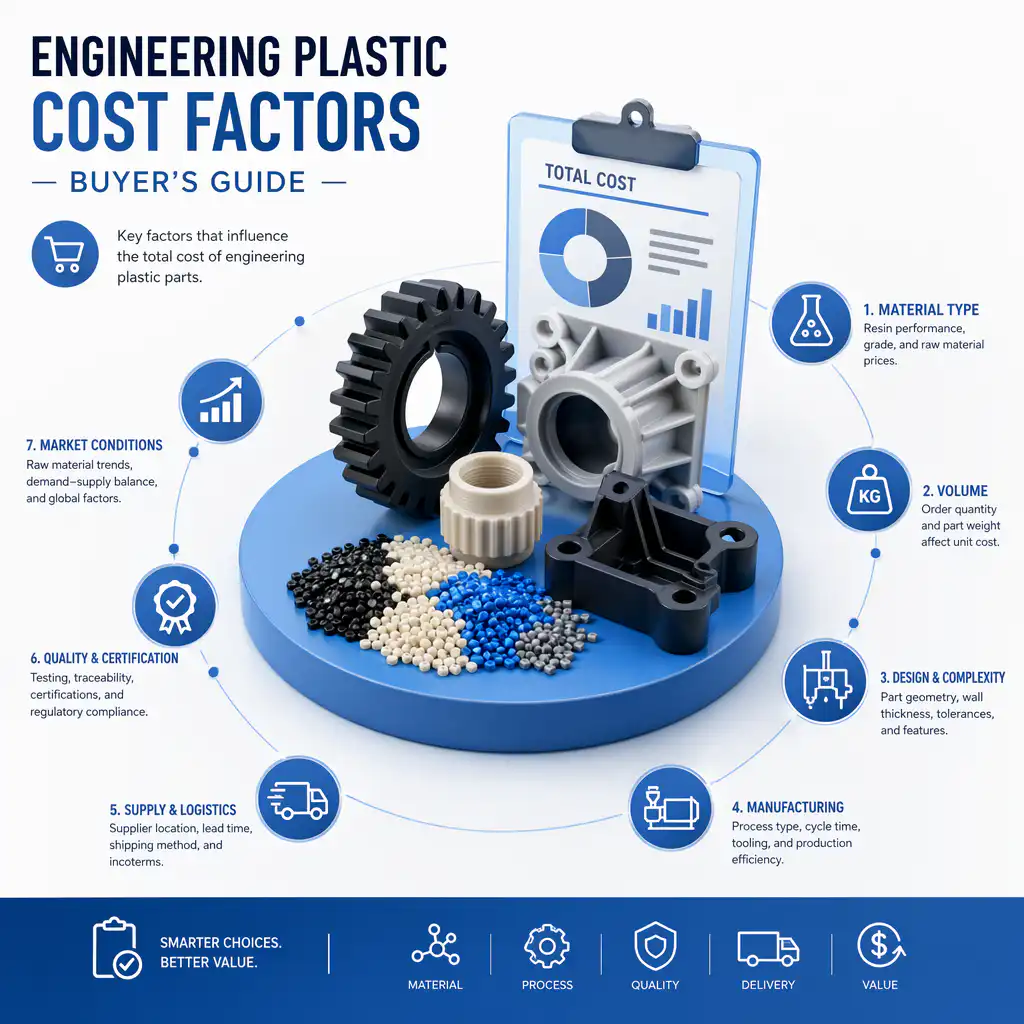
The resin price is only one part of the final cost. The exact polymer grade, reinforcement, processing route, part geometry, tolerance, inspection, documentation, packaging and order quantity all affect the quotation.
Engineering Plastic Cost Components
| Cost component | What changes it | What to define before quotation |
|---|---|---|
| Base resin | PA6, PA66, PBT, POM, PC, PEEK and other polymers have different feedstock and processing requirements. | Exact grade or an approved performance envelope. |
| Reinforcement and additives | Glass fiber, carbon fiber, mineral filler, flame retardant, impact modification and stabilization change material and compounding cost. | Required percentage, rating, color and operating condition. |
| Géométrie de la pièce | Thin walls, deep pockets, undercuts, tight radii, complex ribs and cosmetic surfaces affect tooling, cycle time and reject risk. | Drawing, CAD, critical features and appearance zones. |
| Process route | Injection molding, CNC machining, 3D printing and custom compounding have different setup and volume economics. | Prototype quantity, production quantity and expected annual volume. |
| Tolerance and inspection | Tighter tolerances and additional reports require more process control and measurement time. | Critical dimensions, datum scheme, sampling plan and measurement condition. |
| Documents and compliance | COA, material declarations, traceability, PPAP or specific test reports add defined approval work. | Applicable document, standard, market and submission stage. |
| Packaging and delivery | Moisture protection, labeling, individual protection, freight mode and delivery term change landed cost. | Destination, Incoterm, packaging requirement and target date. |
How Quantity Changes Cost
Quantity affects material purchasing, machine setup, tooling amortization, inspection time and packaging. There is no universal discount percentage for one, ten or one hundred tonnes, because grade availability, formulation, color, market conditions and payment terms vary.
Compare Total Approved Cost
A low unit price can become expensive if it excludes drying control, sampling, inspection, rejects, packaging or delivery. Normalize the following fields before comparing alternatives.
- Manufacturer, complete grade name and allowed substitution rules.
- Reinforcement, additives, color and material condition.
- Tooling, setup, samples, finishing and assembly included in the quote.
- Dimensional inspection, material records and compliance documents.
- Packaging, delivery term, destination and quotation validity.

Choose the Manufacturing Route by Volume and Risk
3D printing can be efficient for early geometry checks and complex low-quantity parts. CNC machining can suit precise prototypes, bridge production and parts made from stock shapes. Injection molding becomes attractive when tooling cost can be justified by repeat volume, cycle time and part consistency. The lowest-risk route depends on the drawing and approval plan.

Questions fréquemment posées
Why is an engineering plastic quotation higher than the resin price?
The quotation can include compounding, drying, setup, tooling, processing, inspection, packaging, documentation, scrap allowance and delivery. Resin price alone does not represent the finished scope.
Does a larger quantity always reduce the unit price?
It often spreads setup or tooling cost across more units, but the result still depends on grade availability, cycle time, quality requirements, packaging and commercial terms.
What information produces a more accurate quotation?
Provide the drawing or CAD, exact grade or required properties, quantity, annual volume, tolerance, finish, inspection documents, destination and target timing.
Related Engineering Plastic Resources
- Nylon material properties and grade comparison
- Nylon plastic granule price factors
- Nylon injection molding services
- Integrated plastic manufacturing solution
Request an Engineering Plastic Cost Review
Send the information needed to compare material, process and approval scope.
Drawing or CAD, dimensions and tolerance.
Grade, reinforcement, color and operating condition.
Prototype, order quantity and annual volume.
Documents, packaging, destination and timing.