Les matériaux destinés au moulage par injection plastique doivent être choisis en fonction des exigences de l'application, telles que la charge, la chaleur, les chocs, l'exposition aux produits chimiques, la stabilité dimensionnelle, l'état de surface, la souplesse, l'indice de résistance au feu, l'exposition aux UV et le coût de production. Parmi les choix courants, on trouve l'ABS, le PC, le nylon, le PP, le PE, le POM, le PBT, le TPE et le PMMA.
De nombreux problèmes liés aux pièces moulées trouvent leur origine dans un choix de matériau mal défini. Une résine facile à mouler peut ne pas résister à la chaleur, aux contraintes ou à l'exposition aux produits chimiques, tandis qu'une résine haute performance peut entraîner une augmentation des coûts ou nécessiter des modifications de conception. Un guide de sélection pratique doit établir un lien entre la fonction de la pièce et sa facilité de fabrication.
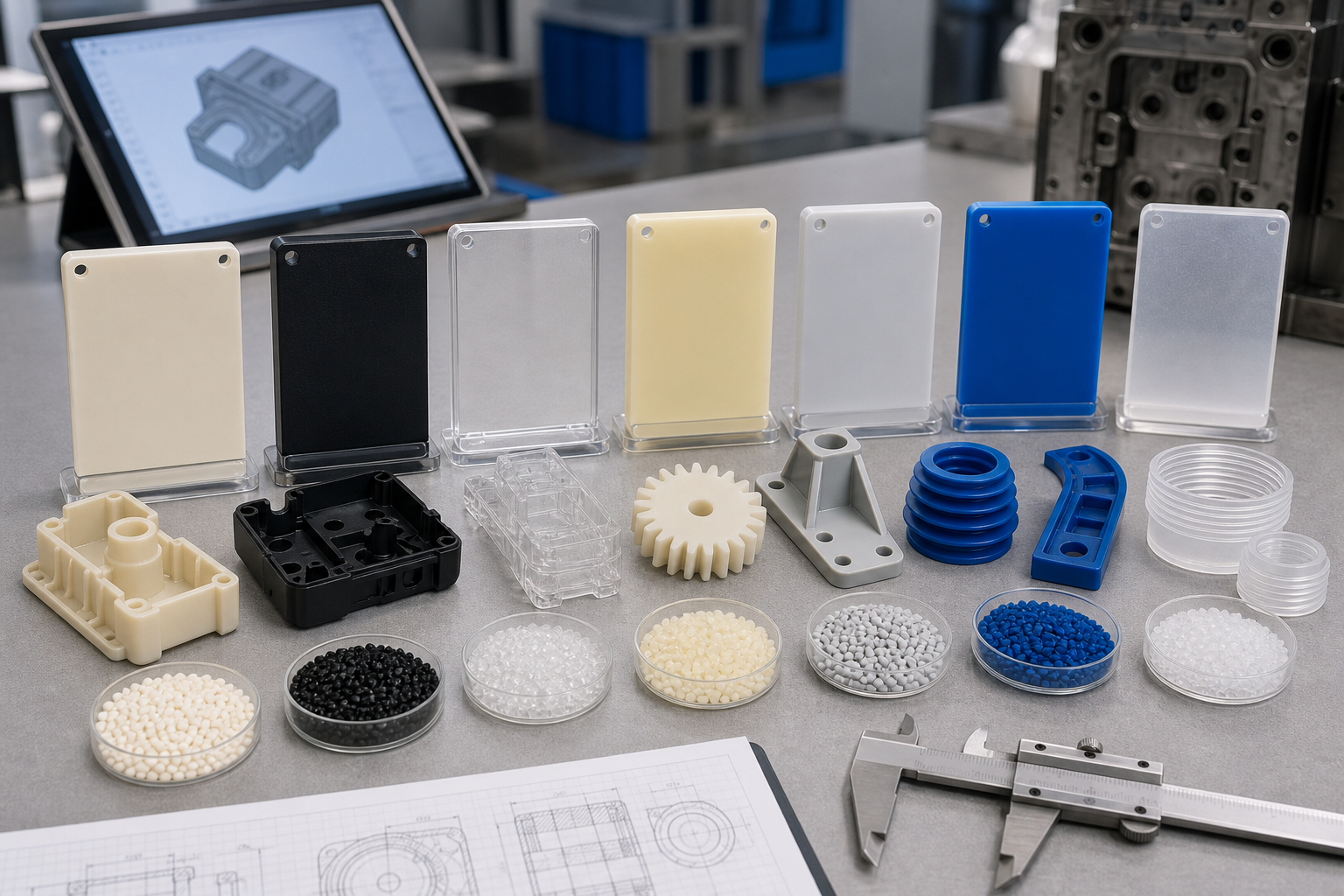
Matériaux couramment utilisés pour le moulage par injection
| Cause / matière | Signe ou utilisation typique | Intervention de l'acheteur ou du service d'ingénierie |
|---|---|---|
| ABS | Boîtiers, couvercles, pièces destinées au grand public et à l'industrie | Bonne usinabilité et bon état de surface |
| PC | Composants transparents et résistants aux chocs | Conception tenant compte des besoins de séchage et des contraintes |
| Nylon PA6 / PA66 | Engrenages, supports, pièces d'usure et éléments structurels | Vérifier les caractéristiques d'absorption d'humidité et les options de fibre de verre |
| PP | Charnières souples, clips, conteneurs et pièces légères | Bonne résistance chimique et bon comportement à la fatigue |
| POM / acétal | Engrenages de précision, bagues et pièces coulissantes | Bonne stabilité dimensionnelle et bonne résistance à l'usure |
Comment choisir un plastique pour le moulage par injection
- Précisez la charge, la température, l'exposition aux produits chimiques et le mode d'assemblage de la pièce.
- Distinguer les exigences esthétiques des exigences fonctionnelles.
- Vérifiez si la pièce doit présenter de la rigidité, de la ténacité, de la souplesse ou une résistance à l'usure.
- Vérifiez les exigences en matière de retrait, d'absorption d'humidité et de tolérance avant la fabrication des outils.
- Demandez si un matériau utilisé pour un prototype peut être adapté au moulage en série.
Choix des matériaux en fonction de l'application
| Matériau / boîtier | Principale préoccupation | Note relative à la sélection |
|---|---|---|
| Pièces automobiles situées sous le capot | PA66 GF, PBT, PPS | La stabilité thermique, chimique et dimensionnelle est importante |
| Boîtiers électriques | ABS, PC-ABS, PC ignifugé, PBT | Une résistance aux chocs et une résistance au feu peuvent être exigées |
| Housses transparentes | PC, PMMA | Trouver le juste équilibre entre résistance aux chocs et clarté |
| Joints souples ou garnitures d'étanchéité | TPE, TPU | La dureté, l'adhérence et la déformation rémanente après compression sont des facteurs importants |
| Pièces d'usure et pièces coulissantes | POM, nylon, grades chargés en PTFE | Il convient de vérifier le frottement, l'humidité et les tolérances |
Détails de l'appel d'offres de l'acheteur pour la sélection des matériaux
Pour obtenir une analyse utile, veuillez nous envoyer le modèle 3D ou le dessin 2D, le type de résine ou le matériau cible, des photos de la pièce si le défaut est déjà présent, les informations relatives à la machine et au moule si elles sont disponibles, le volume annuel prévu, les exigences esthétiques, les cotes critiques, l'environnement d'application et toute norme d'inspection applicable. Nylon Plastic peut examiner la conception, le matériau et le procédé de moulage avant que des modifications ne soient apportées à l'outillage ou à la production.
La place du nylon modifié dans le choix des matériaux
| Orientation des matériaux | Quand cela constitue un point de départ concret | Vérifications avant la mise en circulation |
|---|---|---|
| PA non pourvu | La résistance, la fatigue, l'usure, la qualité de surface ou un objectif de coût équilibré sont les critères déterminants dans la prise de décision | État d'humidité, variation dimensionnelle, chaleur, charge et exposition aux produits chimiques |
| PA-GF20 | Il est nécessaire d'obtenir une rigidité modérée, de maîtriser le fluage et de réduire le retrait sans recourir à une armature maximale. | Orientation des fibres, résistance de la ligne de soudure, surface, usure des outils et dimensions contrôlées |
| PA-CF30 | La rigidité spécifique, une dilatation thermique plus faible, une réduction du poids ou une caractéristique électrique ciblée sont des critères importants | Conductivité, anisotropie, résistance aux chocs, usure des outils, sens d'écoulement et données précises sur la nuance |
| PP, PEHD ou PEBD | Les spécifications de la pièce imposent un procédé à base de polyoléfine non modifiée | Rétrécissement, rigidité, exposition aux produits chimiques, comportement des charnières, couleur et adaptation à l'application |
Le PA non chargé, le PA-GF20 et le PA-CF30 constituent les principales variantes de nylon modifié à prendre en compte lorsqu'un projet nécessite une solution de moulage à base de nylon. Le PP, le PEHD et le PEBD restent des options générales en matière de matières premières et ne doivent pas être considérés comme interchangeables avec le nylon renforcé.
Comment le plastique nylon contribue à la réalisation du projet
Nylon Plastic accompagne ses clients dans le choix des matériaux et la fabrication de pièces en plastique finies grâce à ses service de moulage par injection de plastique. Pour le choix des matériaux destinés au moulage par injection, cette analyse utile permet de mettre en relation le plan, le matériau, le processus d'outillage ou d'usinage, les conditions de contrôle et le plan de production avant l'approbation du devis.
- Traduire les critères suivants : charge, température, humidité, produits chimiques, tolérance, aspect, volume annuel et homologations, en une exigence de classe.
- Envisagez l'utilisation de composés de nylon modifiés sur mesure lorsque les grades PA standard ne répondent pas aux exigences en matière de rigidité, de résistance aux chocs, d'usure, de résistance à la chaleur, de couleur ou de conformité.
- Établissez un lien entre la résine sélectionnée et les contrôles relatifs au séchage, au retrait, à la conception des points d'injection et des évents, à l'échantillonnage, au certificat d'analyse (COA), à la teneur en humidité et à la traçabilité des lots.
Lire la suite
- Plastiques techniques en nylon modifié
- Choix du nylon pour le moulage
- Services de moulage par injection de nylon
Questions fréquemment posées
Comparer en détail Propriétés du PA66 GF30 et choix de la nuance pour les différents niveaux de renforcement en fibre de verre (GF15, GF30 et GF60) dans notre guide dédié au nylon chargé de fibre de verre.
Quels sont les matériaux les plus couramment utilisés pour le moulage par injection de plastique ?
Parmi les choix courants, on trouve le nylon, l'ABS, le PC, le PP, le PE, le POM, le PBT, le TPE et le PMMA. Le choix du matériau approprié dépend des exigences de la pièce, du procédé de fabrication et de la qualité requise.
Dans quels cas dois-je opter pour du PA non chargé pour le moulage par injection ?
Optez pour le PA non chargé lorsque la résistance, la fatigue, l'usure, la qualité de surface et un objectif de coût équilibré priment sur une rigidité maximale ou un retrait minimal.
Dans quels cas le PA-GF20 ou le PA-CF30 sont-ils indiqués ?
Le PA-GF20 est une solution pratique offrant un renforcement modéré. Le PA-CF30 est recommandé pour des exigences spécifiques en matière de rigidité, de faible dilatation thermique, de poids ou de propriétés électriques. Ces deux grades nécessitent une validation spécifique à chaque cas.
Le matériau utilisé pour le prototype peut-il devenir le matériau de production ?
Parfois, mais il convient de comparer les caractéristiques mécaniques, l'humidité, le retrait, les tolérances, l'aspect, la conformité, la mise en œuvre et le coût dans le cadre du processus de production final avant validation.
Demander une évaluation d'un matériau destiné au moulage par injection
Veuillez nous transmettre le plan, les conditions d'utilisation, les quantités, la résine actuellement utilisée, les caractéristiques critiques et les exigences d'homologation afin que nous puissions procéder à une comparaison des matériaux et des procédés.