Pourquoi la finition de surface est-elle importante dans le moulage par injection ?
Lorsque les ingénieurs conçoivent des pièces en plastique, ils se concentrent généralement sur la géométrie, l'épaisseur des parois et le choix des matériaux. Mais les spécifications relatives à la finition de surface sont tout aussi cruciales : elles ont une incidence sur tous les aspects, de l'esthétique et du toucher de la pièce au coût du moule, en passant par la durée du cycle de fabrication et la durabilité à long terme. Une texture bien choisie peut masquer les marques d'affaissement et lignes de soudure, améliorer l'adhérence de la peinture, réduire les frottements et même rehausser la perception de la qualité du produit. Un choix inadapté peut entraîner des problèmes d'éjection, allonger de plusieurs semaines la fabrication du moule ou doubler le budget consacré à l'outillage.
La finition de surface en moulage par injection ne se résume pas à un simple chiffre. Il s'agit d'un système : deux normes principales régissent le secteur : SPI (Association de l'industrie des matières plastiques) les normes de finition des moules largement utilisées en Amérique du Nord, et VDI 3400 les normes de texture couramment appliquées en Europe et en Asie. Il est essentiel, pour toute personne chargée de définir les spécifications des pièces en plastique, de bien comprendre ces deux aspects, ainsi que leurs implications en aval pour le démoulage, la peinture et les opérations secondaires.
Ce guide couvre l'ensemble des aspects liés à la finition de surface des pièces en plastique : les grades SPI de A à D avec leurs valeurs Ra et leurs applications, le tableau des textures VDI 3400 avec les exigences en matière d'angle de dépouille, les méthodes de texturation des moules et leurs compromis, les options de peinture et de finition secondaire, ainsi qu'un barème de coûts pratique qui met en correspondance le grade de finition et son impact sur le budget du moule.
Normes SPI relatives à l'état de surface : classification complète
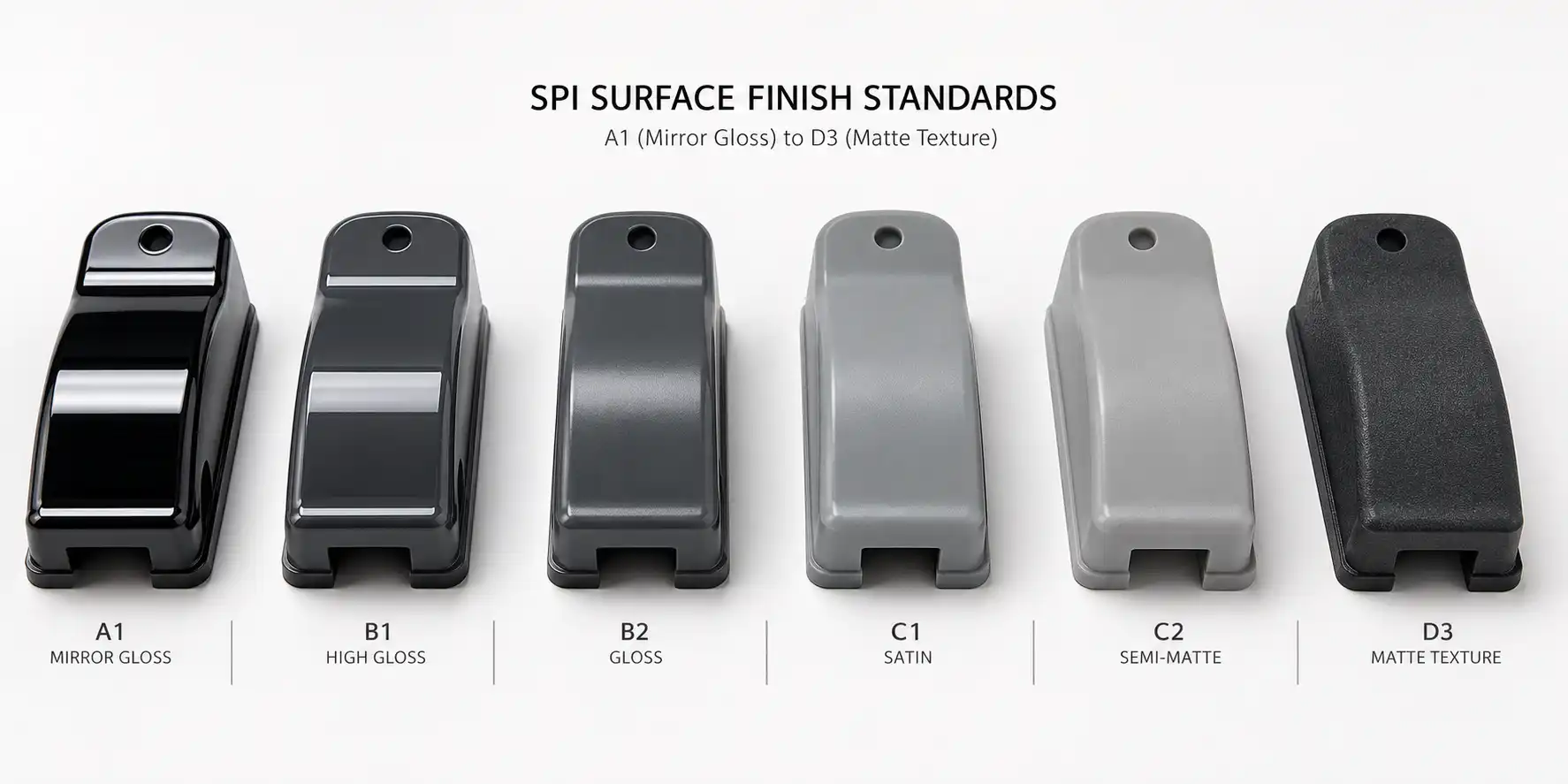
La norme SPI (aujourd'hui PLASTICS Industry Association) relative à la finition de surface classe les surfaces des moules d'injection en quatre catégories — A, B, C et D —, chacune correspondant à une méthode de finition et à une plage de rugosité de surface différentes. Ce système est hiérarchisé : le polissage au diamant de classe A produit les surfaces les plus lisses et les plus réfléchissantes ; le sablage à sec de classe D produit les finitions les plus rugueuses et les plus mates.
Chaque classe correspond à une valeur Ra (rugosité moyenne) spécifique, mesurée en micro-pouces (?in) et en micromètres (?m). La valeur Ra correspond à la moyenne arithmétique des écarts du profil de surface par rapport à la ligne moyenne ; il s'agit du paramètre le plus couramment utilisé pour caractériser la texture de surface dans le secteur industriel. Des valeurs Ra faibles indiquent des surfaces plus lisses ; des valeurs élevées indiquent des surfaces plus rugueuses.
| Niveau SPI | Méthode de finition | Ra (?in) | Ra (?m) | Applications typiques |
|---|---|---|---|---|
| A-1 | Disque de polissage diamanté de grade #3 | 0-1 | 0-0.025 | Lentilles optiques, miroirs, pièces transparentes, présentoirs en acrylique |
| A-2 | Disque de polissage diamanté de grade #6 | 1-2 | 0.025-0.05 | Pièces cosmétiques à finition brillante, verres transparents, boîtiers de dispositifs médicaux |
| A-3 | Disque de polissage diamanté de grade #15 | 2-3 | 0.05-0.08 | Boîtiers cosmétiques, composants transparents, électronique grand public |
| B-1 | Papier abrasif grain 600 | 2-3 | 0.05-0.08 | Surfaces esthétiques principales, façades d'appareils électroménagers, garnitures intérieures automobiles |
| B-2 | Papier abrasif grain 400 | 4-5 | 0.10-0.127 | Surfaces esthétiques secondaires, boîtiers d'outils électriques, biens de consommation courante |
| B-3 | Papier abrasif grain 320 | 9-10 | 0.23-0.25 | Zones esthétiques peu visibles, composants structurels internes |
| C-1 | Pierre à poncer grain 600 | 10-12 | 0.25-0.30 | Surfaces fonctionnelles présentant des exigences esthétiques modérées |
| C-2 | Pierre à poncer grain 400 | 25-28 | 0.63-0.71 | Pièces fonctionnelles non esthétiques, capots d'équipements industriels |
| C-3 | Pierre à poncer grain 320 | 38-42 | 0.96-1.07 | Pièces industrielles, surfaces internes cachées, sous le capot des véhicules |
| J-1 | Dry Blast #11 – Billes de verre | 32-38 | 0.81-0.96 | Finition satinée, surfaces cachées, produits de consommation texturés |
| J-2 | Sablage à sec #240 à l'oxyde d'aluminium | 42-47 | 1.07-1.19 | Surfaces texturées offrant une bonne prise en main, surfaces anti-reflets, biens durables |
| J-3 | Sablage à sec #24 à l'oxyde d'aluminium | 100-120 | 2.54-3.05 | Texture épaisse, usage industriel (non cosmétique), surfaces offrant une adhérence maximale |
Une règle empirique pratique : Les finitions de catégorie A sont destinées aux pièces qui doivent avoir l'aspect du verre ??lentilles, capots transparents, surfaces esthétiques haut de gamme. Catégorie B couvre la plupart des éléments destinés aux consommateurs, pour lesquels l'aspect esthétique est important mais où la perfection n'est pas exigée. Catégorie C C'est la solution incontournable pour les pièces fonctionnelles qui seront visibles mais ne feront pas l'objet d'une évaluation. Catégorie D est destiné aux surfaces cachées, aux textures antidérapantes ou lorsqu’un aspect mat ou rugueux est recherché.
Normes VDI 3400 relatives aux textures : le système européen
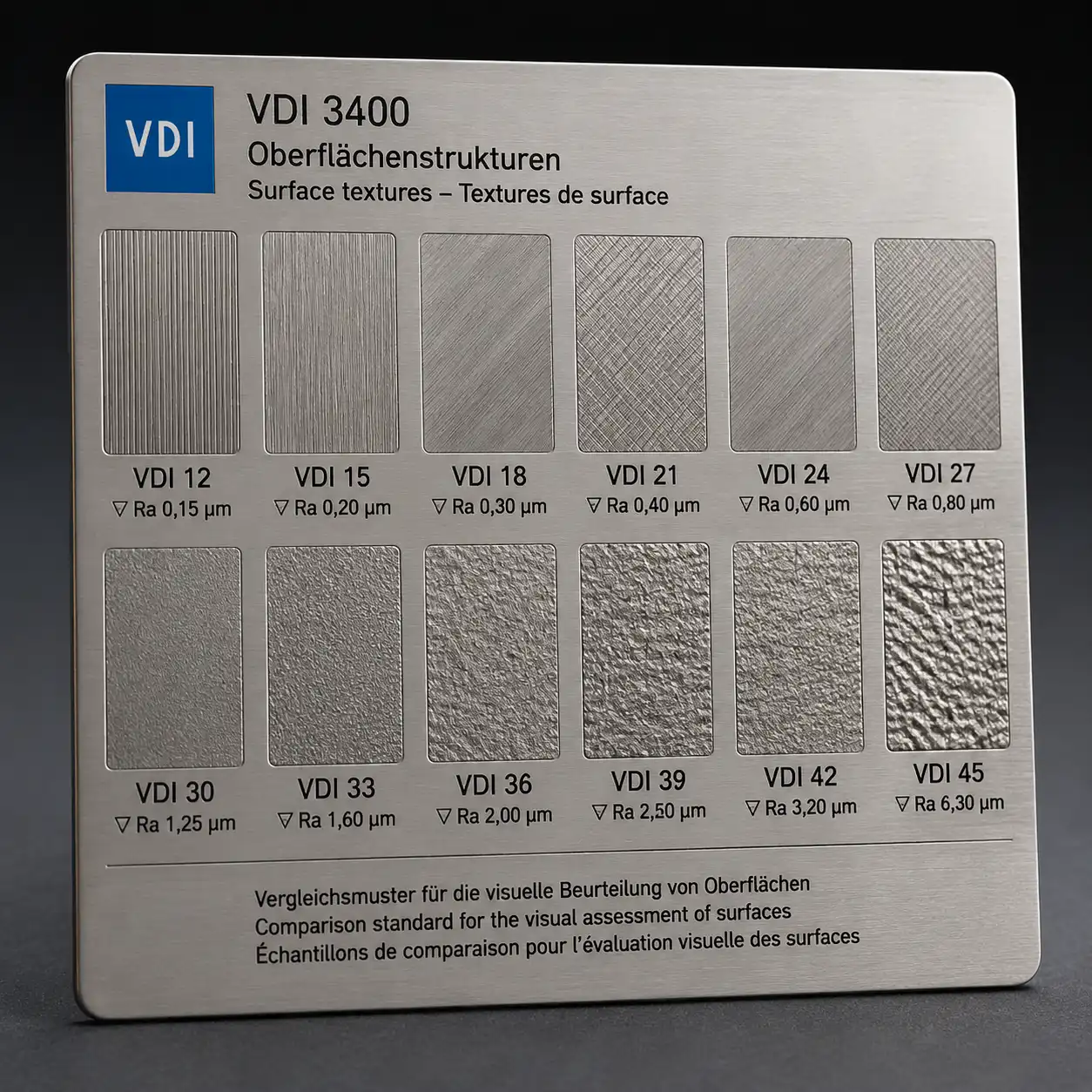
Alors que la norme SPI domine les spécifications relatives aux moules en Amérique du Nord, la VDI 3400 La norme VDI 3400 (publiée par le Verein Deutscher Ingenieure, ou Association des ingénieurs allemands) constitue la principale référence en matière de texture en Europe et dans une grande partie de l'Asie. Contrairement à la norme SPI, qui classe les textures en fonction de la méthode de finition, la norme VDI 3400 définit les textures de surface par des grades numériques correspondant à des paramètres de rugosité spécifiques, principalement le Ra (rugosité moyenne arithmétique) et le Rz (hauteur moyenne crête-vallée).
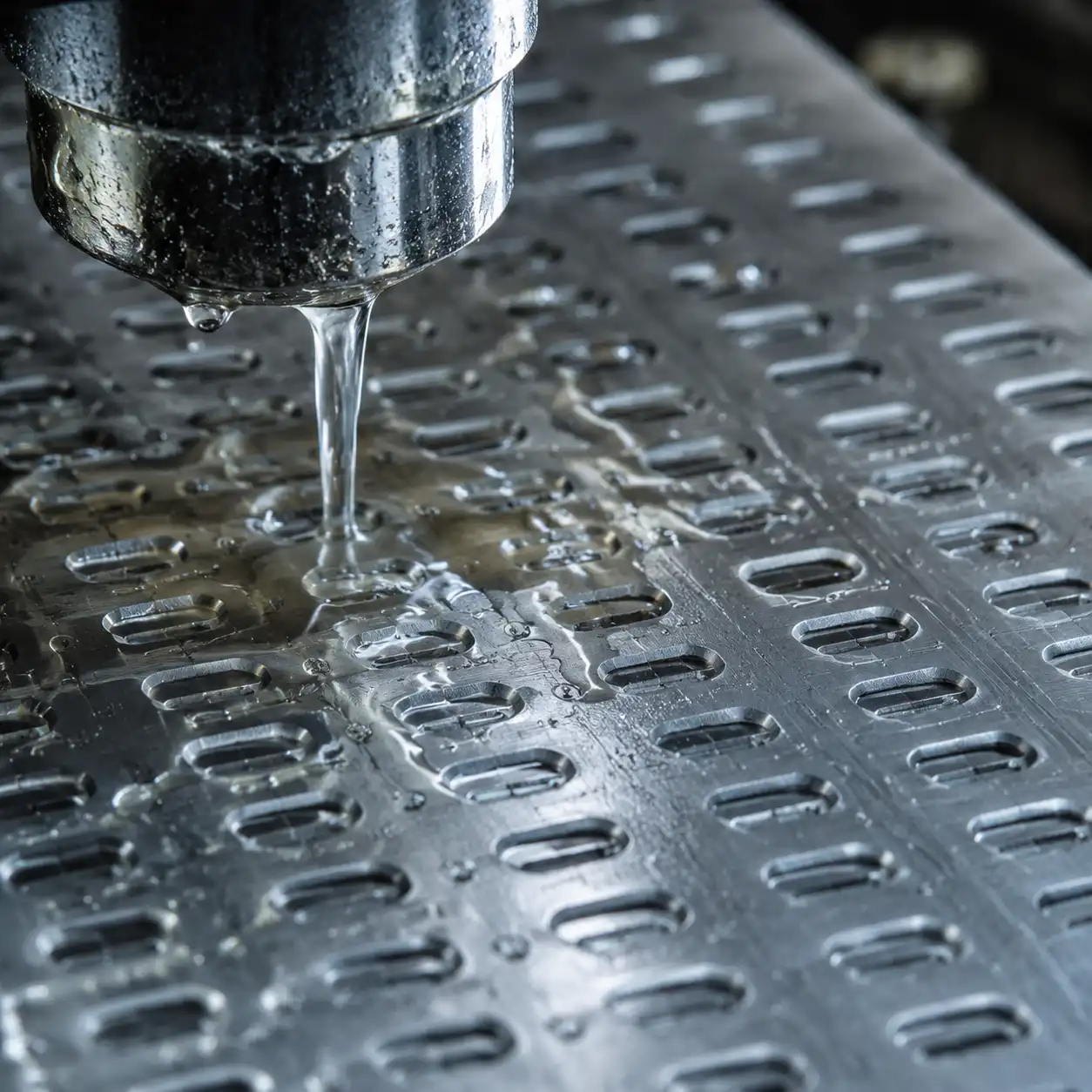
Les textures VDI sont obtenues par gravure chimique ou par électroérosion (EDM) sur la surface du moule ; elles vont de la VDI 12 (très fine, équivalente approximativement à la SPI B-3) à la VDI 45 (très grossière, à grain profond). Un aspect essentiel à prendre en compte avec les textures VDI est que les motifs à grain plus profond nécessitent des angles de dépouille plus importants pour permettre une éjection réussie de la pièce — un facteur qui doit être intégré dès le départ dans la géométrie de la pièce.
| Niveau VDI | Ra (?m) | Rz (?m) | Profondeur de texture (mm) | Angle de tirage minimal | SPI comparable |
|---|---|---|---|---|---|
| VDI 12 | 0.40 | 1.50 | 0.002 | 0,5° | B-3 / C-1 |
| VDI 15 | 0.56 | 2.20 | 0.003 | 0,5° | C-1 |
| VDI 18 | 0.80 | 3.20 | 0.004 | 0,5° | C-1 / C-2 |
| VDI 21 | 1.12 | 4.50 | 0.006 | 0,5° | C-2 |
| VDI 24 | 1.60 | 6.30 | 0.009 | 1,0° | C-3 |
| VDI 27 | 2.24 | 9.00 | 0.013 | 1,0° | J-1 |
| VDI 30 | 3.15 | 12.5 | 0.018 | 1,5° | J-2 |
| VDI 33 | 4.50 | 18.0 | 0.025 | 2,0° | J-2 / J-3 |
| VDI 36 | 6.30 | 25.0 | 0.035 | 2,5° | J-3 |
| VDI 39 | 9.00 | 36.0 | 0.050 | 3,0° | J-3 |
| VDI 42 | 12.5 | 50.0 | 0.070 | 4,0° | J-3 |
| VDI 45 | 18.0 | 70.0 | 0.100 | 5,0° | J-3 |
Notez que le relation exponentielle entre le nombre de VDI et l'angle de dépouille: une texture VDI 24 ne nécessite qu'un angle de dépouille de 1 degré, tandis qu'une texture VDI 45 en exige 5 ??soit une multiplication par cinq en seulement 21 niveaux VDI. Pour les nervures profondes, les bossages ou les parois verticales hautes, cela peut modifier fondamentalement la géométrie de la pièce et la conception de l’outillage. Impliquez toujours votre mouliste dès le début lorsque vous spécifiez des textures VDI supérieures à 30.
Comparaison des méthodes de texturation des moules
L'application d'une texture à la cavité d'un moule est une opération spécialisée réalisée après l'usinage de la cavité de base. Quatre méthodes principales dominent la pratique industrielle, chacune présentant des avantages, des limites et des coûts spécifiques. Le choix de la méthode de texturation dépend du matériau du moule, de la complexité du motif souhaité, du volume de production et du budget.
| Méthode | Processus | Avantages | Limites | Coût relatif |
|---|---|---|---|---|
| Gravure chimique | Un masque résistant aux acides est appliqué sur le moule ; un bain d'acide dissout l'acier exposé jusqu'à une profondeur contrôlée | Motif uniforme sur des formes géométriques complexes ; large gamme de motifs standard disponibles ; coût modéré | Moins précis que le laser ; limité aux aciers de moulage résistants aux acides ; autorisation environnementale requise | $$ |
| Texturation EDM | Une électrode en graphite ou en cuivre présentant un motif de texture inversé érode la surface du moule par décharge électrique | Fonctionne sur tous les matériaux de moule conducteurs, y compris les aciers trempés ; contrôle précis de la profondeur | Procédé plus lent ; l'usure des électrodes doit être surveillée ; moins adapté aux détails très fins | $$$ |
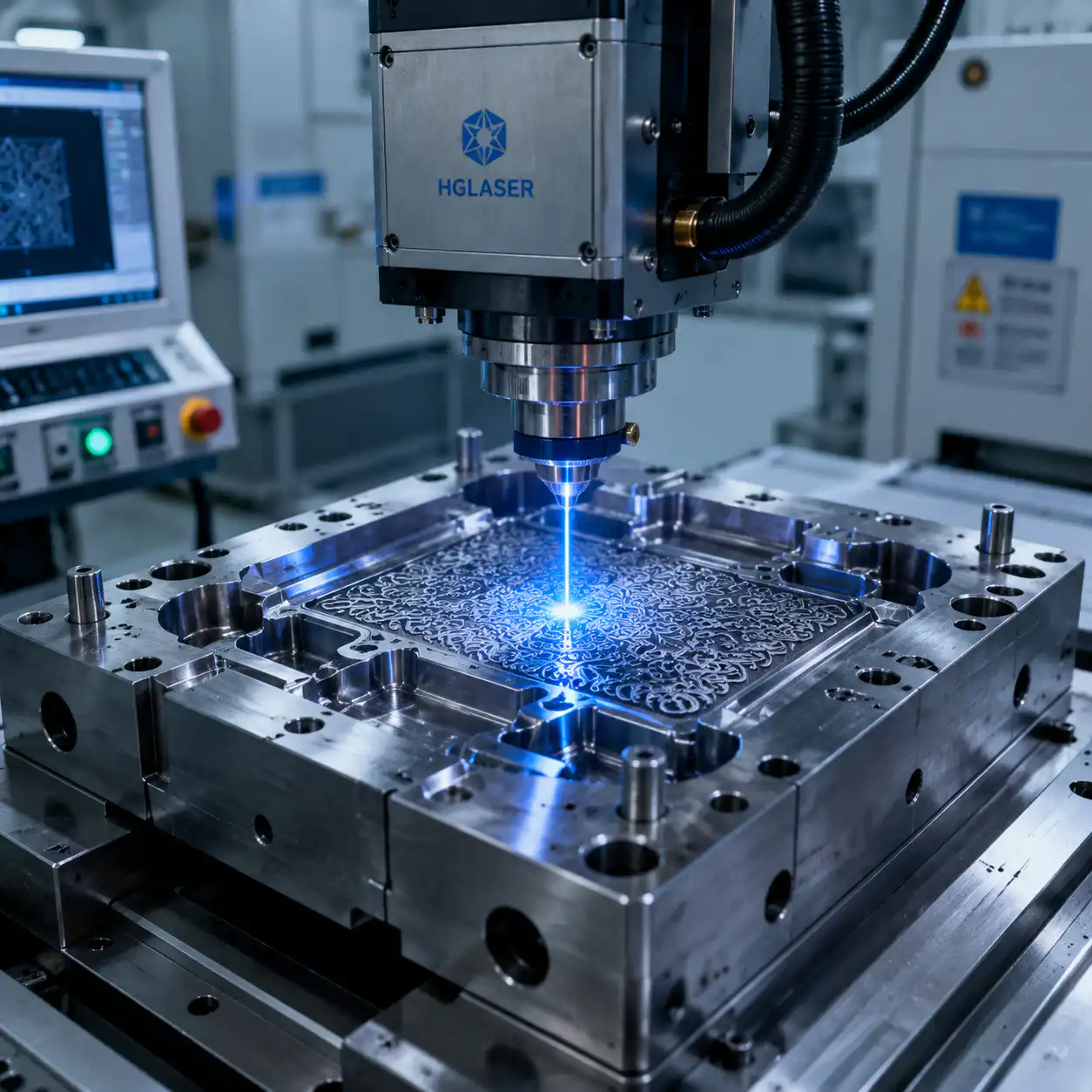
| Texturation au laser | Un système laser CNC à 5 axes enlève la surface du moule par couches de l'ordre du micron, en suivant les données numériques du motif. | Précision et répétabilité optimales ; complexité illimitée des motifs, y compris les logos et les microtextures ; le flux de travail numérique permet des itérations rapides | Coûts d'équipement et de traitement très élevés ; plus lent pour les très grandes surfaces ; nécessite une programmation FAO spécialisée | $$$$ |
| Sablage | L'air comprimé propulse des agents abrasifs (billes de verre, oxyde d'aluminium, carbure de silicium) contre la surface du moule | Méthode la plus rapide ; coût le plus bas ; adaptée aux surfaces mates uniformes et aux finitions SPI de catégorie D | C'est l'élément le moins homogène d'un lot de production à l'autre ; il se limite à des textures simples et uniformes ; il ne permet pas de créer des motifs directionnels. | $ |
Texturation au laser Cette technique s'est largement imposée au cours de la dernière décennie, notamment dans le domaine de l'habillage intérieur automobile, où des motifs géométriques et des grains de cuir complexes sont requis. Le principal obstacle reste le coût : un insert de moule texturé au laser peut coûter deux à trois fois plus cher que son équivalent gravé chimiquement. Cependant, pour la production en grande série, où la cohérence des motifs sur plusieurs cavités de moule est essentielle, l’investissement est généralement rentabilisé grâce à la réduction des rebuts et des problèmes de qualité.
Comment la texture influe sur le démoulage
La texture de surface crée un verrouillage mécanique entre la pièce moulée et la paroi de la cavité du moule pendant le refroidissement. À mesure que le plastique se rétracte sur le noyau, les crêtes et les creux de la texture augmentent la force nécessaire pour éjecter la pièce. Si les angles de dépouille sont insuffisants, la pièce va frotter, rayer, voire se gripper dans le moule, endommageant ainsi à la fois la surface de la pièce et la texture du moule elle-même.
La relation fondamentale entre la profondeur de la texture et l'angle de dépouille requis s'exprime par la formule suivante :
Angle de dépouille minimal = arctan(profondeur de texture / course d'éjection par degré)
Dans la pratique, on applique une règle de conception plus simple : ajouter 1 degré de dépouille pour chaque 0,025 mm (0,001 pouce) de profondeur de relief, avec un minimum de 0,5 degré pour obtenir les finitions les plus lisses. Cela signifie qu'une texture VDI 27 d'une profondeur de 0,013 mm nécessite un angle de dépouille d'environ 1 degré, tandis qu'une texture VDI 42 d'une profondeur de 0,070 mm exige au moins 3 degrés.
Zones à risque élevé de problèmes d'éjection liés à la texture :
- Nervures profondes et bossages : Le plastique se contracte fortement sur ces éléments ; un angle de dépouille insuffisant sur les nervures texturées est la cause la plus fréquente d'échec de l'éjection.
- Grandes parois verticales : La surface de contact cumulée d'un mur haut amplifie l'effet de frottement lié à la texture. Les murs d'une hauteur supérieure à 50 mm présentant une texture de classe VDI 30 ou plus grossière doivent faire l'objet d'un examen minutieux.
- Zones de sous-coupe : La texture crée en effet des micro-contre-dépouilles. Si une pièce présente déjà une contre-dépouille mécanique, l'ajout d'une texture peut rendre son éjection impossible sans recourir à des élévateurs ou à des glissières.
- Profilés à paroi mince : Les parois fines refroidissent et se rétractent plus rapidement, ce qui les serre davantage contre le noyau. Associé à la texture, ce phénomène peut entraîner une déformation de la pièce lors de l'éjection.
Si la conception de votre pièce impose des angles de dépouille inférieurs à ceux requis par la texture, envisagez les stratégies d'atténuation suivantes : lisser la texture de manière directionnelle le long de l'axe d'éjection (réduit la traînée de 20 à 30%), utilisez un revêtement antiadhésif tels que le nickel imprégné de PTFE, ou opter pour un degré de rugosité inférieur qui permet tout de même d'obtenir l'effet visuel souhaité.
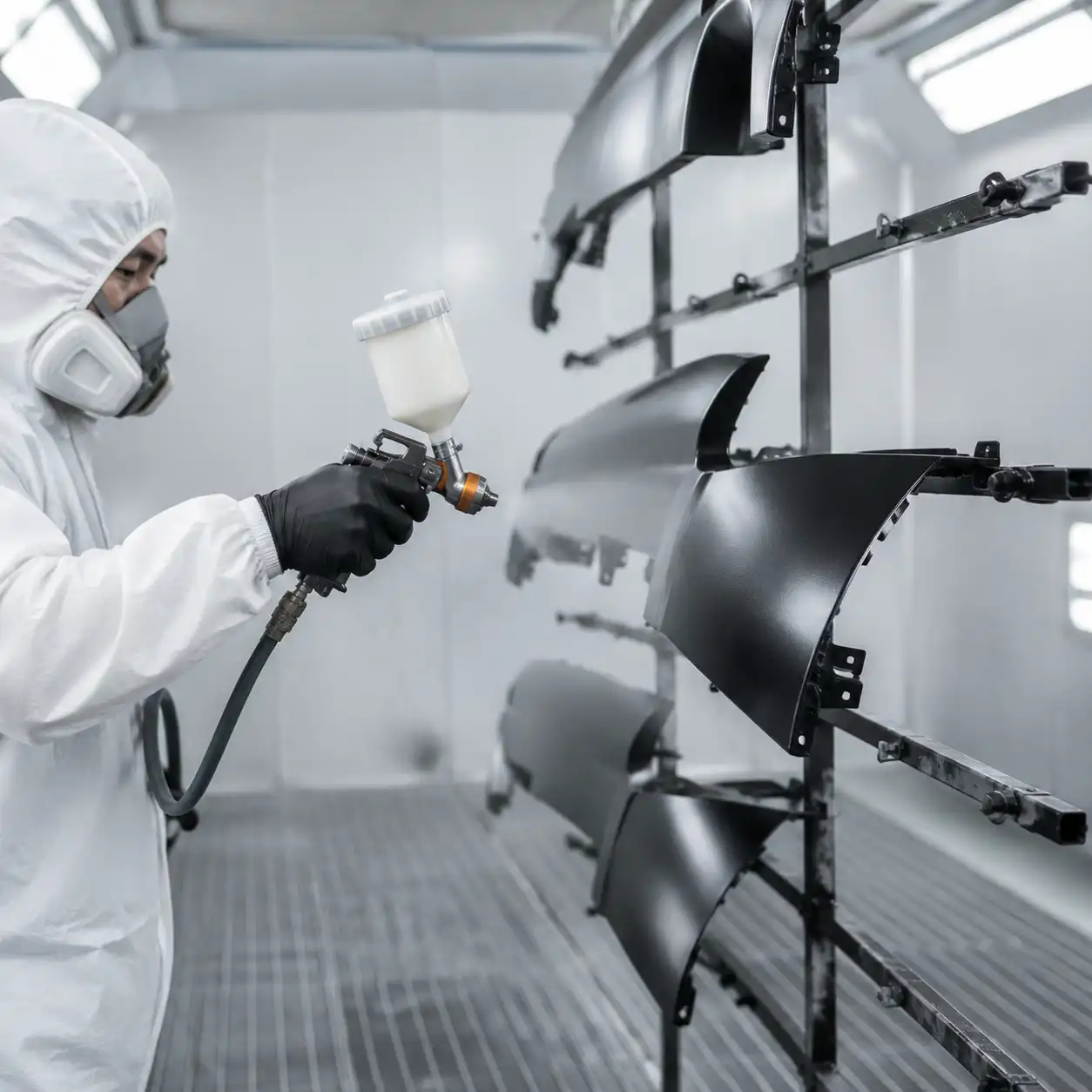
Peinture des pièces en plastique : préparation de la surface et choix de la peinture
De nombreuses pièces moulées par injection doivent être peintes pour assurer la correspondance des couleurs, offrir une protection contre les UV ou obtenir une finition esthétique haut de gamme. Cependant, les plastiques posent des défis particuliers en matière d'adhérence : la plupart des polymères présentent une faible énergie de surface intrinsèque, ce qui signifie que la peinture ne mouille pas facilement la surface et n'y adhère pas sans traitement préalable.
Méthodes de préparation des surfaces
Traitement à la flamme : Une flamme contrôlée passe sur la surface en plastique, oxydant ainsi la couche moléculaire la plus externe. Cela augmente l'énergie de surface d'environ 30 dynes/cm (polypropylène non traité) à plus de 45 dynes/cm, ce qui est bien supérieur au minimum de 38 à 40 dynes/cm généralement requis pour l'adhérence de la peinture. Le traitement à la flamme est rapide, peu coûteux et donne de bons résultats sur de grandes surfaces planes, mais son efficacité diminue avec le temps : les pièces doivent être peintes dans les heures qui suivent le traitement.
Traitement au plasma : Le plasma à basse pression ou atmosphérique bombarde la surface avec du gaz ionisé, créant ainsi des sites réactifs qui se lient chimiquement aux molécules de peinture. Le plasma permet d'obtenir une énergie de surface plus élevée et plus uniforme que le traitement à la flamme – dépassant souvent 50 dynes/cm – et son effet dure plus longtemps (plusieurs jours plutôt que quelques heures). En contrepartie, le coût de l'équipement et la durée du cycle sont plus élevés.
Apprêts chimiques et agents favorisant l'adhérence : Pour les matériaux tels que le nylon et le polypropylène, les apprêts à base de polyoléfine chlorée (CPO) font office de couche de liaison : ils adhèrent à la surface plastique à faible énergie tout en offrant une couche de finition pouvant être peinte. Ils s'appliquent sous forme de fines couches, soit par essuyage, soit par pulvérisation, avant la peinture.
Choix de la peinture en fonction du type de plastique
| Type de plastique | Énergie de surface (non traitée) | Préparation recommandée | Systèmes de peinture compatibles |
|---|---|---|---|
| Nylon (PA6/PA66) | 36 à 42 dynes/cm | Appliquer une couche d'apprêt + ponçage léger ; ou traitement au plasma | Polyuréthane 2K, apprêts époxy, peintures acryliques à base d'eau |
| Polypropylène (PP) | 29 à 31 dynes/cm | Traitement à la flamme ou au plasma + apprêt CPO ; obligatoire pour garantir l'adhérence | Peintures acryliques avec apprêt CPO, polyuréthane bicomposant, peintures spécifiques au TPO |
| Polycarbonate (PC) | 42 à 46 dynes/cm | Nettoyage au solvant + léger polissage ; éviter les solvants agressifs qui provoquent l'apparition de fissures sur le PC | Laques acryliques, polyuréthane bicomposant, revêtements durcissables aux UV |
| ABS | 38 à 42 dynes/cm | Nettoyage au solvant ; bonne adhérence en général, sans apprêt | Peintures acryliques, émaux alkydes, polyuréthane bicomposant, systèmes à base d'eau |
| POM (acétal/Delrin) | 34 à 38 dynes/cm | Gravure chimique ou au plasma ; l'un des plastiques les plus difficiles à peindre | Apprêts spéciaux + polyuréthane bicomposant ; tester minutieusement l'adhérence |
Autres techniques de finition pour les pièces en plastique
Au-delà de la peinture, plusieurs procédés de finition secondaires apportent une valeur ajoutée fonctionnelle ou décorative aux pièces moulées par injection. Chaque technique est adaptée à des géométries, des volumes de production et des exigences esthétiques spécifiques.
Tampographie : Cette technique utilise un tampon en silicone pour transférer l'encre d'une plaque gravée vers la surface de la pièce. Elle est idéale pour les surfaces courbes ou irrégulières sur lesquelles les étiquettes ou les décalcomanies ne pourraient pas être appliquées à plat. Parmi les applications courantes, on peut citer les touches de clavier, le marquage des dispositifs médicaux et les boutons de commande automobiles. L'impression au tampon permet d'obtenir des largeurs de trait allant jusqu'à 0,1 mm et peut imprimer plusieurs couleurs avec une précision de repérage de 0,05 mm.
Marquage à chaud : Une matrice chauffée presse un film support métallisé contre la surface de la pièce, transférant ainsi une fine couche métallique ou pigmentée. Ce procédé permet d'obtenir des finitions métalliques brillantes (or, argent, chrome) difficiles à réaliser avec de la peinture. Il est couramment utilisé pour les emballages de cosmétiques, les emblèmes automobiles et les garnitures d'appareils électroménagers. L'estampage à chaud nécessite une surface plane ou légèrement incurvée et donne les meilleurs résultats sur les thermoplastiques capables de supporter un contact bref avec la matrice, dont la température est comprise entre 120 et 180 degrés Celsius.
Galvanoplastie sur plastique : Ce procédé consiste à déposer une couche métallique (généralement du chrome, du nickel ou du cuivre) sur un substrat en plastique par un procédé de placage sans courant suivi d’une galvanoplastie. L’ABS est le plastique le plus facile à plaquer en raison de sa phase butadiène, qui offre des sites de gravure permettant l’adhérence du catalyseur. Les pièces en plastique plaquées offrent l'aspect et le toucher du métal pour un poids et un coût nettement inférieurs. Ce procédé nécessite une conception minutieuse du moule, avec des rayons généreux (minimum 0,5 mm) et l'absence d'angles vifs, afin de garantir une épaisseur de placage uniforme.
PVD (dépôt physique en phase vapeur) : Procédé de revêtement sous vide permettant de déposer de fines couches de métaux ou de céramiques sur des surfaces en plastique. Le PVD permet d'obtenir des revêtements extrêmement durables et résistants à l'usure, d'une épaisseur comprise entre 1 et 5 microns. Contrairement à la galvanoplastie, le PVD est un procédé respectueux de l'environnement qui ne génère aucun déchet chimique liquide. Couramment utilisé pour les garnitures intérieures automobiles haut de gamme, les composants de montres et les appareils électroniques grand public haut de gamme, où l'aspect métallique doit résister à des manipulations fréquentes sans s'user.
Coût et qualité de finition : ce pour quoi vous payez
La relation entre la qualité de la finition de surface et le coût du moule n'est pas linéaire ; elle est exponentielle dans le haut de gamme. Une finition miroir SPI A-1 peut augmenter le coût de finition du moule de 150 à 250% par rapport à une texture de référence SPI D-3, car chaque passage à un niveau supérieur nécessite une main-d’œuvre de plus en plus qualifiée, des abrasifs plus fins et un temps de polissage plus long. Cela peut également avoir une incidence sur le calendrier de fabrication du moule, c’est pourquoi notre Guide des délais de livraison considère que la spécification des textures est l'une des causes les plus courantes de retards de dernière minute.
| Niveau SPI | Coût par rapport à la référence D-3 | Temps de finition (cavité type) | Le meilleur rapport qualité-prix pour |
|---|---|---|---|
| J-3 | Valeur de référence | 15 à 30 min | Pièces industrielles non esthétiques, supports internes |
| J-2 | +5-10% | 20 à 40 min | Surfaces cachées nécessitant une bonne adhérence ou une résistance aux rayures |
| J-1 | +10-15% | 30 à 60 min | Produits grand public au fini satiné, boîtiers d'outils électriques |
| C-3 | +15-20% | 45 à 90 min | Capots d'équipements industriels, parties fonctionnelles apparentes |
| C-2 | +20-30% | 1 à 2 heures | Pièces fonctionnelles générales présentant des exigences esthétiques modérées |
| C-1 | +30-40% | 1,5 à 3 heures | Surfaces visibles des produits cosmétiques d'entrée de gamme |
| B-3 | +40-50% | 2 à 4 heures | Surfaces esthétiques secondaires pour lesquelles le coût est un facteur déterminant |
| B-2 | +50-65% | 3 à 5 heures | Les biens de consommation pour lesquels l'aspect joue un rôle déterminant dans les décisions d'achat |
| B-1 | +65-80% | 4 à 8 heures | Surfaces esthétiques de premier plan, produits de grande consommation haut de gamme |
| A-3 | +80-100% | 6 à 12 heures | Appareils électroniques grand public au fini ultra-brillant, façades d'appareils électroménagers haut de gamme |
| A-2 | +100-150% | 8 à 16 heures | Pièces cosmétiques à finition miroir, caches pour dispositifs médicaux |
| A-1 | +150-250% | 12 à 24 heures et plus | Lentilles de qualité optique, composants médicaux transparents |
L'impact sur les coûts est particulièrement marqué lors du passage des grades C (polissage à la pierre) aux grades A (polissage au diamant). Chaque étape du grade A nécessite un composé diamanté distinct, un nettoyage entre chaque application pour éviter toute contamination croisée, ainsi qu'une inspection à la loupe. Pour un moule à 4 à 8 cavités, ces coûts se multiplient, ce qui fait de la spécification de la classe A un choix budgétaire important qui doit être justifié par des exigences produit clairement définies.
Une recommandation pratique : précisez la finition souhaitée uniquement là où vous en avez besoin. De nombreuses conceptions réussies utilisent les finitions SPI A-2 ou A-3 sur les surfaces extérieures visibles, B-2 sur les surfaces secondaires, et C-2 ou D-1 sur les éléments internes. Votre plan de moule doit indiquer explicitement les différents niveaux de finition pour les différentes zones de la cavité, plutôt que d'appliquer un seul niveau à l'ensemble du moule.
Questions fréquemment posées
Quelle finition SPI est utilisée en standard pour la plupart des pièces moulées par injection ?
La spécification SPI B-2 (polissage au papier abrasif de grain 400) est la norme par défaut la plus courante pour les pièces moulées par injection à usage général. Elle permet d’obtenir une surface lisse et uniforme à un coût raisonnable, ce qui représente un surcoût d’environ 50 à 65% par rapport à une texture de référence D-3. La finition B-2 masque efficacement les légères lignes de coulée et les marques d’affaissement, tout en étant réalisable sur la plupart des aciers de moulage, notamment le P20 et le H13. Pour les pièces destinées aux consommateurs, dont l’aspect influence directement la perception de l’acheteur, les finitions B-1 ou A-3 sont plus courantes. Pour les composants structurels internes, les finitions C-2 ou C-3 sont la norme. Il convient toujours d’adapter le grade de finition à la visibilité de la pièce et à ses exigences fonctionnelles, plutôt que d’opter par défaut pour un seul grade pour toutes les applications.
La texture de la surface a-t-elle une incidence sur la résistance de la pièce ?
Oui, la texture de surface a une incidence sur la résistance des pièces, mais principalement par son influence sur la concentration des contraintes et l’amorçage des fissures, et non par une modification des propriétés intrinsèques du matériau. Les textures plus rugueuses (valeurs Ra plus élevées) créent davantage d’irrégularités de surface qui agissent comme des concentrateurs de contraintes, ce qui peut réduire la durée de vie en fatigue et la résistance aux chocs. Cet effet est particulièrement marqué dans les matériaux fragiles tels que le polystyrène et le polycarbonate non chargé, où une surface rugueuse de type D-3 peut réduire la résistance aux chocs de 10 à 15% par rapport à une surface polie de qualité A. Dans les matériaux ductiles comme le polypropylène et le nylon, cet effet est moins significatif. Pour les pièces structurelles soumises à des charges cycliques ou à des chocs, des finitions plus lisses sont recommandées. De plus, une texture créant des arêtes vives à la surface du moule peut induire des effets d’entaille si ces arêtes sont orientées perpendiculairement à la direction principale des contraintes.
Est-il possible de modifier la texture SPI une fois le moule découpé ?
Les textures peuvent être modifiées après la découpe du moule, mais avec des contraintes importantes. Il est toujours possible de passer d’une finition lisse à une finition plus rugueuse — par exemple, en passant de SPI B-2 à C-2 ou D-1 — car le rugosage d’une surface ne nécessite que des étapes supplémentaires d’abrasion ou de grenaillage. Le processus inverse, c'est-à-dire passer d'une surface rugueuse à une surface lisse, est beaucoup plus difficile : il nécessite un polissage progressif à travers chaque grade intermédiaire pour éliminer les rayures les plus profondes, ce qui prend du temps et peut altérer les dimensions de la cavité si une quantité importante de matière doit être retirée. Les textures gravées de type VDI peuvent être décapées chimiquement puis réappliquées, mais chaque cycle enlève une fine couche d’acier de moule (généralement 0,005 à 0,010 mm), qui s’accumule et finit par faire sortir la cavité des tolérances. Les textures réalisées au laser peuvent être modifiées numériquement, mais le processus implique tout de même de retirer la texture existante avant d’appliquer de nouveaux motifs. La meilleure pratique consiste à finaliser le cahier des charges de la texture avant la fabrication du moule et à utiliser une plaque ou un échantillon de texture pour validation.
Quel indice VDI correspond à une finition mate ?
Une finition mate (peu brillante, non réfléchissante) sur une pièce en plastique correspond généralement à des valeurs comprises entre VDI 24 et VDI 30, en fonction du matériau utilisé et du degré de matité souhaité. La norme VDI 24 (équivalente à environ SPI C-3) produit un fini satiné-mat fin qui diffuse suffisamment la lumière pour éliminer la plupart des reflets tout en restant relativement lisse au toucher. La norme VDI 27 produit une texture mate plus prononcée avec un toucher légèrement rugueux ; c’est la gamme que l’on retrouve couramment sur les panneaux intérieurs automobiles et les boîtiers d’appareils électroniques grand public. La norme VDI 30 crée une surface mate nettement texturée, à la fois visuellement et tactilement rugueuse ; elle est souvent utilisée sur les manches d’outils et les surfaces à forte adhérence. Pour obtenir l’aspect mat « soft-touch » très prisé dans les intérieurs automobiles haut de gamme, les fabricants appliquent souvent une peinture mate ou un revêtement « soft-touch » sur un support texturé de type VDI 24-27 plutôt que de se contenter de la texture seule, car le revêtement offre une finition plus homogène et peut intégrer des additifs améliorant le toucher.