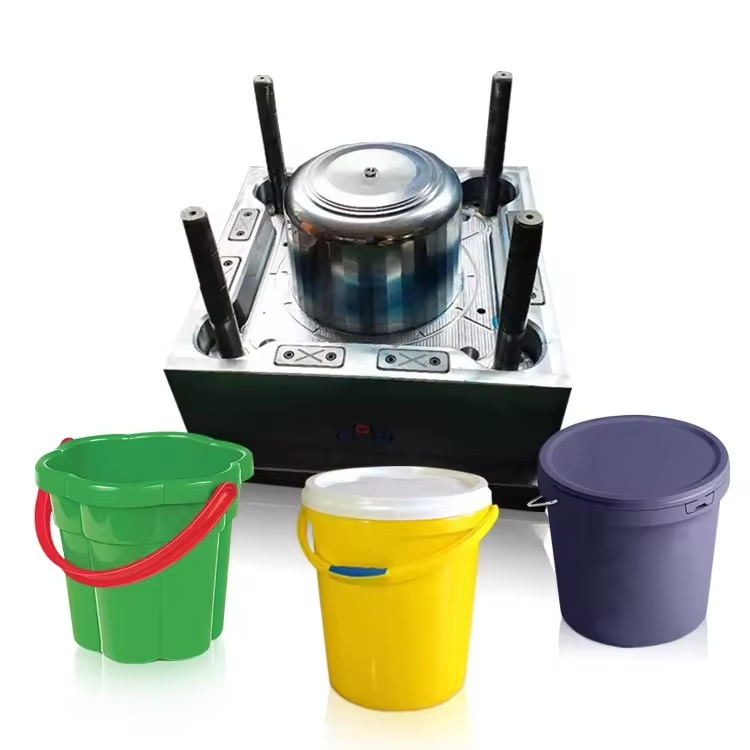
Every successful nylon injection molding project starts somewhere—often with modest volumes that grow as market acceptance increases. Planning for scale from the beginning avoids costly transitions and ensures your manufacturing solution evolves smoothly with your business needs.
Understanding Volume Categories


| Catégorie | Annual Volume | Typical Mold Solution |
|---|---|---|
| Prototype | 50-1,000 parts | Aluminum or 3D printed tool |
| Low volume | 1,000-10,000 parts | Class 103/104 steel mold |
| Medium volume | 10,000-100,000 parts | Class 102/103 mold |
| High volume | 100,000-1,000,000+ parts | Class 101 mold |
The Scaling Journey
Phase 1: Prototype and Validation
Initial production focuses on proving the design and validating market acceptance. Options include 3D printed nylon for 10-100 parts, aluminum prototype mold for 100-5,000 parts, and bridge tooling for 1,000-20,000 parts while production tool is built. At this stage, keep flexibility high and investment low.
Phase 2: Market Entry
As demand grows, transition to single-cavity steel mold with manual operation. Part production 500-2,000 per week typical. Focus on quality consistency and process validation. If volumes increase rapidly, consider adding a second shift before investing in additional cavities.
Phase 3: Volume Production
When demand stabilizes at higher levels: add cavities or invest in multi-cavity production mold, implement automation for part handling and packaging, consider hot runner system for material savings, and optimize cycle time through scientific molding.
Planning for Scale from Day One
Design for Scalability
Choose parting line and gate locations that work in multi-cavity configurations. Design cooling circuits that can be replicated across cavities. Standardize components where possible to simplify spare parts inventory.
Documentation du processus
Document your process parameters thoroughly from prototype through production. This documentation enables faster startup when adding capacity, consistent quality across multiple molds or machines, and troubleshooting reference when issues arise.
Scaling nylon injection molding requires a controlled handoff from prototype evidence to production tooling, material control and repeatable inspection.
Scale-Up Risks That Should Be Closed Before Volume Release
- A prototype mold is treated as production proof without comparing resin, shrinkage, gate, cycle, tool life, and inspection conditions.
- The annual forecast changes but cavitation, automation, packaging, material supply, and quality staffing are not revisited.
- Process settings are transferred without confirming the machine, mold, dryer, resin lot, conditioning state, and measurement method.
- A design is scaled before critical dimensions, assembly fit, cosmetic standards, traceability, and change-control responsibilities are frozen.
Comment le plastique nylon contribue à la réalisation du projet
Nylon Plastic supports the route from 3D printed or CNC prototypes to tooling and molded production. The review can connect modified nylon grade selection, DFM, mold strategy, sampling, inspection, and repeat-order requirements so a scale-up decision is based on evidence.
- Avant d'établir un devis, examinez le plan, les matériaux, les quantités, les caractéristiques essentielles et l'environnement d'utilisation.
- Reliez les échantillons, les rapports dimensionnels, les documents relatifs aux matériaux, la traçabilité et les critères d'acceptation à la même révision.
- Recourez à la formulation sur mesure, au moulage par injection, à l'usinage CNC ou à l'impression 3D lorsque l'application nécessite une autre méthode.
Lire la suite
- Moulage par injection à faible volume
- Outillage rapide vs outillage de série
- Guide des coûts du moulage par injection
- Pièces en plastique moulées sur mesure
Questions fréquemment posées
When should a nylon molding project move from prototype to production tooling?
Move when the geometry, material, critical dimensions, validation plan, and demand are stable enough that production repeatability and lifecycle cost justify the tooling commitment.
Can a prototype mold prove production capability?
It can reveal useful flow, shrinkage, fit, and appearance information, but production capability still depends on tool life, cavitation, machine, process control, inspection, automation, and the approved resin.
What should be frozen before a volume launch?
Freeze the drawing, grade and color, mold specification, critical dimensions, appearance standard, process window, inspection plan, packaging, traceability, and engineering-change process.
How should scale-up cost be compared?
Compare qualified part cost, tooling, sampling, inspection, secondary work, packaging, inventory, maintenance, scrap, freight, and expected change cost at each demand phase.
Request a Nylon Molding Scale-Up Review
Send prototype data, CAD, drawing, material, demand by phase, critical dimensions, and validation requirements for a route-to-production review.