Guide de résistance chimique des plastiques techniques : tableau complet de compatibilité

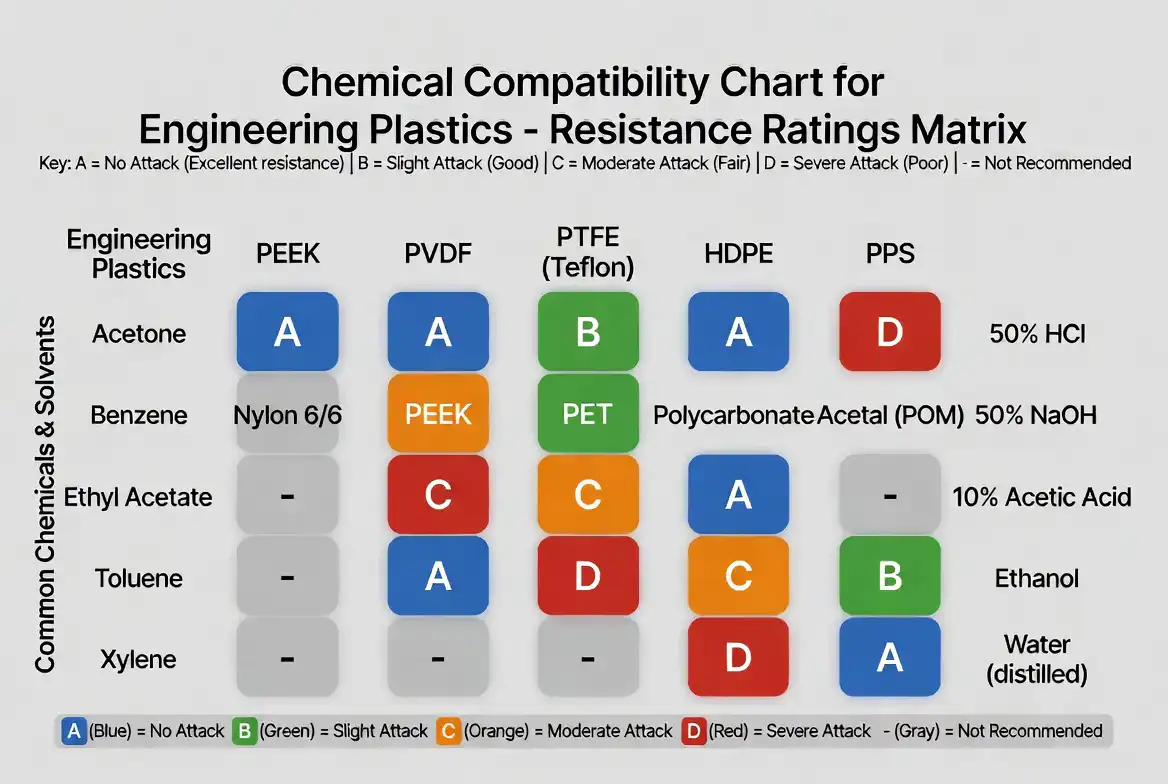
Chemical resistance testing of engineering plastics compatibility chart immersion samples

Why Chemical Resistance Determines Material Selection

Chemical resistance is the most frequently underestimated performance requirement in engineering plastic part design. A material that meets all mechanical and thermal requirements can fail within hours or days of chemical exposure if the compatibility is not properly evaluated. Unlike metals, where corrosion rates are relatively predictable and well-documented, plastic chemical resistance depends on an interaction of polymer chemistry, stress state, temperature, exposure duration, and chemical concentration. Two materials with nearly identical mechanical properties can have completely different chemical resistance profiles, and a material that resists a chemical at room temperature may fail rapidly when the same chemical is at process temperature.

This guide provides a comprehensive framework for evaluating chemical compatibility between engineering plastics and the chemicals they encounter in manufacturing, service, cleaning, and sterilization. The compatibility charts and application guidance below cover the most commonly specified engineering thermoplastics across the chemical families that engineers most frequently encounter.

Understanding Chemical Attack Mechanisms in Plastics

Plastics fail in chemical environments through several distinct mechanisms, and understanding which mechanism applies to your application is essential for selecting the right material and designing the right validation test. Solvation and swelling occur when the chemical absorbs into the polymer, disrupting intermolecular bonds and causing softening, dimensional change, and loss of mechanical properties. This is the most common failure mechanism for amorphous plastics like polycarbonate and ABS exposed to organic solvents. Semi-crystalline engineering plastics like POM, PA66, PPS, and PEEK resist swelling better because the crystalline regions are impermeable to most chemicals, limiting absorption to the amorphous regions between crystallites.

Chemical degradation involves actual chemical reaction between the polymer and the environment. Hydrolysis attacks ester, amide, and carbonate linkages in the polymer backbone, breaking the molecular chains and reducing molecular weight with corresponding loss of mechanical properties. PA66 and PA6 are susceptible to hydrolysis in hot water and steam above 80 degrees Celsius. PBT and PET are susceptible to hydrolysis in hot water and alkaline solutions. Polycarbonate is susceptible to hydrolysis in hot water and amine-containing environments. POM is susceptible to acid-catalyzed hydrolysis, with strong acids attacking the acetal linkages.

Environmental stress cracking is the most insidious chemical failure mechanism because it requires the simultaneous presence of chemical exposure and tensile stress, and the chemical may not visibly attack unstressed material. ESC occurs when a chemical agent that is not a strong solvent for the polymer nevertheless reduces the energy required for crack propagation, causing brittle failure at stress levels well below the material’s yield strength. Polycarbonate is highly susceptible to ESC by many common chemicals including alcohols, acetone, and many surfactants. Amorphous nylons are susceptible to ESC by zinc chloride solutions such as road salt. POM is susceptible to ESC by strong acids and some chlorinated compounds. PEEK and PPS are highly resistant to ESC, which is one reason they are specified for the most demanding chemical processing applications.

Chemical Family Compatibility Matrix

Chemical Family PA66 POM PC PBT PPS Î.-P.-É. PEEK PTFE
Water (23 deg C) G E G E E G E E
Water (80+ deg C) F G F F E G E E
Steam (100+ deg C) P F P P E G E E
Acids, Dilute (10%, 23 deg C) P F G G E G E E
Acids, Concentrated (23 deg C) P P F F E F G E
Acids, Oxidizing P P P P F P P E
Bases, Dilute (10%, 23 deg C) G F F F E F E E
Bases, Concentrated (23 deg C) G F P P E P G E
Aliphatic Hydrocarbons E E G E E E E E
Aromatic Hydrocarbons E G P E E F E E
Alcohols (Methanol, Ethanol) E E F G E G E E
Ketones (Acetone, MEK) E E P G E P E E
Chlorinated Solvents G G P F E P G E
Esters (Ethyl Acetate) E G P G E P E E
Automotive Fuels E E F E E G E E
Motor Oil, Transmission Fluid E E G E E E E E
Brake Fluid (DOT 3/4) F G P F E G E E
Refrigerants (R134a, R1234yf) E E G E E E E E
Hydrogen Peroxide (3-30%) P P G G E G G E

Ratings: E = Excellent, no significant effect. G = Good, minor effect acceptable for many applications. F = Fair, limited exposure only, test required. P = Poor, not recommended. All ratings assume 23 degrees Celsius unless otherwise noted. These are general guidelines; application-specific testing at actual service conditions is always recommended for critical applications.

Environmental stress cracking ESC test samples engineering plastics chemical exposure

Hydrolysis Resistance: The Water Challenge

Hydrolysis is the chemical reaction of water with polymer backbone linkages, breaking molecular chains and permanently degrading mechanical properties. The susceptibility to hydrolysis varies dramatically between polymer families and determines whether a material is suitable for hot water, steam, and humid environment applications.

PA66 and PA6 absorb significant water, 2.5% to 3.0% at 50% relative humidity and 8% to 9% at saturation, which reduces modulus by 25% to 40% and tensile strength by 15% to 25% compared to dry-as-molded properties. This is a reversible physical effect, not hydrolysis. Above 80 degrees Celsius in water, irreversible hydrolysis begins, attacking the amide linkages and reducing molecular weight. At 100 degrees Celsius, PA66 loses approximately 50% of its tensile strength after 1,000 hours of water exposure. Glass fiber reinforcement reduces the rate of property loss but does not prevent hydrolysis. For hot water applications above 80 degrees Celsius, PA66 is not recommended, and alternative materials should be considered.

POM offers better hot water resistance than PA66, with acceptable performance in water up to approximately 80 degrees Celsius for extended periods and to 100 degrees Celsius for intermittent exposure. The acetal linkage is more hydrolysis-resistant than the amide linkage. However, POM is not recommended for continuous steam exposure. PBT offers good resistance to water at temperatures up to 60 degrees Celsius but hydrolyzes at elevated temperature, particularly in alkaline conditions. PPS, PEEK, and PTFE are essentially immune to hydrolysis at any practical temperature, retaining their mechanical properties after thousands of hours in boiling water and steam. This makes them the materials of choice for steam valves, hot water pump components, and sterilizable medical and food processing equipment.

Acid and Base Resistance

Acid resistance varies dramatically across engineering plastics and is often the deciding factor in chemical processing equipment material selection. PPS offers the best acid resistance among melt-processable engineering thermoplastics, withstanding concentrated hydrochloric, sulfuric, and phosphoric acids at elevated temperatures. This makes PPS the standard material for chemical process pump housings, valve bodies, and fittings in acid-handling applications.

PA66 has poor acid resistance. Even dilute mineral acids at room temperature attack the amide linkages, causing rapid loss of mechanical properties. POM has poor resistance to strong acids, which catalyze hydrolysis of the acetal linkage. POM is not recommended for any application involving pH below 4. PEEK offers excellent resistance to most acids at room temperature with the notable exception of concentrated sulfuric and nitric acids, which attack PEEK at elevated temperature. PTFE is universally resistant to all acids at all temperatures, making it the ultimate barrier material for the most aggressive acid environments, though its low mechanical strength requires it to be used as a lining or seal rather than a structural component.

Base resistance follows a different pattern. PA66 and PA6 have good resistance to alkaline solutions, including concentrated sodium hydroxide, because the amide linkage is relatively stable under alkaline conditions. POM has only fair alkali resistance because strong bases can attack the acetal linkage and the end-cap chemistry that stabilizes the polymer. Polycarbonate has poor alkali resistance because the carbonate linkage is rapidly hydrolyzed by bases. PEEK has good resistance to dilute bases and fair resistance to concentrated bases at elevated temperature. PPS and PTFE have excellent universal base resistance.

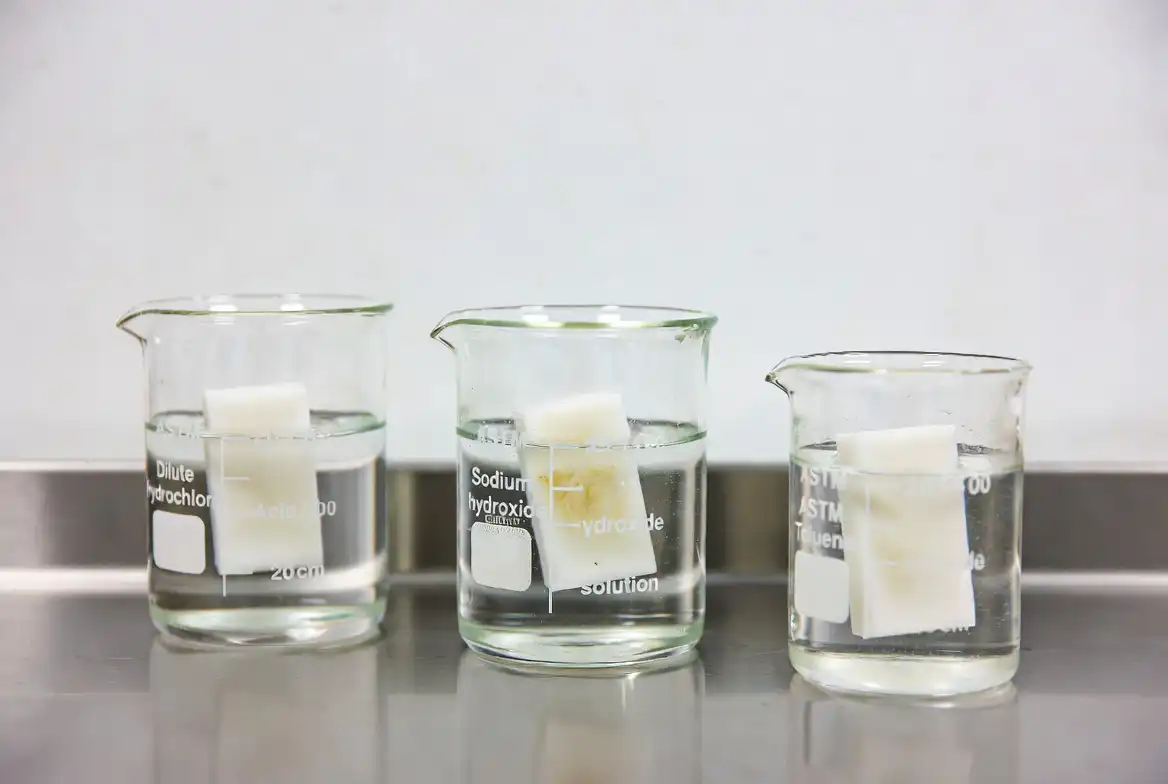
Chemical immersion testing of engineering plastic samples for compatibility evaluation

Organic Solvent Resistance

Organic solvent resistance is determined primarily by whether the polymer is semi-crystalline or amorphous. Semi-crystalline polymers including PA66, POM, PBT, PPS, and PEEK resist most organic solvents because the crystalline regions are impermeable, limiting solvent absorption to the amorphous fraction. Amorphous polymers including polycarbonate, PEI, and polysulfone are swollen or dissolved by a much wider range of organic solvents because the entire polymer matrix is accessible to solvent penetration.

Aliphatic hydrocarbons including hexane, heptane, mineral spirits, and most petroleum fractions are well-tolerated by all common engineering plastics with no significant effect. Aromatic hydrocarbons including benzene, toluene, and xylene attack polycarbonate and PEI through swelling and stress cracking but are well-tolerated by all semi-crystalline engineering plastics. Ketones including acetone, MEK, and MIBK attack polycarbonate aggressively, dissolve PEI partially, and are well-tolerated by semi-crystalline plastics. Chlorinated solvents including methylene chloride, trichloroethylene, and perchloroethylene are aggressive toward most amorphous plastics and partially swell even semi-crystalline plastics at elevated temperature. PEEK and PTFE are the most universally solvent-resistant engineering plastics.

Solvent Type Exemples Resistant Plastics Non-Resistant Plastics
Aliphatic Hydrocarbons Hexane, Heptane, Mineral Spirits All common engineering plastics Aucun
Aromatic Hydrocarbons Toluene, Xylene, Benzene PA66, POM, PBT, PPS, PEEK, PTFE PC, PEI, Polysulfone
Ketones Acetone, MEK, MIBK PA66, POM, PPS, PEEK, PTFE PC, PEI, ABS
Chlorinated Solvents Methylene Chloride, TCE PPS, PEEK, PTFE PC, PEI, PA66 (limited), POM (limited)
Alcohols Methanol, Ethanol, IPA PA66, POM, PPS, PEEK, PTFE PC (ESC risk), PEI (limited)
Esters Ethyl Acetate, Butyl Acetate PA66, PPS, PEEK, PTFE PC, PEI, POM (limited)

FDA Food Contact and Potable Water Compatibility

For applications involving food contact, potable water, or medical device patient contact, chemical resistance must be evaluated alongside regulatory compliance. The relevant standards include FDA 21 CFR for food contact substances, EU Regulation 10/2011 for plastic food contact materials, NSF/ANSI 61 for drinking water system components, and USP Class VI and ISO 10993 for medical device biocompatibility.

POM copolymer is widely used in food processing equipment components including conveyor components, filling machine parts, and dispenser mechanisms. It is compliant with FDA 21 CFR 177.2470 for food contact and EU 10/2011 with appropriate migration testing. POM resists most food products including oils, fats, dairy, and dilute food acids at ambient and moderate temperatures. Hot acidic foods above 80 degrees Celsius should be evaluated carefully because of the risk of acid-catalyzed degradation.

PEEK is the highest-performing food contact engineering plastic, withstanding steam sterilization at 134 degrees Celsius for thousands of cycles, repeated CIP (clean-in-place) chemical cleaning with aggressive caustic and acid solutions, and prolonged contact with all food types at processing temperatures. PEEK is compliant with FDA, EU, and USP Class VI requirements. PPS offers good chemical resistance for food processing at elevated temperature but is typically limited to non-direct food contact applications where its dark color and filler content are not cosmetic concerns. PTFE provides universal chemical resistance for seals and gaskets in food processing, though its creep under load requires mechanically loaded seal designs to maintain sealing force over time.

Cleaning Agent and Sterilization Compatibility

Medical devices, pharmaceutical processing equipment, and food processing machinery are subjected to aggressive cleaning and sterilization chemicals that can attack plastics not selected for chemical compatibility. Common sterilization methods and their compatibility with engineering plastics must be understood at the material selection stage.

Steam autoclaving at 121 to 134 degrees Celsius is compatible with PEEK, PPS, and PTFE for thousands of cycles. PEI tolerates 500 to 1,000 autoclave cycles before significant property degradation. POM and PA66 are not recommended for repeated steam sterilization because of hydrolysis at autoclave temperatures. Ethylene oxide gas sterilization is compatible with virtually all engineering plastics because the process temperature is low, typically 40 to 60 degrees Celsius, and the gas does not chemically attack most polymers. Hydrogen peroxide gas plasma sterilization is compatible with PEEK, PEI, PPS, and PTFE. PA66 and POM are degraded by the peroxide chemistry. Gamma radiation sterilization at 25 to 50 kGy causes significant embrittlement in POM and PTFE due to radiation-induced chain scission. PEEK, PEI, PPS, and PA66 are more radiation-tolerant and are preferred for gamma-sterilized applications.

Chemical resistance application guide engineering plastics processing equipment selection

Real Application Examples

An automotive fuel system component manufacturer specified PA66 GF30 for a fuel rail connector exposed to gasoline, ethanol blends up to E85, and under-hood temperatures reaching 130 degrees Celsius. The selection proved successful through 5,000 hours of fuel immersion testing at temperature with less than 5% loss of tensile strength. The alternative POM material considered would have failed due to stress cracking in the ethanol-blended fuel environment.

A chemical processing equipment manufacturer selected PPS GF40 for a sulfuric acid pump housing operating at 180 degrees Celsius with 70% sulfuric acid concentration. The stainless steel housing it replaced suffered from pitting corrosion at the impeller tip clearance, causing progressive performance degradation. The PPS housing eliminated corrosion entirely and reduced part cost by 45%. After three years of continuous operation, the PPS housing showed no measurable chemical attack and was returned to service after routine inspection.

A medical device manufacturer selected PEEK for a surgical instrument handle requiring 1,000 cycles of steam sterilization at 134 degrees Celsius. Competing materials evaluated included PEI, which showed surface crazing after 600 cycles, and PPS GF40, which met the sterilization requirement but failed the impact test after sterilization due to the inherent brittleness of highly filled PPS. PEEK delivered the required sterilization resistance, impact strength, and biocompatibility in a single material.

A food processing equipment OEM converted a conveyor chain guide from stainless steel to POM copolymer, eliminating the need for external lubrication and reducing noise by 8 dBA. The POM guide operates continuously in a washdown environment with alternating hot water at 85 degrees Celsius and alkaline cleaning solution at pH 12 at 60 degrees Celsius. After 18 months of operation, dimensional measurement showed wear within the acceptable limit of 0.15 mm, and the chain guide continues in service.

testing

Questions fréquemment posées

Comment puis-je tester la résistance chimique pour mon application spécifique ?

La méthode d’essai standard est la norme ASTM D543, qui consiste à immerger des éprouvettes moulées dans le produit chimique concerné à la température d’application pendant une durée spécifiée, généralement 7 jours pour un essai de présélection et de 30 à 90 jours pour la qualification. Mesurer la variation de poids, la variation dimensionnelle et les propriétés mécaniques avant et après l’exposition. Pour les applications impliquant des contraintes, effectuer les essais sous contrainte constante à l’aide d’un dispositif à bande courbée ou à contrainte constante, conformément à la norme ASTM D1693 relative à la fissuration sous contrainte environnementale. Toujours effectuer les essais avec des éprouvettes moulées, et non usinées, car les surfaces usinées peuvent présenter une morphologie cristalline et des contraintes résiduelles différentes de celles des surfaces moulées. Effectuez les essais à la température réelle d’utilisation, car les vitesses d’attaque chimique peuvent être multipliées par 2 à 3 pour chaque augmentation de température de 10 degrés.

Quel plastique technique présente la meilleure résistance chimique globale ?

Le PTFE offre une résistance chimique quasi universelle, supportant pratiquement tous les produits chimiques à l'exception des métaux alcalins fondus et du fluor élémentaire à haute température. Cependant, le PTFE présente une faible résistance mécanique et ne peut pas être moulé par injection. Parmi les plastiques techniques moulables par injection, le PEEK offre la meilleure combinaison entre une large résistance chimique et des performances mécaniques élevées, résistant à la plupart des produits chimiques, à l'exception des acides sulfurique et nitrique concentrés et de certains composés halogénés à haute température. Le PPS offre une résistance aux acides supérieure à celle du PEEK, en particulier face aux acides minéraux concentrés à haute température, mais sa résistance aux températures élevées est légèrement inférieure.

En quoi la température influe-t-elle sur les indices de résistance chimique ?

Chemical attack rates approximately double for every 10 degrees Celsius increase in temperature above room temperature, following the Arrhenius relationship. A material rated “Good” at 23 degrees Celsius may be rated “Poor” at 80 degrees Celsius. Always consult temperature-dependent chemical resistance data from the material supplier. As a practical rule, reduce the expected performance rating by one category (from Excellent to Good, Good to Fair, Fair to Poor) for every 40-degree temperature increase above room temperature, then verify with application-specific testing.

Puis-je utiliser les mêmes données de résistance chimique pour les grades chargés en verre et non chargés d'un même polymère ?

En général, oui, car la résistance chimique est déterminée par la composition chimique de la matrice polymère, et non par la charge. Cependant, le renforcement par des fibres de verre peut accélérer l’attaque chimique de deux manières. Premièrement, l’interface fibre-matrice offre une voie d’accès aux agents chimiques le long de la surface des fibres, ce qui augmente la surface exposée. D'autre part, si le produit chimique attaque l'agent d'encollage ou de couplage présent sur la fibre de verre plutôt que le polymère lui-même, la diminution de l'adhérence interfaciale entraîne une perte de propriétés mécaniques qui s'apparente à une dégradation chimique. Pour les applications critiques, il convient de tester la nuance chargée spécifique plutôt que de se fier aux données relatives aux matériaux non chargés.

What is the difference between chemical resistance and environmental stress cracking resistance?

Chemical resistance testing measures changes in weight, dimensions, and mechanical properties after immersion in a chemical without applied stress. ESC resistance testing measures time to failure under constant strain while exposed to the chemical. A material can have excellent chemical resistance as measured by immersion testing but poor ESC resistance. Polycarbonate provides the classic example: it shows minimal weight change in ethanol immersion but cracks within minutes under tensile strain. ESC is a surface phenomenon driven by the chemical reducing the energy required for crack propagation; it does not require bulk absorption or chemical reaction. Both resistance types must be evaluated for applications involving stress plus chemical exposure.

Créons votre solution personnalisée

Ce champ est requis.
Défiler vers le haut