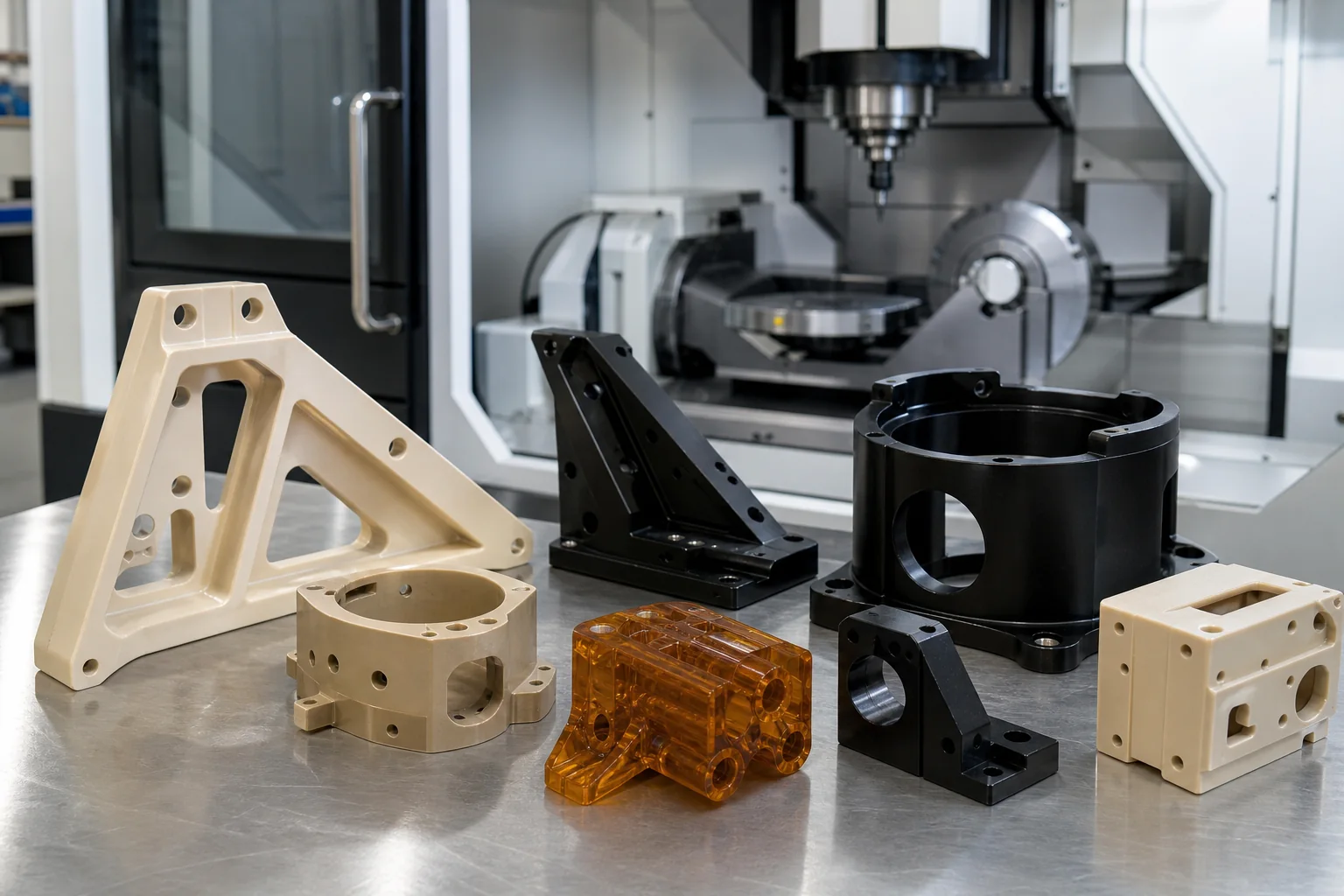
usinage de matières plastiques pour l'aérospatiale transforme des barres de plastique technique certifiées en supports, isolateurs, boîtiers, guides, entretoises et composants de test, sans recourir à des moules d’injection. Ce procédé est particulièrement adapté aux prototypes, aux petites et moyennes séries, aux géométries complexes et aux projets nécessitant un suivi rigoureux des matériaux et des rapports d’inspection.
Le simple fait d'utiliser le terme « aérospatial » ne suffit pas à garantir qu'une pièce est homologuée pour le vol. L'acheteur doit définir l'application (aéronautique ou au sol), la révision du plan, les spécifications des matériaux, le niveau de traçabilité, le plan d'inspection ainsi que toute exigence réglementaire ou spécifique au programme avant qu'un fournisseur ne confirme la procédure à suivre.
À l'attention des acheteurs des secteurs de l'aérospatiale, des drones, de l'avionique et des équipements de soutien au sol
Quand l'usinage CNC du plastique est la solution idéale
Optez pour l'usinage CNC lorsque la géométrie, la documentation et la flexibilité en matière de révision priment sur l'avantage en termes de coût unitaire offert par un moule dédié.
- La taille la plus adaptée : prototypes, pièces de rechange, gabarits, isolateurs et composants fabriqués en petites séries contrôlées
- Priorité relative aux matériaux : choisissez parmi les exigences relatives à la température réelle, aux propriétés chimiques, aux caractéristiques électriques, à l'usure et à l'inflammabilité
- La qualité avant tout : convenir des registres des lots de matériaux, des révisions des plans et des livrables d'inspection avant la validation du bon de commande
Résumé des décisions relatives à l'usinage dans le secteur aérospatial
| Point de décision | Points clés sur l'usinage | Remarque à l'attention de l'acheteur |
|---|---|---|
| PEEK | Option de résistance aux hautes températures et aux agressions chimiques pour les composants soumis à des conditions exigeantes | Vérifier la nuance exacte, la forme du matériau et les documents de certification requis |
| Î.-P.-É. | Utile lorsque la rigidité, les caractéristiques électriques et les performances certifiées en matière de résistance au feu et d'émission de fumée sont des critères importants | Ne partez pas du principe que toutes les notes obtenues dans le cadre du programme PEI répondent aux mêmes exigences du programme. |
| PPS | Solution offrant une stabilité dimensionnelle face à la chaleur et aux produits chimiques | Vérifier la fragilité, les sections des parois et la géométrie des arêtes |
| POM ou nylon | Rentable pour certaines applications en intérieur, dans le domaine des mécanismes, des équipements fixes ou des systèmes d'assistance au sol | Vérifiez le taux d'humidité, la température, l'inflammabilité et les restrictions liées au programme |
| Inspection | Les dimensions critiques peuvent être contrôlées sans pour autant imposer des tolérances serrées partout. | Système de référence national, température de contrôle et format du rapport |
En quoi l'usinage CNC des plastiques destinés à l'aérospatiale diffère-t-il de l'usinage général en atelier de sous-traitance ?
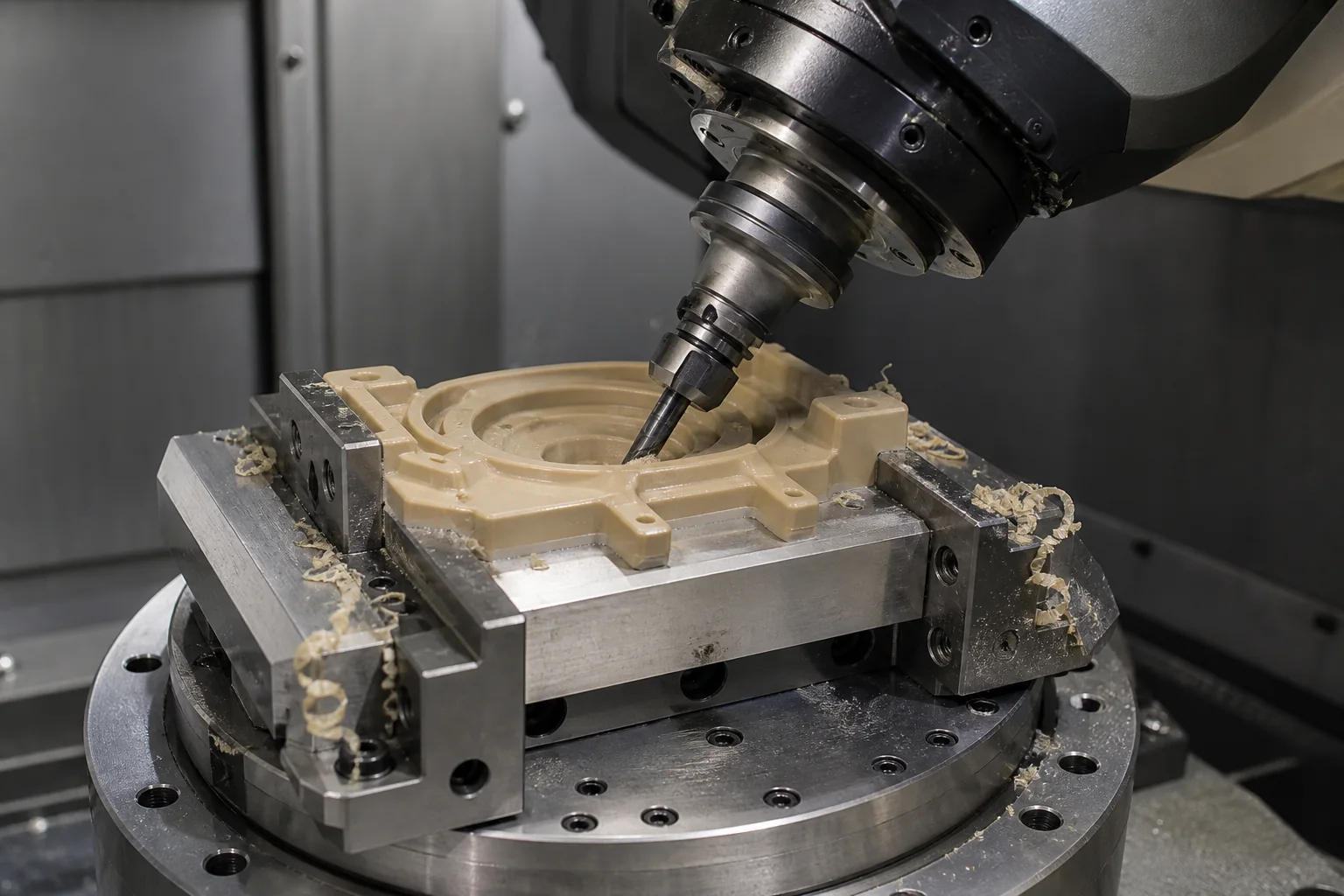
Les plastiques techniques réagissent différemment de l'aluminium à la pression de serrage, à la chaleur de coupe, à l'humidité et aux contraintes internes. L'utilisation d'outils tranchants, un serrage bien soutenu, un enlèvement de matière équilibré et des contrôles intermédiaires adaptés contribuent à préserver la géométrie de la pièce. Les parois minces, les cavités profondes et les éléments longs non soutenus nécessitent une attention particulière, car la pièce peut se déplacer après le desserrage.
L'identification du matériau fait partie intégrante du plan de fabrication. Le devis doit préciser les spécifications de la résine ou de la pièce brute, le nom du fabricant et la nuance le cas échéant, ainsi que la nécessité éventuelle d'un certificat de conformité, d'un rapport d'essai des matériaux, d'une traçabilité des lots ou d'une déclaration du fournisseur. Aucune substitution ne doit avoir lieu sans autorisation écrite lorsqu'un programme contrôle la provenance des matériaux.
Le Recommandations de la FAA concernant les pièces de rechange aéronautiques met l'accent sur la qualité, la conformité et la traçabilité. Pour les engins spatiaux ou les équipements destinés à fonctionner sous vide, le contrôle des matériaux peut également porter sur les traces de dégazage ; la NASA décrit la méthode ASTM E595 dans son Guide de la base de données sur le dégazage. Ces références ne garantissent pas automatiquement la conformité d'une pièce usinée, mais elles montrent pourquoi il est nécessaire de définir les exigences avant la fabrication.
Liste de contrôle pour les appels d'offres relatifs à l'usinage des plastiques dans le secteur aérospatial
- Contrôle du tracé : fournir le dessin validé, le modèle 3D, la révision et une règle de priorité claire en cas de conflit entre les fichiers.
- Statut de la demande : Précisez si la pièce est destinée à l'avion, à la cabine, à un drone, aux essais, à l'outillage ou au matériel de soutien au sol.
- Définition du matériau : Précisez le polymère, la qualité, la couleur, le fabricant d'origine et les alternatives approuvées.
- Traçabilité : définir les exigences en matière de suivi des lots, de certificats de conformité, de rapports sur les matériaux et de conservation des documents.
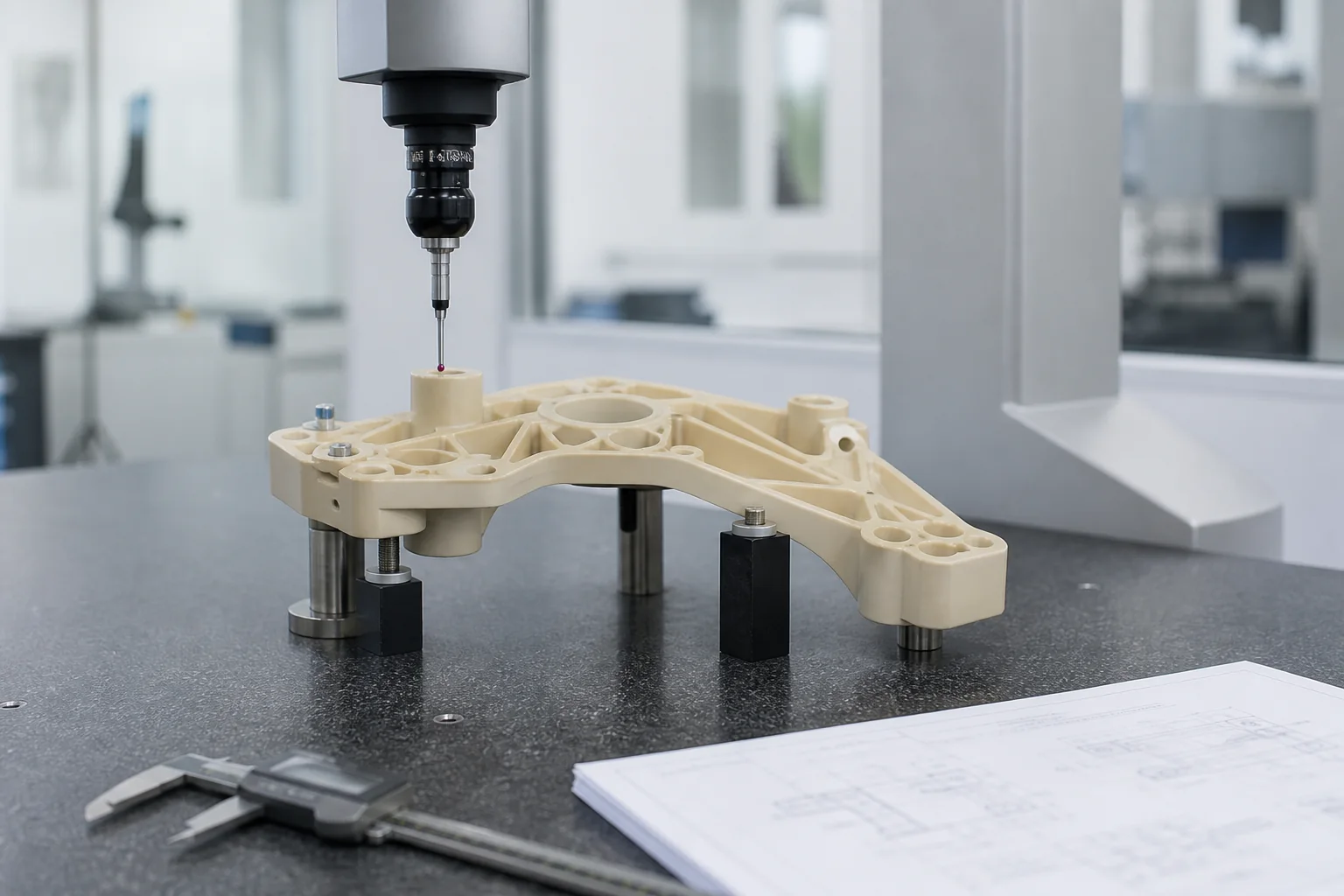
- Inspection : indiquer les cotes critiques, les points de référence, le niveau d'échantillonnage, le format de contrôle du premier article et toute exigence relative au rapport de la machine à mesurer tridimensionnelle (MMT).
- Manipulation : notamment les exigences en matière de propreté, de marquage, d'emballage, ainsi que les restrictions relatives aux arêtes vives et à la contamination.
- Données commerciales : indiquer le nombre de prototypes, la demande annuelle, le calendrier de livraison et la phase de révision prévue.
Matrice des applications et des matériaux
| Candidature | Orientation des matériaux | Détails de l'appel d'offres à confirmer |
|---|---|---|
| Isolateur ou boîtier avionique | PEEK, PEI or another electrically suitable qualified grade | Voltage, temperature, flame/smoke and cleanliness requirements |
| Structural bracket or spacer | PEEK, PEI, PPS or reinforced grade after load review | Load case, creep, fasteners, wall sections and critical datums |
| Low-friction guide or wear part | Filled PEEK, PTFE-based grade, POM or nylon depending environment | Load, speed, mating surface, lubrication and temperature |
| UAV payload component | Lightweight polymer selected from stiffness and environment | Vibration, temperature, UV, mass target and assembly interfaces |
| Jig, fixture or ground-support component | POM, nylon, PEI, PEEK or plate material based on function | Service life, contact surfaces, calibration and replacement plan |
Risques courants liés aux projets et solutions pratiques
| Risque | Pourquoi cela se produit-il ? | Solution pratique |
|---|---|---|
| Material document is rejected | The quote did not define grade, lot or report requirements | Approve the material and documentation package before stock purchase |
| Part moves after machining | Clamp stress, heat or unbalanced stock removal changed geometry | Use supported workholding, staged machining and stabilization where needed |
| Inspection results disagree | Temperature, datum setup or measurement method differs | Agree on datum simulation, conditioning and report method |
| Close tolerance drives unnecessary cost | Metal-like tolerances were copied to noncritical plastic features | Classify dimensions by function and protect only true interfaces |
| Supplier implies certification not held | Marketing language was accepted instead of project evidence | Request the exact quality-system scope and required records before award |
CNC Machining vs Injection Molding and Additive Manufacturing
CNC machining uses commercial stock and avoids mold lead time, making it practical for low volumes, revision-heavy programs and parts that need machined surfaces or tight local features. Injection molding can lower unit cost after geometry, material, validation and demand are stable, but tooling and process qualification require a larger commitment.
Additive manufacturing can accelerate fit checks, ducts and complex internal geometry. It is not automatically interchangeable with machined stock because anisotropy, porosity, surface condition and material documentation differ by process. The buyer should compare the actual acceptance criteria rather than choosing a process from shape alone.
Need a manufacturability and documentation review?
Send the drawing, application status, material specification, quantity, critical dimensions and required records. We will identify open questions before preparing a quote.
Pourquoi choisir le plastique nylon ?
Established in 2005, Nylon Plastic supports engineering-plastic selection, CNC manufacturing and dimensional review for custom projects. We confirm the material, tolerances, inspection scope, documentation and delivery plan against the supplied drawing rather than presenting a generic aerospace certification claim.
Lire la suite
- Aerospace Plastic Molding Supplier Guide
- Guide de sélection des matériaux pour l'usinage CNC
- Pièces en plastique usinées sur mesure
- Services de fraisage CNC de matières plastiques
Questions fréquemment posées
Quels sont les plastiques couramment utilisés pour l'usinage CNC dans le secteur aérospatial ?
Le PEEK, le PEI, le PPS, les grades à base de PTFE, le POM et le nylon peuvent être envisagés, mais le choix approprié dépend des exigences précises liées au vol, à la cabine, au drone, aux essais ou au soutien au sol.
L'usinage CNC permet-il à une pièce en plastique d'être homologuée pour le secteur aérospatial ?
Non. L'homologation ou l'acceptation dépend de l'autorité de conception, des spécifications des matériaux, des contrôles des fournisseurs, des inspections, de la traçabilité et des exigences applicables du programme.
Quels documents de traçabilité peuvent être demandés ?
Les acheteurs peuvent demander un certificat de conformité, l'identification du lot de stock ou de résine, un rapport d'essai des matériaux, les registres d'achat et les rapports d'inspection. Le contenu exact du colis doit être convenu avant le lancement de la production.
Les pièces en plastique destinées à l'aérospatiale peuvent-elles être usinées selon des tolérances serrées ?
Les caractéristiques critiques peuvent souvent être maîtrisées, mais les tolérances dépendent du matériau, des dimensions, de l'épaisseur de paroi, de l'humidité, de la température, de la stratégie de fixation et de la méthode de mesure.
Que doit contenir un appel d'offres pour l'usinage de pièces en plastique destinées au secteur aérospatial ?
Indiquez la révision du dessin et de la maquette, l'état d'avancement de la demande, les spécifications des matériaux, les sources approuvées, les quantités, les cotes critiques, le plan de contrôle, la documentation et les exigences en matière d'emballage.
For an aerospace plastic machining RFQ
Upload the drawing and list the application, grade, quantity, critical features, inspection reports and traceability documents required for supplier review.