Services
3D Printing for Prototyping & Production
What is 3D Printing?
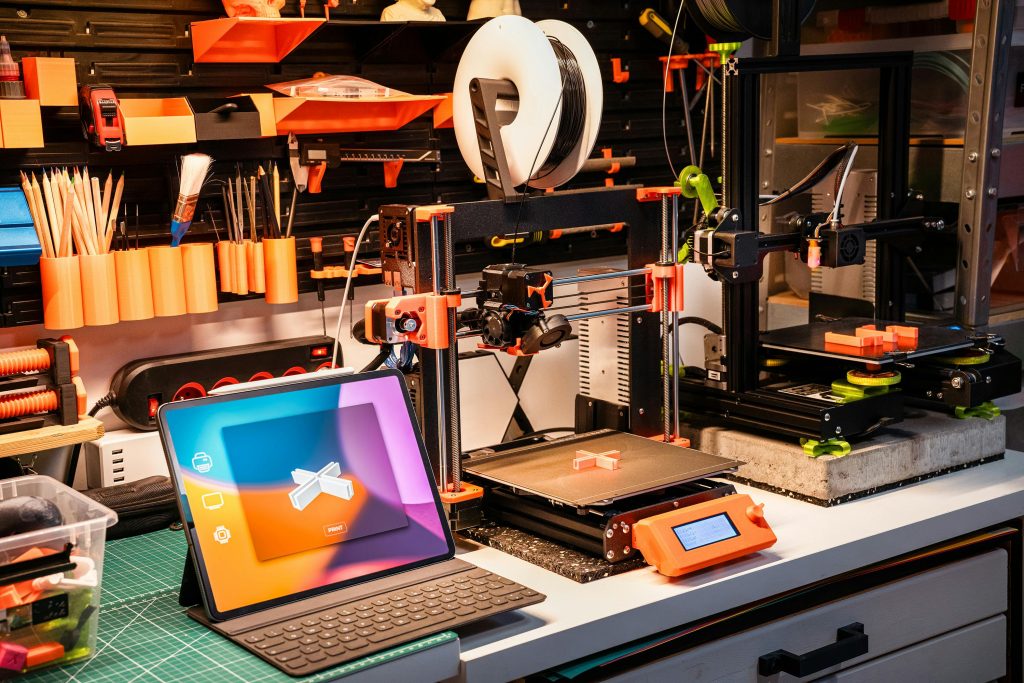
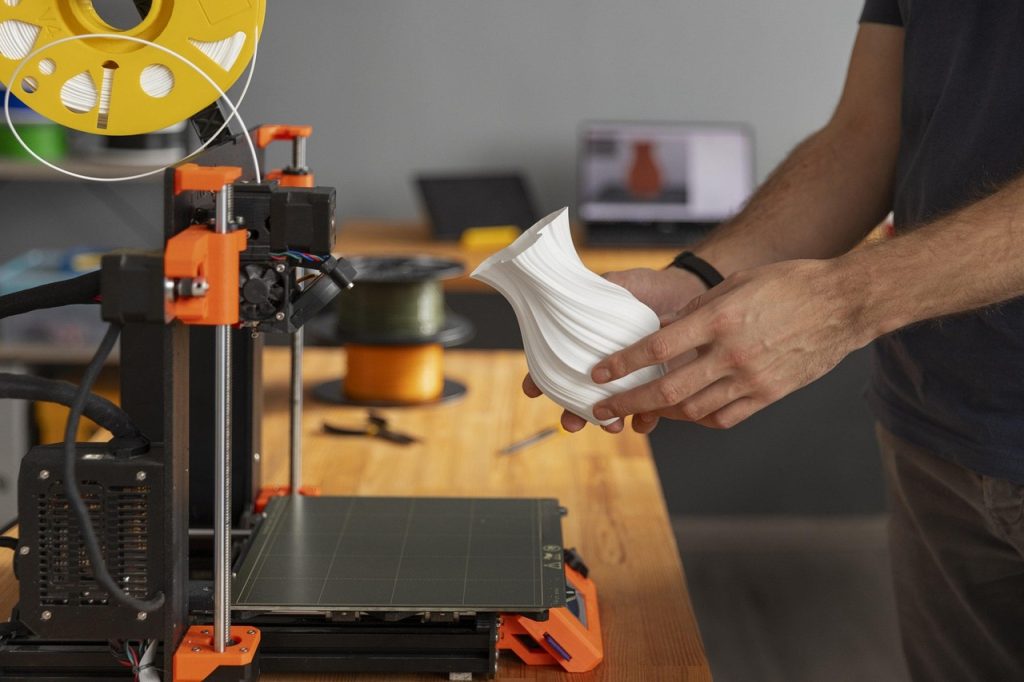
⇒3D printing is a manufacturing process that creates three-dimensional solid objects directly from digital files. The technology works by using specialized software that translates digital models into instructions for the printing machine, which builds objects using various raw materials including polymers, resins, or metal powders.
⇒The process operates on additive manufacturing principles, constructing objects by depositing successive layers of material that immediately solidify according to the program’s specifications. Depending on the printer’s speed, you can observe the object gradually taking shape throughout the process.
⇒The workflow integrates several key components. It begins with a 3D model, either originally designed using computer-aided design software or sourced from online model libraries. Once obtained, the digital file undergoes “slicing” to prepare it for printing.
⇒Slicing software digitally divides the 3D model into numerous thin horizontal layers. These layer instructions are then transferred to the 3D printer via USB, WiFi, or other file transfer methods. With the prepared file loaded, the printing process commences.
⇒After preparing the 3D printing machine and loading the file, the manufacturing process begins. Completion time ranges from minutes to hours, determined by the object’s complexity and the printer’s capabilities. This technology offers remarkable design freedom, enabling the creation of virtually any geometry imaginable.
3D Printing Materials Overview
Material Selection Guide:
Métaux: Ideal for high-strength, heat-resistant applications
Plastiques techniques: Perfect for functional prototypes and end-use parts
Specialty Polymers: Best for flexible or chemically resistant components
Photopolymer Resins: Excellent for high-detail models and visual prototypes
| Catégorie de matériaux | Type de matériau | Propriétés principales | Applications courantes |
|---|---|---|---|
| Métaux | Aluminium | Lightweight, good strength-to-weight ratio | Automotive parts, aerospace components |
| Cuivre | Excellent thermal & electrical conductivity | Heat exchangers, electrical components | |
| Acier inoxydable | Corrosion resistance, durability | Medical instruments, industrial parts | |
| Titane | High strength, biocompatible | Aerospace, medical implants | |
| Plastics & Polymers | ABS | Impact resistant, durable | Prototypes, consumer products |
| PA (Nylon) | Strong, flexible, wear-resistant | Functional parts, gears, hinges | |
| Polycarbonate | High strength, transparent | Engineering components, protective gear | |
| Polypropylène | Chemical resistant, flexible | Living hinges, containers | |
| TPU | Flexible, rubber-like | Gaskets, seals, flexible parts | |
| Resins | Digital Photopolymer | High detail, smooth surface | Detailed prototypes, dental models |
Our 3D Printing Processes
Advanced Manufacturing Technologies for Every Stage of Product Development
Stereolithography (SLA)
Selective Laser Sintering (SLS)
PolyJet
Multi Jet Fusion (MJF)
Digital Light Synthesis (DLS)
Our 3D Printing Technologies
Advanced additive manufacturing solutions for precision parts and prototypes
Stereolithography (SLA)
High-precision technology producing smooth, detailed parts with exceptional surface quality.
- Ideal for intricate prototypes and master patterns
- Excellent for end-use components requiring fine features
- Wide range of engineering and specialty resins
Selective Laser Sintering (SLS)
Industrial solution for functional prototypes and production parts without support structures.
- Perfect for complex geometries and internal channels
- Durable nylon materials for functional testing
- Ideal for low-to-medium volume production
PolyJet Technology
Multi-material 3D printing for realistic prototypes with varied textures and properties.
- Excellent for detailed visual models and overmolding
- Wide range of material combinations in single builds
- High-resolution printing with smooth surfaces
Multi Jet Fusion (MJF)
High-speed production technology delivering functional parts with consistent mechanical properties.
- Optimized for rapid iteration and medium-volume manufacturing
- Excellent mechanical properties and surface finish
- Cost-effective for functional prototypes and end-use parts
Digital Light Synthesis (DLS)
Advanced light-based manufacturing for precise, engineering-grade components.
- Consistent part quality with excellent mechanical performance
- Ideal for demanding applications and end-use parts
- Superior surface finish and dimensional accuracy
3D Printing Services FAQ
We provide industrial-grade 3D printing solutions including:
SLA (stéréolithographie): High-resolution printing with smooth surface finish, ideal for detailed prototypes and visual models
SLS (frittage sélectif par laser): Durable functional parts without support structures, perfect for complex geometries
FDM (Fused Deposition Modeling): Cost-effective prototyping with engineering-grade thermoplastics
PolyJet: Multi-material printing for realistic prototypes with varied textures
MJF (Multi Jet Fusion): High-speed production of functional parts with consistent quality
We offer comprehensive material options:
Plastiques: ABS, Nylon, Polycarbonate, ULTEM, TPU, Polypropylene
Resins: Standard, Engineering, Dental, Castable, High-Temperature
Métaux: Aluminum, Stainless Steel, Titanium, Inconel
Matériaux spécialisés: Glass-filled composites, flexible materials, biocompatible resins
Our rapid turnaround times include:
Standard projects: 3-5 business days
Express service: 24-48 hours (available for most technologies)
Complex/large projects: 5-7 business days
Production volumes: 1-2 weeks depending on quantity
We maintain strict tolerances:
ALS: ±0.1mm (0.004") or ±0.1% of feature size
SLS: ±0.2mm (0.008") or ±0.2% of feature size
FDM: ±0.15mm (0.006") or ±0.15% of feature size
Metal Printing: ±0.1mm (0.004") or ±0.1% of feature size
We support all major 3D file formats:
Preferred: STEP, STL, OBJ
Also Accepted: 3MF, IGES, X_T
CAD Native: SLDPRT (SolidWorks), F3D (Fusion 360), PRT (Creo)
Yes, our design optimization services include:
Free design for manufacturability (DFM) analysis
Wall thickness optimization and support reduction
Material selection guidance based on application
File repair and mesh optimization
Assembly design and part consolidation
Our manufacturing capabilities include:
Large Format SLA: 1500 × 750 × 550 mm
Industrial SLS: 650 × 350 × 560 mm
Production FDM: 900 × 600 × 900 mm
Metal Systems: 400 × 400 × 400 mm
Our quality assurance process includes:
ISO 9001 certified manufacturing processes
First article inspection and in-process quality checks
Comprehensive post-processing and finishing
Material certification and traceability
Detailed quality reports with each order
Absolutely. We specialize in:
Prototypage: 1-50 parts with rapid turnaround
Bridge Production: 50-500 parts for market testing
Production Volumes: 500+ parts with volume pricing
Just-in-Time Manufacturing: Ongoing production support
Our expertise spans multiple industries:
Medical & Dental: Surgical guides, dental models, custom implants
Aerospace & Defense: Lightweight components, ducting, brackets
Automobile: Functional prototypes, jigs and fixtures
Produits de consommation: Product development, packaging, displays
Industrie: Custom tooling, replacement parts, maintenance
Comprehensive finishing options available:
Standard: Support removal, light sanding
Premium: Smoothing, painting, dyeing, clear coating
Professional: Vapor smoothing, plating, assembly
Specialty: Medical-grade sterilization, UL certification

Analyse de faisabilité de la conception : limiter les risques avant le début de la production.
Allez au-delà des simples contrôles DFM. En associant une simulation avancée à notre expertise technique, nous vous donnons les moyens de perfectionner votre conception et d’éviter des modifications coûteuses en fin de cycle. Vous pouvez vous attendre à :
Principaux avantages
Réduction des coûts : réalisez des économies grâce à une utilisation optimisée des matériaux et à une conception intelligente de l'épaisseur des parois.
Fabricabilité améliorée : valider la faisabilité de la production grâce à l'évaluation des angles de dépouille et des lignes de joint.
Moins de défauts : recevez des alertes précoces concernant d'éventuels problèmes tels que les creux de moulage et les lignes de soudure.
Une confiance fondée sur les données : prenez des décisions éclairées grâce à une analyse détaillée du flux de matière dans le moule, portant sur le remplissage, le refroidissement et le gauchissement.
Choisissez vos matériaux en toute confiance
Principaux avantages
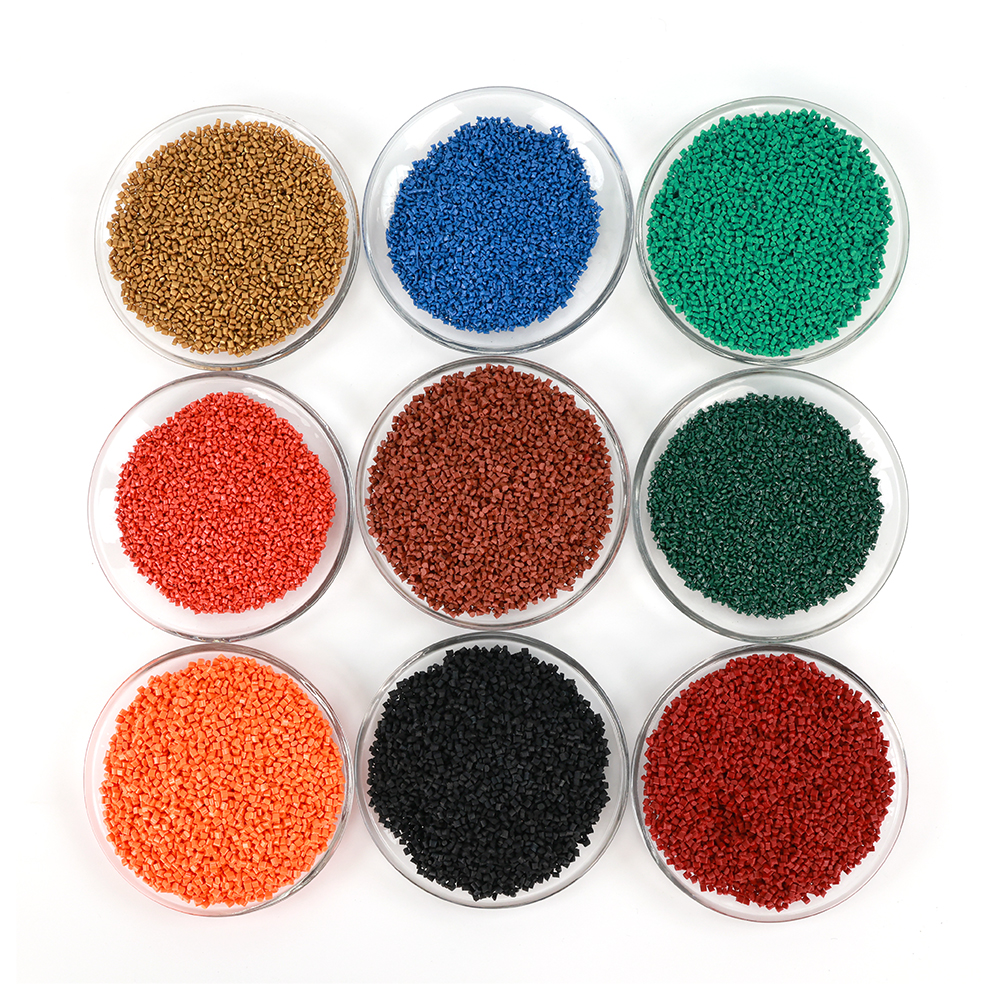
Définissez vos besoins en fonction des exigences mécaniques, thermiques et chimiques.
Assurez la conformité grâce aux conseils d'experts sur les directives RoHS et REACH, ainsi que sur d'autres normes.
Trouver le juste équilibre entre coût et performances afin d'identifier la solution la plus économique.
Validez votre choix grâce à des essais de matériaux réalisés par des professionnels et à un accompagnement en matière de certification.
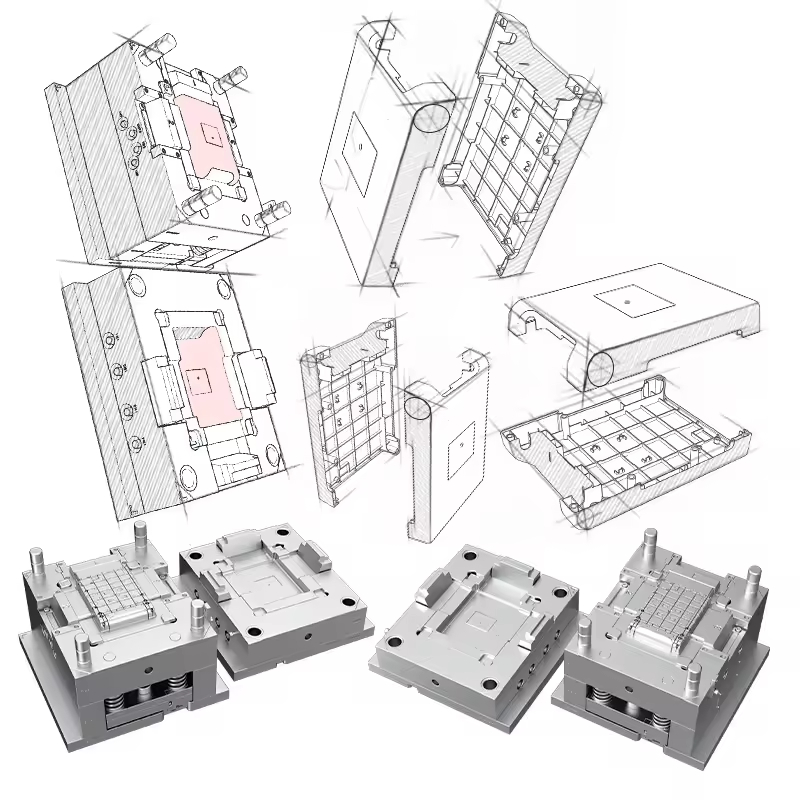
Partenaire spécialisé dans la conception de moules de précision
Voici ce à quoi vous pouvez vous attendre :
Efficacité de production optimisée : des moules conçus pour réduire les temps de cycle et maximiser le rendement.
Qualité des pièces contrôlée : stabilité dimensionnelle et excellence esthétique garanties pour chaque pièce.
Fiabilité à long terme et facilité d'entretien : des conceptions qui minimisent les temps d'arrêt et réduisent les coûts d'exploitation sur toute la durée de vie.
Une solution sur mesure : un moule conçu avec précision pour répondre aux exigences spécifiques de votre produit et à vos objectifs de volume.
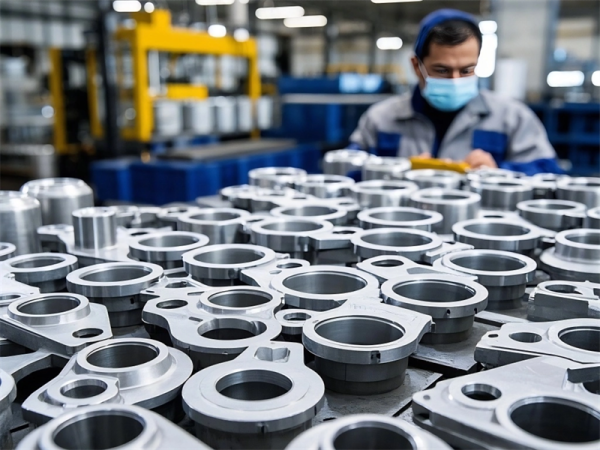
Optimisez votre rendement et la qualité de votre production
Vos principaux avantages :
Amélioration de l'efficacité et du rendement grâce à la réduction des temps de cycle.
Une meilleure homogénéité de la qualité, avec une réduction des variations d'une pièce à l'autre.
Réduction significative des coûts grâce à la minimisation des rebuts et du gaspillage d'énergie.
Une chaîne de production plus performante, offrant une plus grande stabilité opérationnelle globale.
Processus en 3 étapes
Comment ça marche ?
Dès la confirmation de votre commande de moules d'injection, nous suivons une procédure standardisée afin de garantir la transparence et la fluidité des étapes tout au long du processus. Ce processus permet à notre équipe et à nos clients d'être tenus pleinement informés de l'avancement du projet, garantissant ainsi que chaque phase est menée à bien de manière efficace. Voici comment nous démarrons et menons à bien votre projet de moules d'injection :