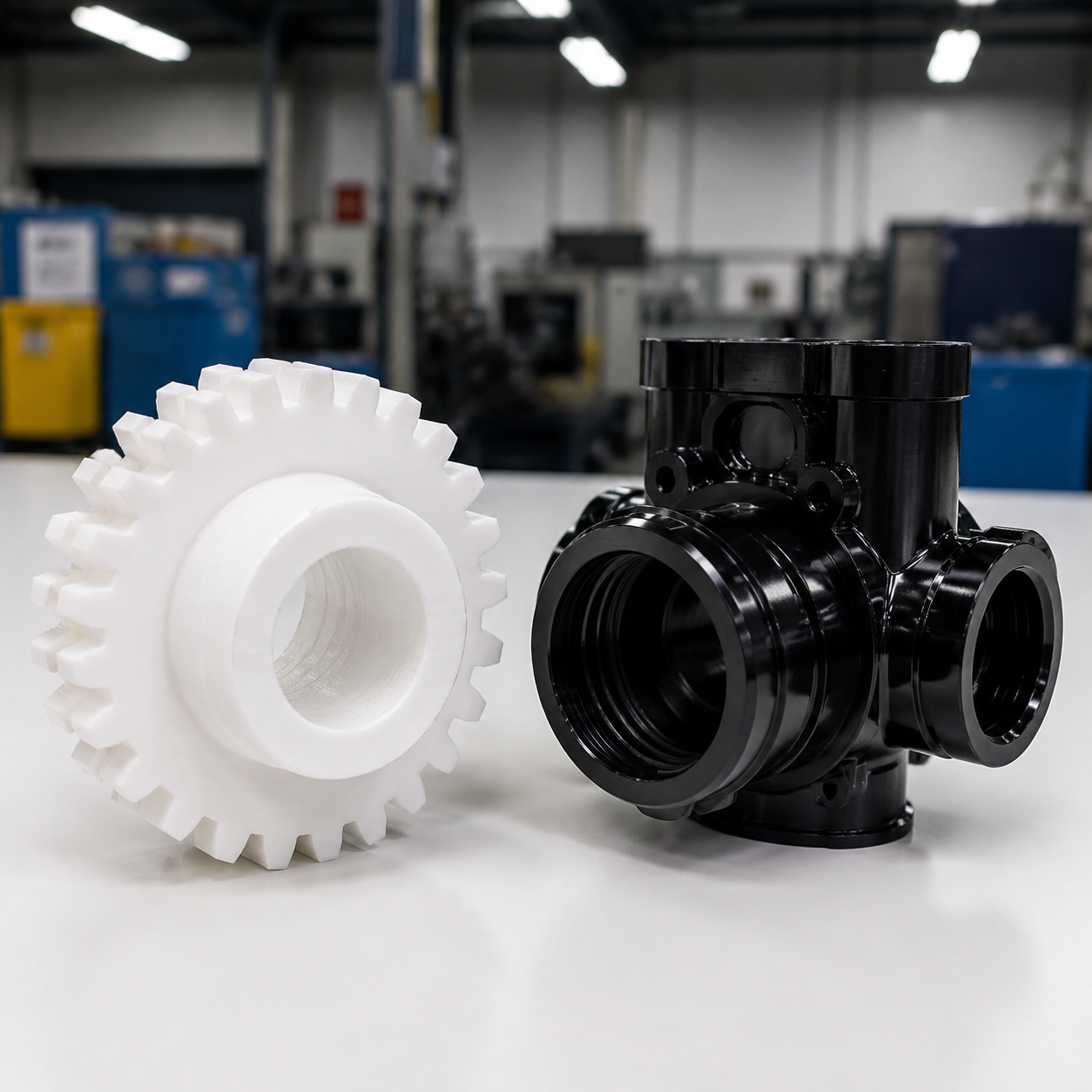
Réponse rapide à l'intention des ingénieurs et des équipes chargées des achats : Delrin est la marque déposée par DuPont pour désigner l’homopolymère d’acétal (POM-H). Lorsqu’un plan spécifie simplement “ acétal ” sans précision, les fournisseurs peuvent fournir soit de l’homopolymère, soit du copolymère (POM-C) — or, ces deux matériaux présentent des comportements suffisamment différents pour entraîner des défaillances en service. Pour les engrenages CNC à tolérances serrées, les applications soumises à une fatigue à cycles élevés et les pièces nécessitant la meilleure finition de surface à la sortie de la machine, optez pour l’homopolymère Delrin. Pour les applications impliquant de l’eau chaude, des environnements acides ou des pièces tournées de grand diamètre où la porosité axiale pourrait poser problème, optez pour le copolymère d’acétal.
Ce guide s'adresse aux ingénieurs qui ont besoin de préciser le bon article sur le bon de commande, et pas seulement en comprendre les propriétés chimiques. Nous nous appuyons sur les données d'usinage de plus de 500 pièces industrielles en acétal fabriquées dans notre usine, toutes qualités confondues et selon trois procédés de fabrication différents.
Notions de base sur les matériaux : homopolymère ou copolymère — Quels changements en atelier ?
Ces deux grades appartiennent à la famille du polyoxyméthylène (POM), mais leur structure moléculaire diffère à un niveau qui a une incidence sur tous les processus en aval :
- Delrin (POM-H) : Motifs répétitifs uniformes -CH₂O-. Une cristallinité plus élevée (~75-85%) se traduit par une plus grande dureté, une plus grande rigidité et une meilleure résistance à la fatigue — mais aussi par des contraintes résiduelles plus importantes après usinage.
- Copolymère d'acétal (POM-C) : Contient des motifs comonomères -CH₂CH₂O- sporadiques qui interrompent la cristallinité. Cela réduit légèrement la rigidité, mais améliore considérablement la résistance chimique et la stabilité dimensionnelle après usinage.
Comparaison directe de biens immobiliers
| Propriété | Delrin (POM-H) | Copolymère d'acétal (POM-C) | Pourquoi est-ce important ? |
|---|---|---|---|
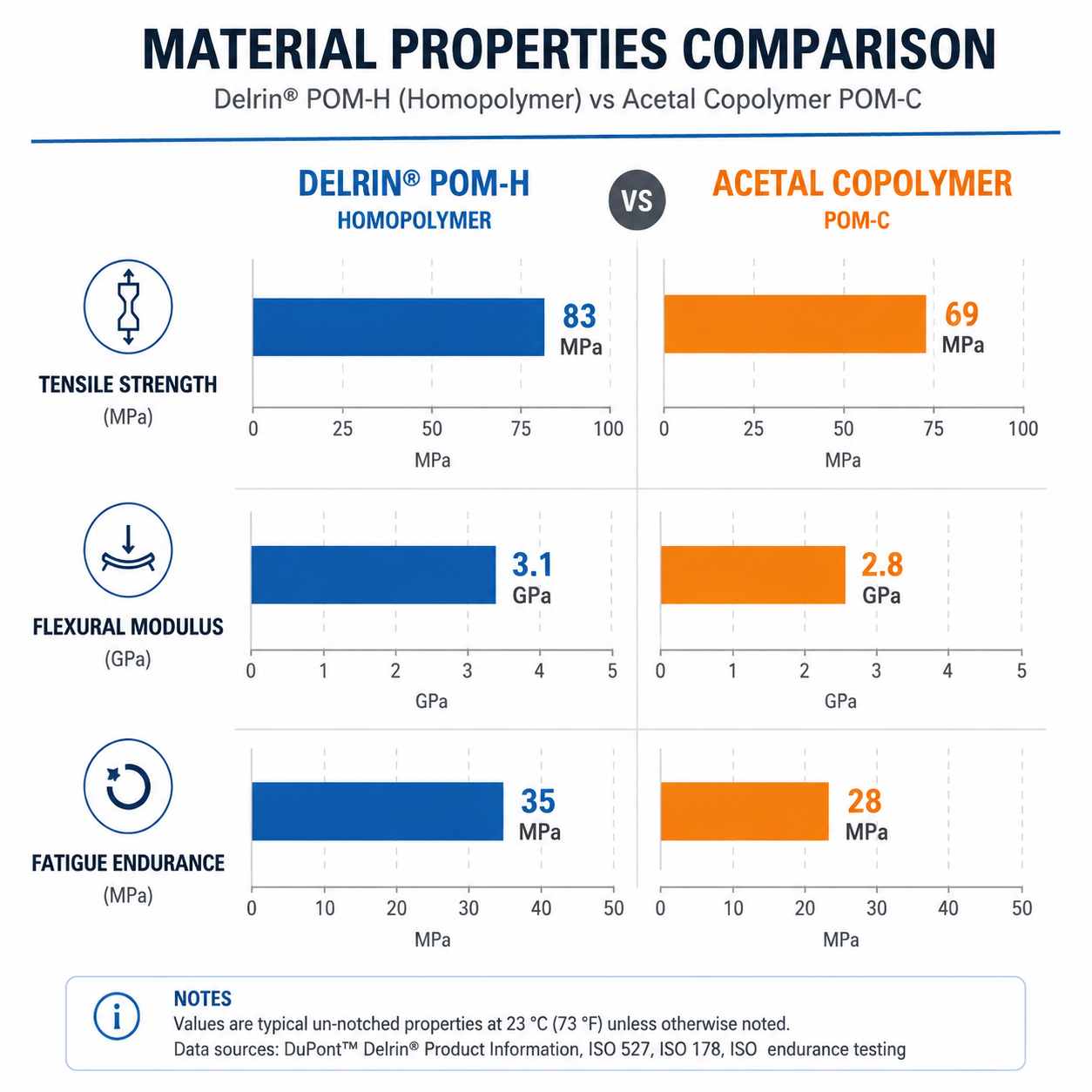
| Résistance à la traction (MPa) | 70-83 | 60-69 | Le Delrin supporte une charge statique supérieure d'environ 20% avant la limite d'élasticité |
| Module de flexion (GPa) | 2.8-3.1 | 2.4-2.8 | Une sensation de plus grande rigidité — essentielle pour la force de retenue par encliquetage |
| Résistance à la fatigue à 10⁶ cycles (MPa) | 35 | 28 | Élément clé de différenciation pour les engrenages et les ressorts |
| Résistance au choc Izod, avec entaille (J/m à 23 °C) | 69-122 | 53-163 | Les copolymères offrent un choix plus large ; le choix de la qualité est important |
| Absorption d'eau, 24 h (%) | 0.25 | 0.22 | Similaires à température ambiante ; divergent au-delà de 60 °C |
| Température maximale en service continu (°C) | 90-100 | 100-110 | Le copolymère : la solution idéale pour les environnements à haute température |
| Déformation par fluage après 1 000 h à 23 °C, 10 MPa (%) | ~0.5 | ~0.8 | Le Delrin conserve mieux ses dimensions sous une charge constante |
| Coefficient de frottement (sur surface sèche par rapport à l'acier) | 0.2-0.35 | 0.25-0.40 | Le Delrin est légèrement plus glissant — ce qui le rend plus adapté aux roulements |
Règles de conception pour les pièces en Delrin et en acétal
Ces règles proviennent directement de notre cellule d'usinage CNC et s'appliquent aussi bien aux prototypes qu'aux séries de production. Adaptez-les au moulage en ajoutant des angles de dépouille (1 à 2° minimum pour les deux matériaux).
Règles de conception des pièces en acétal (issues de l'atelier)
Ces données s'appuient sur les données d'usinage de plus de 500 pièces industrielles en acétal produites dans notre usine (1er trimestre 2026). Vous pouvez les intégrer directement dans vos dessins CAO.
| Paramètre | Delrin (POM-H) | Copolymère d'acétal (POM-C) |
|---|---|---|
| Épaisseur minimale de la paroi | 1,0 mm | 0,8 mm |
| Rayon de courbure recommandé | R ≥ 0,5 mm | R ≥ 0,3 mm |
| Tolérance du diamètre du trou (CNC) | ±0,025 mm | ±0,05 mm |
| Rapport d'aspect maximal (profondeur/diamètre) | 6:1 | 5:1 |
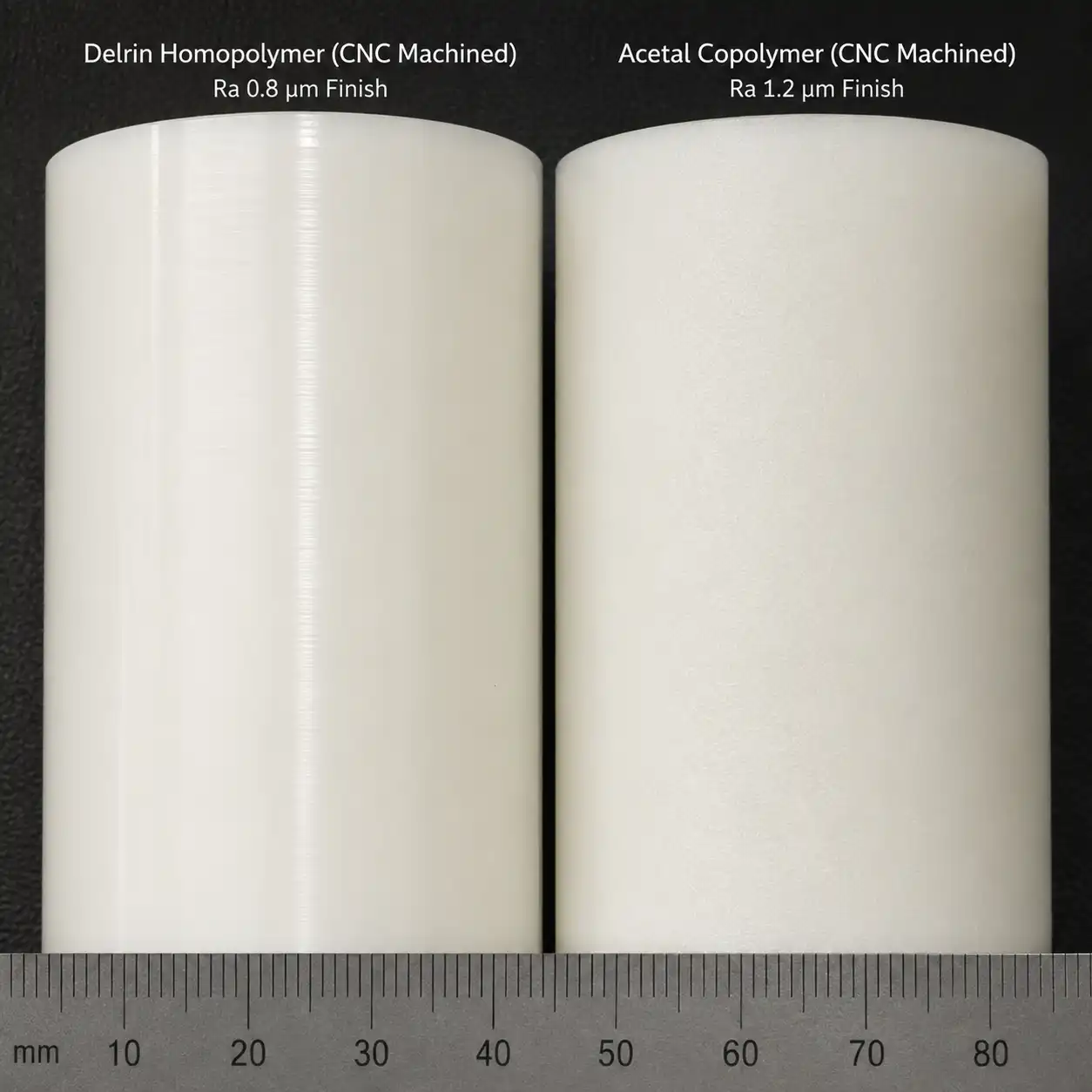
| État de surface à la sortie de l'usinage (Ra) | 0,8 μm | 1,2 μm |
| Risque de déformation après usinage | Modéré (il est recommandé de se détendre) | Faible (meilleure stabilité dimensionnelle) |
Ces valeurs sont valables dans des conditions d'usinage standard à 20 °C, avec des outils en carbure bien affûtés et en coupe à sec. Pour les règles de conception en matière de moulage par injection, veuillez vous reporter à notre consultation de l'équipe d'ingénieurs.
Pourquoi la porosité de la ligne médiane modifie la conception des pièces
L’une des différences les moins évoquées entre ces deux matériaux concerne la porosité centrale des tiges extrudées en Delrin. Lorsque le diamètre de la tige dépasse 40 mm, l’extrusion de POM-H présente généralement un noyau central poreux (de 0,5 à 2 mm de diamètre) dû au retrait lors du refroidissement. Si la conception de votre pièce prévoit une surface d'étanchéité critique ou un alésage à tolérance serrée sur l'axe de la tige, cette porosité entraîne des fuites ou des alésages hors spécifications. Le copolymère ne présente pas ce problème : le comonomère perturbe suffisamment la cristallisation pour éliminer les vides au centre.
Règle pratique : Si votre pièce comporte un trou traversant ou une surface d'étanchéité passant par le centre de la tige et que le diamètre de celle-ci dépasse 40 mm, optez pour un copolymère d'acétal. Un client a ainsi économisé 18% sur un lot retourné de composants destinés à une vanne d'eau, simplement en optant pour ce changement de matériau.
Applications industrielles : les atouts de chaque nuance
| L'industrie | Pièces courantes | Note souhaitée | Justification du choix |
|---|---|---|---|
| Automobile | Vannes du système d'alimentation en carburant, composants des ceintures de sécurité, engrenages des lève-vitres | Delrin (POM-H) | Résistance à la fatigue accrue pour une durabilité de plus de 100 000 cycles ; faible perméabilité au carburant |
| Dispositifs médicaux | Mécanismes d'inhalateurs, corps de stylos à insuline, manches d'instruments chirurgicaux | Copolymère d'acétal (POM-C) | Meilleure résistance aux produits chimiques utilisés pour la stérilisation ; teneur en substances extractibles plus faible |
| Machines industrielles | Rouleaux de convoyeur, cages de roulements, roues de pompe, bandes d'usure | Delrin (POM-H) | Résistance à l'usure supérieure et faible coefficient de frottement (autolubrifiant) ; dureté plus élevée |
| Électronique grand public | Mécanismes de clavier, engrenages d'imprimante, tubes d'objectif d'appareil photo | Copolymère d'acétal (POM-C) | Meilleure résistance à l'eau chaude pour les applications compatibles avec le lave-vaisselle ; fluage réduit sous une charge de ressort constante |
| Plomberie et gestion des fluides | Sièges de soupapes, composants de mitigeurs de douche, pièces internes de compteurs d'eau | Copolymère d'acétal (POM-C) | Gonflement réduit à chaud ; évite les problèmes de porosité centrale susceptibles de provoquer des fuites dans le POM-H |
| Industrie agroalimentaire | Buses de remplissage, guides de convoyeur, revêtements de planches à découper | Les deux (qualités conformes aux normes de la FDA) | Utiliser un homopolymère pour les applications à contact sec ; un copolymère pour les applications à contact humide ou à haute température, conformément à la norme NSF 51. |
La tendance est claire : le Delrin s'impose dans les applications mécaniques dynamiques (engrenages, roulements, ressorts) où la résistance à la fatigue et un faible coefficient de frottement constituent des exigences primordiales. Le copolymère d'acétal s'impose quant à lui dans les applications impliquant des fluides, des produits chimiques ou une stérilisation — ainsi que dans tous les cas où la géométrie de la pièce rend la porosité axiale risquée.
Comparaison des tolérances selon le procédé de fabrication
La tolérance réalisable dépend autant du procédé de fabrication que du choix des matériaux. Vous trouverez ci-dessous un guide pratique destiné aux ingénieurs chargés de rédiger les annotations sur les plans.
| Processus de fabrication | Tolérance du Delrin (POM-H) | Tolérance du copolymère d'acétal (POM-C) | Meilleur pour |
|---|---|---|---|
| Usinage CNC | ±0,025 mm | ±0,05 mm | Prototypes, petites et moyennes séries (< 1 000 pièces), pièces à tolérances serrées |
| Moulage par injection | ±0,10 mm | ±0,08 mm | Volume élevé (> 5 000 pièces) ; les moules en copolymère offrent une plus grande régularité |
| Impression 3D (FDM) | ±0,20 mm | ±0,15 mm | Prototypes rapides uniquement ; non recommandé pour les essais fonctionnels |
Ces tolérances peuvent être respectées dans des conditions d'atelier standard. Des tolérances plus strictes sont disponibles sur demande, moyennant des contrôles de processus supplémentaires.
Il convient de noter que la relaxation des contraintes post-usinage plus faible du copolymère lui confère un léger avantage en termes de tolérance dans le moulage par injection : la pièce sort du moule avec des dimensions plus proches de ses dimensions finales et subit moins de variations au cours des 72 premières heures.
Cadre décisionnel en matière de coûts : quand opter pour le Delrin ?
Cadre d'analyse des coûts : Delrin ou copolymère d'acétal ?
Le coût des matériaux ne représente qu'environ 15 à 201 TP3T du coût total des pièces usinées. La véritable différence réside dans l'efficacité du processus et le taux de rebut :
- Prix des matières premières : Une tige en Delrin coûte généralement 10 à 15% plus cher qu'une tige en copolymère d'acétal standard de même diamètre.
- Durée d'usinage : Le Delrin se découpe plus proprement et plus rapidement : comptez un temps de cycle par pièce réduit de 8 à 12% par rapport au copolymère, à tolérance équivalente.
- Taux de rejet (données internes) : Les pièces en copolymère présentent davantage de défauts visuels (stries de porosité centrales) : taux de rebut de 3 à 51 TP3T contre environ 11 TP3T pour le Delrin dans les opérations de tournage CNC.
- Seuil de rentabilité : Si votre volume annuel dépasse 2 000 pièces, le taux de rebut réduit du Delrin compense le surcoût de la matière première. En dessous de 2 000 pièces, le copolymère générique s'avère plus rentable.
- Coût caché : Le copolymère proposé pour les assemblages où la précision dimensionnelle est essentielle peut générer des rebuts de type 1-2% dus à une dérive dimensionnelle après usinage, résultant de la libération des contraintes résiduelles au cours des 72 premières heures.
La décision en matière de coût se résume souvent à une question simple : “ Que se passerait-il si cette pièce venait à présenter une défaillance ? ” Pour les composants non critiques, qu’ils soient esthétiques ou servant à l’espacement, le copolymère permet de réaliser des économies. En revanche, pour les composants soumis à des charges, essentiels à la sécurité ou soumis à un nombre élevé de cycles, le surcoût du Delrin est largement compensé par la réduction des retours sur le terrain.
Problèmes courants et solutions
Lorsqu'une pièce en acétal présente un défaut ou est rejetée lors du contrôle qualité à la réception, la cause première est souvent une incompatibilité des matériaux. Voici les quatre problèmes les plus fréquents que nous constatons lorsque nos clients nous confient des pièces à retoucher :
| Problème | Cause matérielle probable | Corriger |
|---|---|---|
| Usure des dents d'engrenage après moins de 50 000 cycles | Utilisation d'un copolymère à la place d'un homopolymère (limite de fatigue de 28 MPa contre 35 MPa) | Optez pour le Delrin de grade 100 ou 150 pour les engrenages ; ajoutez un grade chargé en PTFE (Delrin 500AF) s'ils ne sont pas lubrifiés |
| Apparition de fissures superficielles après plus de 6 mois d'utilisation | Fissuration sous contrainte due à un environnement acide (fréquente dans le POM-H) | Passez au POM-C ; vérifiez la compatibilité chimique avec votre fluide de process |
| Croissance dimensionnelle dans le domaine de l'eau chaude | Le POM-H absorbe davantage d'eau à température élevée (~0,81 TP3T à 80 °C) | Utiliser du POM-C (absorption 0,61 TP3T) ; pré-traiter les pièces en les laissant tremper dans de l'eau à 60 °C pendant 24 heures avant le contrôle qualité final. |
| Porosité visible sur les surfaces tournées | Porosité centrale — inhérente au procédé d'extrusion du POM-H | Préciser “ POM-C ” pour les pièces présentant de grands diamètres de tournage (> 50 mm) ; demander au fournisseur une qualité « à faible porosité ». |
Comment indiquer correctement « acétal » sur votre bon de commande
Évitez l'erreur la plus courante en matière d'approvisionnement : indiquer “ Acétal ” sur le bon de commande sans préciser la nuance. Un bon de commande correctement rédigé doit inclure :
- Famille et type de matériau : “ Homopolymère d'acétal (Delrin 150) ” ou “ Copolymère d'acétal (équivalent au Celcon M90) ”
- Forme : “ Tige extrudée, diamètre 50 mm ” ou “ Granulés pour moulage par injection ”
- Exigence de tolérance : “ Conformément à la norme ISO 2768-m ” ou indication spécifique
- Exigences particulières concernant les nuances : “ Conforme aux normes de la FDA ”, “ Stabilisé aux UV (Delrin 527) ”, “ Chargé en PTFE (Delrin 500AF) ”
Ce niveau de précision empêche le fournisseur de remplacer l'homopolymère par un copolymère lorsque le plan indique simplement “ acétal ” — une pratique plus courante que ne le pensent la plupart des ingénieurs.
Conclusion et recommandations
Le choix entre le Delrin et l'acétal ne consiste pas à déterminer quel matériau est “ meilleur ”, mais à associer la nuance appropriée à l'application concernée. Utilisez l'homopolymère Delrin pour les pièces mécaniques soumises à des contraintes dynamiques, pour lesquelles la résistance à la fatigue, l'état de surface et un faible coefficient de frottement sont essentiels. Utilisez le copolymère d’acétal pour les applications en contact avec des fluides, les environnements à haute température ou chimiquement agressifs, ainsi que pour les pièces tournées de grand diamètre présentant un risque de porosité axiale.
Vous ne savez toujours pas quelle nuance convient à votre projet ? Notre équipe d'ingénieurs examine le choix des matériaux dans le cadre de chaque devis. Envoyez-nous votre plan ou votre fichier 3D et nous vous recommanderons gratuitement la nuance la mieux adaptée à votre application.
Fabrication de précision
Tolérance CNC de ±0,01 mm pour plus de 50 types de plastiques techniques
Certifié ISO 9001
Contrôle qualité complet avec rapports de MMT pour chaque commande
Livraison sous 15 à 25 jours
Du prototype à la production, expédition dans le monde entier
Livraison internationale
DDP disponible aux États-Unis, dans l'Union européenne et en Asie-Pacifique
Téléchargez le guide complet sur l'usinage des plastiques techniques (PDF)
Ce guide traite des règles de conception, des tableaux de tolérances et des recommandations de choix des matériaux pour le Delrin, le nylon, le PEEK, l'ABS, le PTFE et 8 autres plastiques techniques. Il s'appuie sur plus de 15 ans de données d'usinage recueillies dans nos ateliers.
Télécharger le PDF gratuitement
Aucune inscription requise. Mise à jour au 1er trimestre 2026.
Articles connexes
- Nylon 6 ou Nylon 66 : guide de sélection pour le moulage par injection
- Moulage par insertion : guide technique complet pour les pièces hybrides métal-plastique
- Normes SPI relatives à l'état de surface dans le moulage par injection de plastique
- Conception à emboîtement pour le moulage par injection : guide complet
Questions fréquemment posées
Puis-je remplacer le Delrin par un copolymère d'acétal dans une conception d'engrenage existante sans modifier les dimensions ?
Oui, mais avec certaines réserves. Le copolymère présente une résistance à la fatigue inférieure d’environ 20% (28 MPa contre 35 MPa à 10&sup6; cycles) et un fluage légèrement plus élevé sous charge constante. Pour les engrenages soumis à une charge statique, fonctionnant sous un couple modéré et dotés de parois minces, la substitution directe est possible. Pour les engrenages soumis à une charge dynamique à haut nombre de cycles ou les manchons de roulement non lubrifiés, il faut s’attendre à un jeu radial supplémentaire pouvant atteindre 30 microns après le premier mois de fonctionnement. Sur le plan dimensionnel, l’outillage identique peut être utilisé — mais en cas de passage d’un homopolymère à un copolymère, il convient d’envisager d’augmenter l’épaisseur de paroi de 8 à 10% afin de compenser la rigidité moindre.
Pourquoi ma pièce en Delrin usinée par CNC se déforme-t-elle après être restée une semaine sur une étagère ?
Il s'agit d'une libération de contraintes résiduelles — une caractéristique bien connue de l'homopolymère d'acétal. Lors de l'extrusion, la surface extérieure de la tige refroidit plus rapidement que son cœur, ce qui crée un gradient de contraintes. Lorsque vous enlevez de la matière de manière asymétrique lors de l'usinage, ce déséquilibre des contraintes provoque un gauchissement dans les 24 à 72 heures. Trois solutions : (1) procéder d'abord à un usinage grossier, laisser la pièce reposer pendant 24 heures, puis effectuer l'usinage de finition ; (2) recuire la tige à 160 °C pendant 1 heure par tranche de 25 mm d'épaisseur avant l'usinage ; (3) opter pour un copolymère d’acétal pour les pièces nécessitant un enlèvement de matière fortement asymétrique. Nous recommandons généralement le recuit pour toute pièce en Delrin dont la planéité ou la cylindricité doit rester dans une tolérance de 0,05 mm.
Quelle nuance offre les meilleures performances dans des environnements exposés à l'eau chaude ou à la vapeur ?
Le copolymère d'acétal (POM-C) présente de meilleures performances que le Delrin (POM-H) dans l'eau chaude à plus de 60 °C. Le copolymère absorbe moins d’eau à température élevée (~0,61 TP3T contre ~0,81 TP3T à 80 °C), gonfle moins et résiste nettement mieux à l’hydrolyse, c’est-à-dire à la dégradation chimique de la chaîne polymère par l’eau. Pour des applications telles que les composants de mitigeurs de douche, les pièces de lave-vaisselle ou les éléments internes de machines à café, le copolymère est le choix standard. Si l’application nécessite également la conformité aux normes de la FDA, spécifiez un copolymère de qualité alimentaire tel que le Celcon M25 ou un équivalent.
Quels sont les traitements de surface disponibles pour les pièces en Delrin et en copolymère d'acétal ?
Le Delrin à l'état brut d'usinage offre la meilleure finition naturelle (Ra 0,8 μm avec des outils en carbure tranchants à une vitesse de rotation comprise entre 5 000 et 8 000 tr/min). Le copolymère d’acétal à l’état brut présente généralement un Ra compris entre 1,0 et 1,2 μm. Aucun de ces deux matériaux n’admet bien la peinture ou le placage en raison de leur faible énergie de surface. Le grenaillage produit une finition mate uniforme sur les deux matériaux (Ra 2,0-3,0 μm) et constitue la finition secondaire la plus courante. Pour obtenir un aspect brillant, le polissage à la flamme convient aux deux types de matériaux, mais nécessite un contrôle minutieux de la température afin d’éviter la fusion de la surface. Aucun de ces matériaux ne doit être soumis à un polissage à la vapeur (pratique courante pour l’acrylique) : les solvants utilisés attaquent l’acétal.