PA66, also called polyamide 66 or nylon 66, is a semi-crystalline engineering thermoplastic selected for strength, heat resistance, fatigue performance and wear. It is widely molded into automotive, electrical, industrial and consumer components, but its properties depend strongly on moisture condition, reinforcement, temperature and the exact commercial grade.
What Is PA66 (Nylon 66)?
PA66 is produced from hexamethylenediamine and adipic acid. The repeating amide groups create strong intermolecular hydrogen bonding, which supports a higher melting range and generally higher stiffness than PA6. “Nylon 66,” “PA66” and “polyamide 66” identify the same polymer family, but they are not complete purchasing specifications.
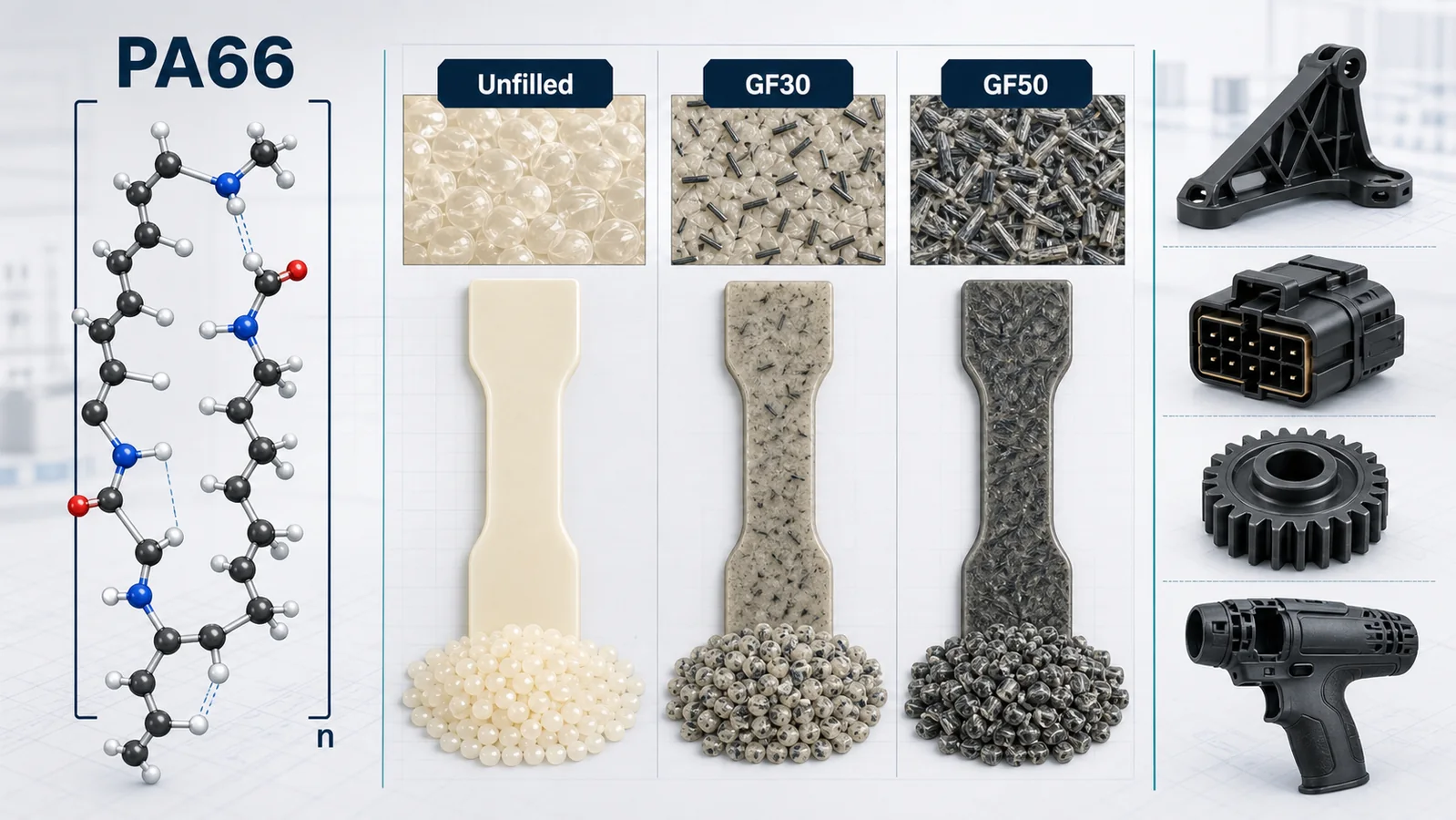
A production specification should identify the resin supplier and grade, reinforcement level, heat or UV stabilization, impact modification, flame rating, color, recycled-content restrictions and conditioning state. Unfilled PA66, PA66-GF30 and PA66-GF50 can behave like very different materials even though all carry the PA66 name.
PA66 Properties at a Glance
| Property area | Typical PA66 behavior | Engineering implication |
|---|---|---|
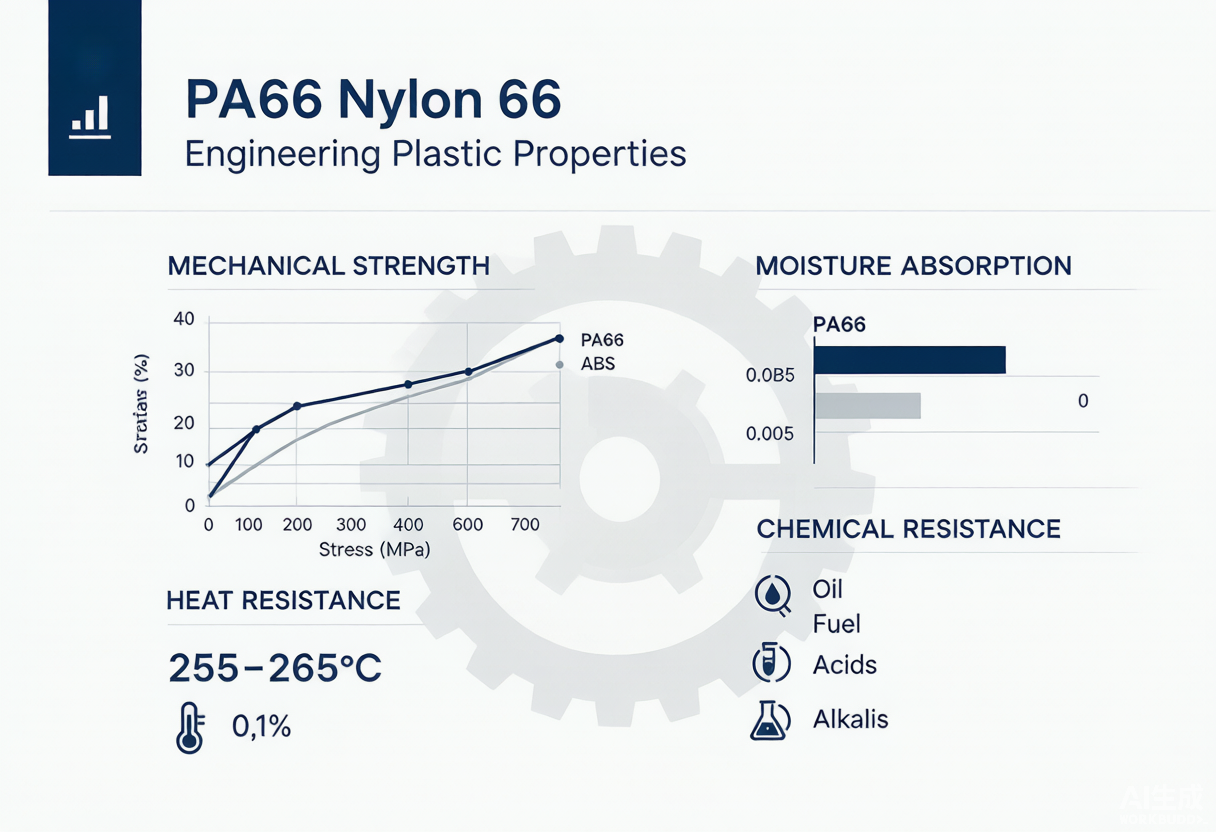
| Strength and stiffness | High for an unfilled engineering nylon; rises substantially with glass fiber | Useful for brackets, housings, gears and load-bearing molded parts |
| Thermal behavior | Melting range commonly around 255–265°C; service capability is grade- and load-dependent | Use HDT, RTI and creep data rather than melting point alone |
| Absorption de l'humidité | Lower than PA6 in many comparisons but still significant | Dimensions, stiffness, strength and impact change between dry and conditioned states |
| Wear and fatigue | Good sliding, abrasion and repeated-load performance | Suitable for gears, bearings, guides and mechanical linkages when friction and lubrication are reviewed |
| Résistance chimique | Generally good against oils, fuels and many hydrocarbons; weaker against strong acids and oxidizers | Validate the exact chemical, concentration, temperature, stress and exposure time |
| Comportement électrique | Useful insulation properties, available in flame-retardant grades | Moisture and grade additives can affect dielectric results and dimensional fit |
Datasheet values are not universal design allowables. Test method, specimen thickness, moisture condition, fiber orientation and temperature can change the reported result. Compare grades using matched conditions and validate the finished part.
PA66 Advantages and Limitations
| Avantages | Limitations to control |
|---|---|
| High strength-to-weight ratio and good fatigue resistance | Moisture-driven dimensional and mechanical-property changes |
| Higher heat capability than many commodity thermoplastics | Requires disciplined drying before melt processing |
| Good wear, abrasion and chemical resistance | Can be attacked by strong acids and oxidizing chemicals |
| Broad range of reinforced, flame-retardant and stabilized grades | Fiber-filled grades are anisotropic and may warp around uneven geometry |
| Suitable for high-volume injection molding | Overheating or excessive residence time can degrade the polymer |
PA66 is a strong candidate when structural load, repeated stress and elevated temperature matter. It is less attractive when extremely low moisture uptake, optical clarity or very tight humidity-independent dimensions dominate the application.
PA66 vs PA6, PA12 and PBT
| Matériau | Relative strengths | Typical reason to choose it instead |
|---|---|---|
| PA66 | Strength, heat, fatigue, wear and reinforced-grade availability | Balanced structural nylon for demanding molded components |
| PA6 | Toughness, flow and often lower material cost | Complex molded parts where PA66 heat capability is unnecessary |
| PA12 | Lower moisture uptake, flexibility and low-temperature toughness | Tubing, fluid systems and dimensionally sensitive wet environments |
| PBT | Low moisture uptake, electrical performance and dimensional stability | Connectors, sensor housings and precision parts exposed to humidity |
Use the dedicated PA6 vs PA66 guide for a direct family comparison, the PA12 material guide for long-chain nylon selection, and the Nylon vs PBT comparison for moisture-sensitive electrical and automotive applications.
Unfilled and Reinforced PA66 Grades
Unfilled PA66 provides the best balance of toughness, fatigue and surface quality. Glass fiber raises stiffness, strength, heat deflection and creep resistance, but it reduces elongation and creates orientation-dependent shrinkage. Mineral filler can improve flatness and dimensional control where maximum strength is not required. Impact modifiers trade some stiffness for better notched or low-temperature impact.
- PA66-GF15 : moderate reinforcement where surface and toughness still matter.
- PA66-GF30 : common structural grade for brackets, housings and electrical components.
- PA66-GF50 : very high stiffness for metal-replacement candidates, with increased warpage and processing sensitivity.
- Flame-retardant PA66: selected by the required UL rating, thickness, color and electrical test condition.
- Heat- or hydrolysis-stabilized PA66: used when long-term temperature, coolant or hot-water exposure must be controlled.
For reinforced-grade selection, review the Guide sur le PA66 GF30 and the PA66 GF30 GF50 comparison.
Grade-specific technical evidence
PA66 Datasheets and Document Control
The verified material library lists separate PA66 GF10, GF15, GF20, GF25, GF30, GF35, GF40 and GF50 datasheets, with flame-retardant versions listed separately. This matters because a value from PA66 GF30 must not be used as the specification for unfilled PA66, PA66 GF50 or PA66 GF30 FR.
Datasheet library availability checked September 14, 2026. Use the current document revision supplied for the quoted grade.
Injection Molding and Part-Design Controls
PA66 must be dried to the resin supplier’s target before molding. Excess moisture can reduce molecular weight and cause splay, brittleness or inconsistent properties. Melt temperature, residence time and shear should remain within the selected grade’s processing window.
Part design should use uniform walls, practical radii and gradual transitions. Gate location controls weld lines and glass-fiber orientation; cooling balance controls warpage; venting reduces burns and incomplete filling. For tight dimensions, state whether acceptance applies dry-as-molded or after conditioning and define the measurement environment.
| Production control | Evidence to request |
|---|---|
| Material and drying | Grade certificate, lot traceability, dryer temperature, time and moisture verification |
| Molding process | Approved process window, cavity pressure or equivalent controls, cycle and cooling records |
| Dimensions | Datum-based report with conditioning and free-state inspection defined |
| Functional performance | Load, torque, leak, wear, dielectric, thermal-cycle or chemical test as applicable |
Common PA66 Applications
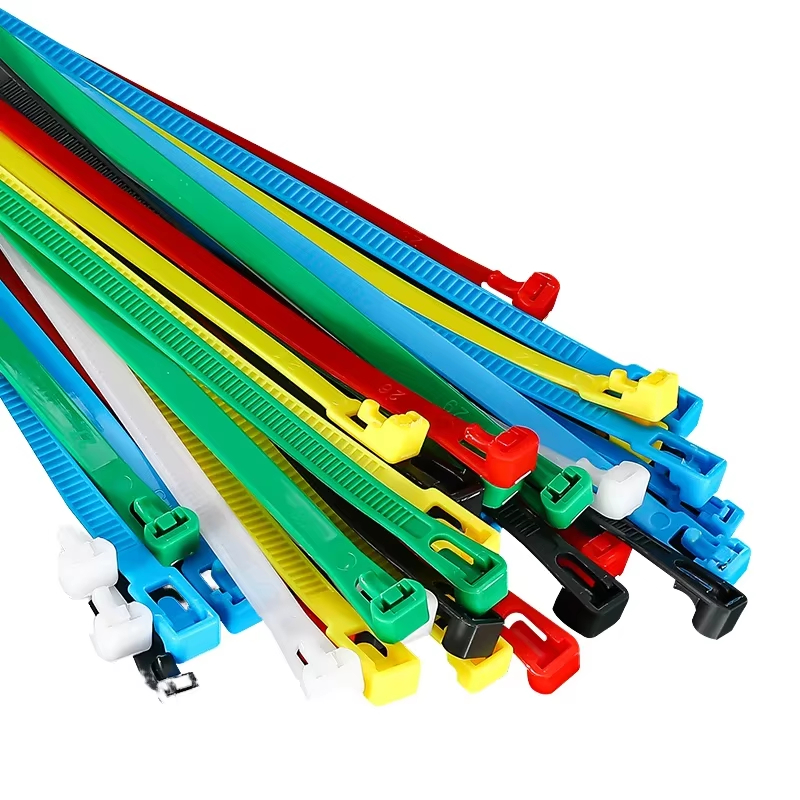
PA66 is used for automotive under-hood brackets, cooling-system components, electrical connectors, circuit-protection parts, gears, bearings, cable ties, power-tool housings, appliance parts and industrial mechanisms. Reinforced grades can replace aluminum or zinc in selected components when creep, fastening, tolerances and temperature are validated.
The application name alone does not qualify a grade. An electrical connector may prioritize CTI, flammability and moisture-controlled dimensions; a gear may prioritize fatigue, wear and lubrication; an under-hood bracket may prioritize creep, heat aging and chemical resistance.
PA66 RFQ and Grade-Approval Checklist
- Drawing, 3D model, annual volume and target production process
- Exact load, temperature, humidity, chemical and service-life conditions
- Required PA66 grade, reinforcement, color, flame rating and declarations
- Critical dimensions, conditioning state, inspection restraint and capability targets
- Surface, wear, dielectric, torque, leak or assembly requirements
- Material certificate, first-article report, sampling plan and change-control expectations
Share these requirements before tooling so the resin grade, gate and cooling strategy, tolerances and validation plan can be reviewed together. For molded PA66 parts, see our nylon injection molding services.
Certifications, Compliance and Material Substitution
A statement that PA66 is “food grade,” “medical grade,” “automotive grade” or “flame retardant” is not sufficient by itself. The requirement normally applies to a specific commercial formulation, color, thickness, manufacturing condition and market. Define the applicable regulation or customer standard, required supplier declaration, lot traceability and whether testing applies to the resin pellet or the finished component.
For electrical parts, confirm the exact UL file, flammability thickness, comparative tracking index and temperature classification. For automotive programs, identify restricted-substance reporting, PPAP level, material data submission, change notification and heat- or fluid-aging tests. For parts contacting food, water or medical systems, review the relevant regional requirements and the complete formulation, including pigments and processing aids.
Material substitutions require engineering approval even when both candidates are labeled PA66-GF30. Glass type, fiber length, coupling chemistry, stabilizers, flame retardants and base-polymer viscosity can change flow, warpage, strength, surface finish and long-term aging. A controlled substitution review should compare matched datasheets, process trials, dimensions and functional tests. Record the approved manufacturer, grade and revision on the drawing or material specification so purchasing cannot replace it with a nominally similar compound without requalification.
Questions fréquemment posées
Comparer PA66 properties and PA6 vs PA66 comparison including strength, heat, cost and application recommendations.
Is PA66 the same as Nylon 66?
Yes. PA66, polyamide 66 and Nylon 66 refer to the same polymer family. A complete specification still needs the commercial grade, reinforcement, additives, color and conditioning requirements.
What is the difference between PA66 and PA6?
PA66 generally provides higher melting temperature, stiffness and heat capability, while PA6 often offers easier flow, toughness and lower cost. Moisture, grade and reinforcement can change the comparison.
Does PA66 absorb water?
Yes. PA66 is hygroscopic. Absorbed moisture changes dimensions and mechanical properties, so drawings and tests should define dry or conditioned state and the measurement environment.
What temperature can PA66 withstand?
The answer depends on grade, load, exposure time and test criterion. Use continuous-use, RTI, HDT, creep and aging data for the exact grade rather than relying only on its melting point.
When should PA66-GF30 or GF50 be used?
Use glass-filled PA66 when stiffness, heat deflection, creep resistance and dimensional control justify lower elongation and greater anisotropy. GF50 needs especially careful flow, warpage and fastening review.
Request a PA66 Material and Part Review
Send the drawing, service conditions, required volume and current material target. We can review PA66 grade selection, manufacturability, inspection requirements and the route from sample approval to production.