Services
3D Printing Services for Prototyping and Production
What is 3D Printing?
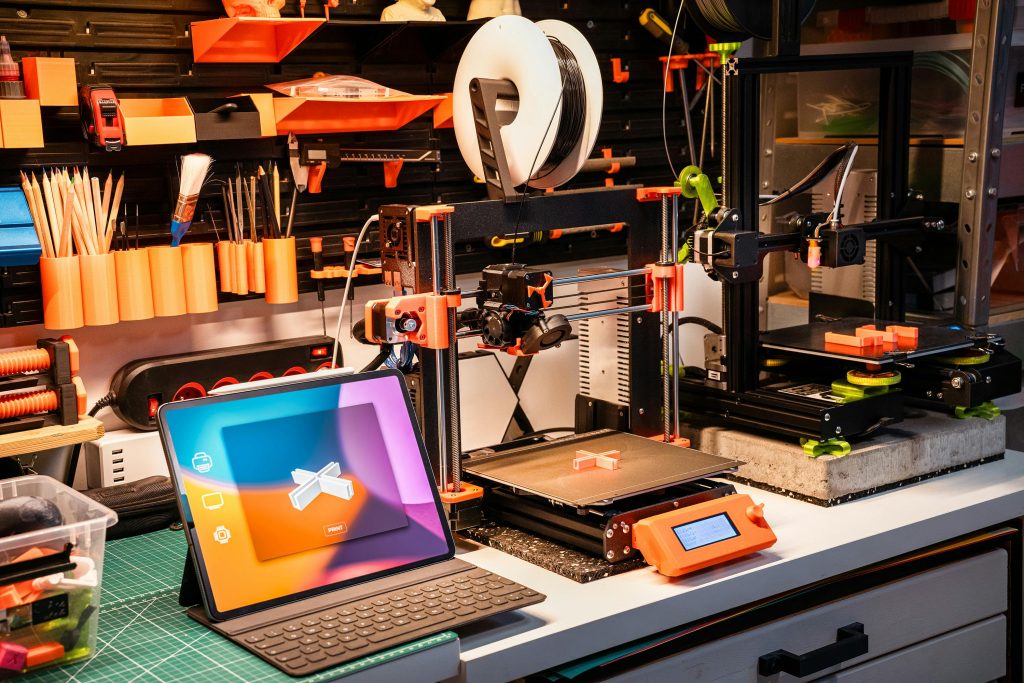
3D printing is a manufacturing process that creates three-dimensional solid objects directly from digital files. The technology works by using specialized software that translates digital models into instructions for the printing machine, which builds objects using various raw materials including polymers, resins, or metal powders.
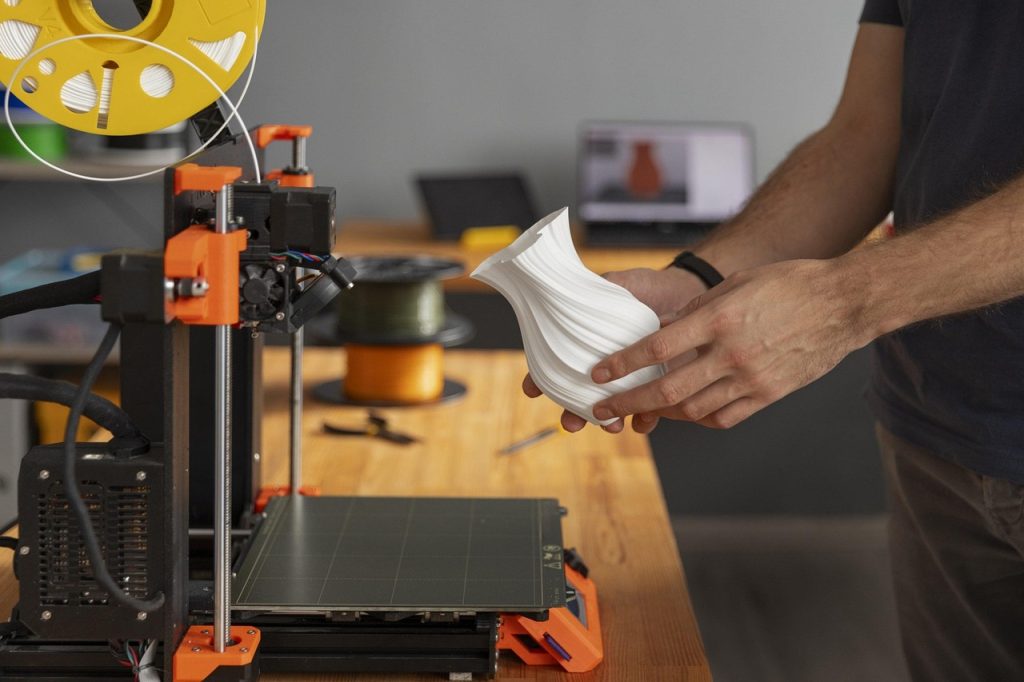
The process operates on additive manufacturing principles, constructing objects by depositing successive layers of material that immediately solidify according to the program’s specifications. Depending on the printer’s speed, you can observe the object gradually taking shape throughout the process.
The workflow integrates several key components. It begins with a 3D model, either originally designed using computer-aided design software or sourced from online model libraries. Once obtained, the digital file undergoes “slicing” to prepare it for printing.
Slicing software digitally divides the 3D model into numerous thin horizontal layers. These layer instructions are then transferred to the 3D printer via USB, WiFi, or other file transfer methods. With the prepared file loaded, the printing process commences.
After preparing the 3D printing machine and loading the file, the manufacturing process begins. Completion time ranges from minutes to hours, determined by the object’s complexity and the printer’s capabilities. This technology offers remarkable design freedom, enabling the creation of virtually any geometry imaginable.
3D Printing Materials Overview
Material Selection Guide:
Métaux: Ideal for high-strength, heat-resistant applications
Plastiques techniques: Perfect for functional prototypes and end-use parts
Specialty Polymers: Best for flexible or chemically resistant components
Photopolymer Resins: Excellent for high-detail models and visual prototypes
| Catégorie de matériaux | Type de matériau | Propriétés principales | Applications courantes |
|---|---|---|---|
| Métaux | Aluminium | Lightweight, good strength-to-weight ratio | Automotive parts, aerospace components |
| Cuivre | Excellent thermal & electrical conductivity | Heat exchangers, electrical components | |
| Acier inoxydable | Corrosion resistance, durability | Medical instruments, industrial parts | |
| Titane | High strength, biocompatible | Aerospace, medical implants | |
| Plastics & Polymers | ABS | Impact resistant, durable | Prototypes, consumer products |
| PA (Nylon) | Strong, flexible, wear-resistant | Functional parts, gears, hinges | |
| Polycarbonate | High strength, transparent | Engineering components, protective gear | |
| Polypropylène | Chemical resistant, flexible | Living hinges, containers | |
| TPU | Flexible, rubber-like | Gaskets, seals, flexible parts | |
| Resins | Digital Photopolymer | High detail, smooth surface | Detailed prototypes, dental models |
Our 3D Printing Processes
Advanced Manufacturing Technologies for Every Stage of Product Development
Stereolithography (SLA)
Selective Laser Sintering (SLS)
PolyJet
Multi Jet Fusion (MJF)
Digital Light Synthesis (DLS)
3D Printing Services FAQ
We provide industrial-grade 3D printing solutions including:
SLA (stéréolithographie): High-resolution printing with smooth surface finish, ideal for detailed prototypes and visual models
SLS (frittage sélectif par laser): Durable functional parts without support structures, perfect for complex geometries
FDM (Fused Deposition Modeling): Cost-effective prototyping with engineering-grade thermoplastics
PolyJet: Multi-material printing for realistic prototypes with varied textures
MJF (Multi Jet Fusion): High-speed production of functional parts with consistent quality
We offer comprehensive material options:
Plastiques: ABS, Nylon, Polycarbonate, ULTEM, TPU, Polypropylene
Resins: Standard, Engineering, Dental, Castable, High-Temperature
Métaux: Aluminum, Stainless Steel, Titanium, Inconel
Matériaux spécialisés: Glass-filled composites, flexible materials, biocompatible resins
Our rapid turnaround times include:
Standard projects: 3-5 business days
Express service: 24-48 hours (available for most technologies)
Complex/large projects: 5-7 business days
Production volumes: 1-2 weeks depending on quantity
We maintain strict tolerances:
ALS: u00b10.1mm (0.004") or u00b10.1% of feature size
SLS: u00b10.2mm (0.008") or u00b10.2% of feature size
FDM: u00b10.15mm (0.006") or u00b10.15% of feature size
Metal Printing: u00b10.1mm (0.004") or u00b10.1% of feature size
We support all major 3D file formats:
Preferred: STEP, STL, OBJ
Also Accepted: 3MF, IGES, X_T
CAD Native: SLDPRT (SolidWorks), F3D (Fusion 360), PRT (Creo)
Yes, our design optimization services include:
Free design for manufacturability (DFM) analysis
Wall thickness optimization and support reduction
Material selection guidance based on application
File repair and mesh optimization
Assembly design and part consolidation
Nos capacités de fabrication comprennent :
Large Format SLA: 1500 u00d7 750 u00d7 550 mm
Industrial SLS: 650 u00d7 350 u00d7 560 mm
Production FDM: 900 u00d7 600 u00d7 900 mm
Metal Systems: 400 u00d7 400 u00d7 400 mm
Our quality assurance process includes:
ISO 9001 certified manufacturing processes
First article inspection and in-process quality checks
Comprehensive post-processing and finishing
Material certification and traceability
Detailed quality reports with each order
Absolutely. We specialize in:
Prototypage: 1-50 parts with rapid turnaround
Bridge Production: 50-500 parts for market testing
Production Volumes: 500+ parts with volume pricing
Just-in-Time Manufacturing: Ongoing production support
Our expertise spans multiple industries:
Soins médicaux et dentaires: Surgical guides, dental models, custom implants
Aérospatiale et défense: Lightweight components, ducting, brackets
Automobile: Functional prototypes, jigs and fixtures
Produits de consommation: Product development, packaging, displays
Industrie: Custom tooling, replacement parts, maintenance
Comprehensive finishing options available:
Standard: Support removal, light sanding
Premium: Smoothing, painting, dyeing, clear coating
Professional: Vapor smoothing, plating, assembly
Specialty: Medical-grade sterilization, UL certification