PA6 GF30 is Nylon 6 reinforced with a nominal 30% glass fiber by weight. It is selected when unfilled PA6 does not provide enough stiffness, creep resistance or dimensional stability. This guide combines a real commercial-grade datasheet, typical cross-supplier property ranges, moisture effects and injection-molding starting conditions.
PA6 GF30 at a Glance
The example values below come from the downloadable PA6 WHG30A datasheet. That PDF does not state specimen conditioning; confirm the method and validate molded parts before design approval.
What Does PA6 GF30 Mean?
- PA6 identifies Polyamide 6, also called Nylon 6.
- GF identifies glass-fiber reinforcement.
- 30 identifies the nominal glass-fiber content by weight.
PA6 GF30 is a material family, not one universal recipe. Heat stabilizers, impact modifiers, lubricants, pigments, flame retardants, resin viscosity and fiber system can all change the final properties and molding behavior. Two materials marked PA6 GF30 are therefore not automatically interchangeable.
PA6 WHG30A Manufacturer Datasheet
The downloadable manufacturer TDS identifies the commercial grade as PA6 WHG30A. The following values are reproduced from that one-page document. They are typical product values, not guaranteed design limits.
| Propriété | Norme d'essai | Unité | PA6 WHG30A |
|---|---|---|---|
| Résistance à la traction | ISO 527-2 | MPa | 165 |
| Tensile Strain at Break | ISO 527-2 | % | 9 |
| Résistance à la flexion | ISO 527-2 | MPa | 230 |
| Module de flexion | ISO 178 | MPa | 6000 |
| Izod Notched Impact Strength | ISO 179 | kJ/m² | 17 |
| Temperature of Deflection Under Load | ISO 75-2/B | °C | 175 |
| Melting Index | ISO 1183 | g/10 min | 20 |
| Densité | ISO 1183 | g/cm³ | 1.36 |
| Molding Shrinkage | ISO 2577 | % | 0.6 |
| Inflammabilité | UL 94 | - | - |
Read the test conditions: ISO 75-2/B is the 0.45 MPa HDT method; it cannot be compared directly with the 1.8 MPa ranges below. The PDF does not state specimen conditioning. Its impact row names Izod but cites ISO 179 (Charpy), its flexural-strength row cites the tensile standard ISO 527-2, and its melting-index row cites ISO 1183 (density); confirm those methods with the supplier before using the figures for approval. The UL 94 result is blank. Request the current signed TDS, batch certificate of analysis and applicable RoHS, REACH or UL documents for the selected grade.
Download PA6 WHG30A Datasheet (PDF)
Need the compound rather than only the data? See the Page produit PA6 GF30 for grade selection and send the part requirements with your datasheet or sample request.
PA6 GF30 Typical Property Data
The following tables show illustrative ranges across commercial PA6 GF30 formulations, not additional specifications for WHG30A. Use them only to identify questions for grade selection; values can differ with formulation, specimen thickness, method and conditioning. The WHG30A PDF above is the source for that named grade.
Illustrative PA6 GF30 Mechanical Ranges (Dry as Molded Examples)
| Propriété | Valeur (plage typique) | Méthode d'essai | Unité |
|---|---|---|---|
| Module de traction | 9,500-10,500 | ISO 527-1/-2 | MPa |
| Résistance à la traction à la rupture | 170-190 | ISO 527-1/-2 | MPa |
| Allongement à la rupture | 3.0-4.5 | ISO 527-1/-2 | % |
| Module de flexion | 8,000-9,500 | ISO 178 | MPa |
| Résistance à la flexion | 260-290 | ISO 178 | MPa |
| Résistance au choc selon la méthode Charpy (avec entaille) | 12-16 | ISO 179/1eA | kJ/m² |
| Résistance au choc selon la méthode Charpy (sans entaille) | 75-95 | ISO 179/1eU | kJ/m² |
| Résistance au choc Izod (avec entaille) | 11-15 | ISO 180/A | kJ/m² |
| Dureté par indentation à la bille | 200-230 | ISO 2039-1 | MPa |
Propriétés physiques
| Propriété | Valeur (plage typique) | Méthode d'essai | Unité |
|---|---|---|---|
| Densité | 1.35-1.38 | ISO 1183 | g/cm³ |
| Absorption d'eau (23 °C, saturation) | 5.5-6.5 | ISO 62 | % |
| Absorption d'eau (23 °C, équilibre d'humidité relative 50%) | 1.5-2.0 | ISO 62 | % |
| Retrait de moulage (parallèle, 1,6 mm) | 0.25-0.40 | ISO 294-4 | % |
| Retrait de moulage (normal, 1,6 mm) | 0.80-1.10 | ISO 294-4 | % |
| Rétrécissement après moulage (parallèle, 1 h à 110 °C) | 0.05-0.10 | ISO 294-4 | % |
| Rétrécissement après moulage (normal, 1 h à 110 °C) | 0.10-0.15 | ISO 294-4 | % |
Propriétés thermiques
| Propriété | Valeur (plage typique) | Méthode d'essai | Unité |
|---|---|---|---|
| Température de fusion (DSC, 10 K/min) | 218-222 | ISO 11357-1/-3 | C |
| HDT à 0,45 MPa | 215-220 | ISO 75-1/-2 | C |
| HDT à 1,8 MPa | 195-210 | ISO 75-1/-2 | C |
| Température de ramollissement Vicat (VST/B50) | 205-215 | ISO 306 | C |
| Coefficient de dilatation thermique linéaire (parallèle, 23-55 °C) | 2.0-3.0 x 10⁻⁵ | ISO 11359-1/-2 | 1/K |
| Coefficient de dilatation thermique linéaire (normal, 23-55 °C) | 6.0-9.0 x 10⁻⁵ | ISO 11359-1/-2 | 1/K |
| Conductivité thermique | 0.28-0.35 | DIN 52612 | W/(m·K) |
| Capacité thermique spécifique | 1.5-1.7 | — | J/(g·K) |
Propriétés électriques
| Propriété | Valeur (plage typique) | Méthode d'essai | Unité |
|---|---|---|---|
| Constante diélectrique (1 MHz) | 3.5-4.5 | IEC 60250 | — |
| Facteur de dissipation (1 MHz) | 0.01-0.03 | IEC 60250 | — |
| Résistivité volumique | 1013-1015 | IEC 60093 | ohm·cm |
| Résistivité superficielle | 1012-1014 | IEC 60093 | ohm |
| Indice de suivi comparatif (CTI) | 500-600 | IEC 60112 | V |
| Rigidité diélectrique (1,6 mm) | 30-35 | IEC 60243-1 | kV/mm |
Inflammabilité
| Propriété | Valeur | Méthode d'essai | Notes |
|---|---|---|---|
| Classification UL 94 (0,8 mm) | HB | UL 94 | Le modèle GF30 standard n'est pas ignifuge |
| Classification UL 94 (1,6 mm) | HB | UL 94 | La norme FR V-0 exige l'utilisation d'un composé ignifuge spécialisé |
| Indice de limite d'oxygène (LOI) | 22-24% | ISO 4589 | Combustion en atmosphère normale |
| Température d'auto-inflammation | >400 °C | ASTM D1929 | — |
Évolution des propriétés sous l'effet du contrôle de l'humidité
Le PA6 absorbe l'humidité présente dans l'environnement. À l'équilibre, avec une humidité relative de 50% à 23 °C, une pièce en PA6 GF30 absorbera environ 1,5 à 2,0% d'eau par rapport à son poids. Cela modifie considérablement ses propriétés mécaniques. La résistance à la traction diminue de 30 à 40%, le module de flexion de 25 à 35%, tandis que la résistance aux chocs augmente de 50 à 100%. Le tableau ci-dessous présente l’évolution approximative des valeurs entre l’état « sec à la sortie du moule » et l’état conditionné (50% d’humidité relative) :
| Propriété | À l'état sec (tel que moulé) | Conditions de test (50% RH, 23 °C) | Modifier |
|---|---|---|---|
| Résistance à la traction (MPa) | 180 | 110-130 | -30 à -40% |
| Module de flexion (GPa) | 9.0 | 6.0-7.0 | de -25 à -35% |
| Résistance au choc Charpy avec entaille (kJ/m²) | 14 | 20-28 | +50 à +100% |
| HDT à 1,8 MPa (C) | 200 | 65-75 (humide) | Baisse significative en condition de saturation totale |

Paramètres de traitement
Séchage
Le PA6 GF30 doit être séché jusqu’à une teneur en humidité inférieure à 0,101 TP3T (objectif : 0,051 TP3T) avant le moulage par injection. Séchage recommandé : 80 °C pendant 4 à 6 heures dans un séchoir à dessiccant avec un point de rosée de -30 °C ou inférieur. Un séchage sur plateau à 80 °C pendant 8 à 12 heures est acceptable pour les applications non critiques, mais il est moins fiable que le séchage par dessiccation. Ne pas sécher à une température supérieure à 90 °C : une décoloration par oxydation (jaunissement) apparaît à des températures plus élevées.
Moulage par injection
| Paramètre | Plage recommandée | Notes |
|---|---|---|
| Température de fusion (buse) | 250-280 °C | L'extrémité inférieure pour les parois fines, l'extrémité supérieure pour les parois épaisses |
| Température du moule | 80-100 °C | 100 °C : température recommandée pour la cristallinité et la surface |
| Vitesse d'injection | Modéré à rapide | Un remplissage plus rapide réduit les variations d'orientation des fibres |
| Maintien de la pression | 50-80% de pression d'injection | Suffisamment pour compenser le rétrécissement et éviter le suremballage |
| Contre-pression | 5 à 15 bars (hydraulique) | Une contre-pression plus élevée améliore l'homogénéité de la masse fondue |
| Vitesse de la vis | 50 à 150 tr/min | Extrémité inférieure pour les granulométries plus importantes, afin d'éviter l'échauffement par cisaillement |
| Temps de séjour (max. à la température de fusion) | 10 à 15 minutes | Purger si la durée est supérieure ; le PA6 dégradé provoque des traces de brûlure et une perte de résistance |
Considérations relatives à la conception des moules
- Type de portail: Tous les types de portes standard conviennent. Les portes à broches, les portes à arêtes et les portes en éventail fonctionnent toutes. Pour les portes en tunnel (sous-marines), il faut prêter attention au diamètre de la porte : celui-ci doit être d'au moins 0,8 mm afin d'éviter un cisaillement excessif avec le 30% GF.
- Emplacement du portail: Positionnez la buse de coulée de manière à ce que le flux s'oriente vers la partie la plus épaisse. Évitez les trajets de coulée trop longs qui risquent de laisser le front de fusion se refroidir avant que la cavité ne soit remplie.
- Évacuation: Une ventilation adéquate est essentielle. Une mauvaise ventilation entraîne des traces de brûlure, des défauts de remplissage et des dépôts sur le moule. Profondeur de ventilation : 0,01 à 0,02 mm.
- Angle de tirage: 1 degré au minimum ; 2 degrés recommandés pour les surfaces texturées. Les nuances GF se contractent fortement autour des noyaux — un angle de dépouille adéquat permet d’éviter les dommages liés à l’éjection.
- Choix de l'acier: La fibre de verre 30% est abrasive. Pour les séries de production dépassant 100 000 moulages, utilisez de l'acier à outils trempé (min. 52 HRC) pour les cavités et les noyaux, en particulier au niveau des canaux d'injection et des zones soumises à une forte usure.
Comparaison entre le PA6 GF30 et les grades apparentés
PA6 GF30 is a common selection, but the following cross-grade values are screening examples, not a matched set of supplier specifications. Compare test method, load and conditioning before using them in a design decision. See the PA6 GF15, PA6 GF30 et PA6 GF40 pages for the available grade routes.
| Propriété | PA6 non chargé | PA6 GF15 | PA6 GF30 | PA6 GF50 | PA66 GF30 |
|---|---|---|---|---|---|
| Résistance à la traction (MPa) | 80 | 120-140 | 170-190 | 200-230 | 180-200 |
| Module de flexion (GPa) | 2.8 | 5.5-6.5 | 8.0-9.5 | 14-16 | 9.0-10.5 |
| Résistance à la rupture par entaille selon la méthode Izod (kJ/m²) | 5-7 | 7-10 | 11-15 | 13-18 | 10-13 |
| HDT à 1,8 MPa (C) | 65-75 | 180-195 | 195-210 | 210-215 | 240-255 |
| Densité (g/cm³) | 1.14 | 1.23 | 1.36 | 1.56 | 1.37 |
| Coût relatif | 1.0x | 1.1x | 1.2x | 1.4x | 1.3x |
PA6 Glass Fiber Grade Comparison: GF15 vs GF30 vs GF40 vs GF50
Glass fiber content drives the performance-cost trade-off in PA6 compounds. The table below shows how increasing glass fiber from 15% to 50% changes key mechanical and thermal properties. Use these screening values to narrow your grade selection before requesting commercial datasheets.
| Propriété | PA6 non chargé | PA6 GF15 | PA6 GF30 | PA6 GF40 | PA6 GF50 |
|---|---|---|---|---|---|
| Tensile Strength (MPa, dry) | 70 – 85 | 110 – 130 | 160 – 190 | 180 – 200 | 200 – 220 |
| Module de flexion (MPa) | 2,500 – 3,000 | 4,500 – 5,500 | 8,000 – 10,000 | 10,500 – 12,000 | 13,000 – 15,000 |
| Allongement à la rupture (%) | 20 – 40 | 3 – 5 | 3 – 5 | 2 – 3 | 1.5 – 2.5 |
| Charpy Notched Impact (kJ/m², 23°C) | 5 – 8 | 8 – 12 | 10 – 15 | 12 – 16 | 13 – 17 |
| Densité (g/cm³) | 1.13 – 1.15 | 1.20 – 1.23 | 1.35 – 1.38 | 1.44 – 1.48 | 1.55 – 1.58 |
| HDT/A, 1.8 MPa (°C) | 60 – 75 | 180 – 195 | 200 – 210 | 210 – 215 | 215 – 220 |
| Point de fusion (°C) | 220 – 225 | 220 – 225 | 220 – 225 | 220 – 225 | 220 – 225 |
| Mold Shrinkage (flow, %) | 1.0 – 1.5 | 0.4 – 0.7 | 0.2 – 0.5 | 0.15 – 0.35 | 0.10 – 0.25 |
| Applications typiques | Non-structural clips, covers | Housings, brackets, medium stiffness | Engine covers, fan shrouds, power tool housings | High-stiffness frames, pump bodies | Metal replacement, extreme rigidity |
Selection guidance: PA6 GF30 is the most commonly specified glass-filled PA6 grade because it delivers the best stiffness-to-cost ratio for typical structural applications. Move to GF40 or GF50 only when the application demands stiffness approaching aluminum or when wall thickness is constrained. Stay with GF15 when flow into thin-wall features or impact toughness at low temperature matters more than maximum rigidity.
PA6 GF30 Commercial Grade Equivalents
| Fournisseur | PA6 GF30 Grade | Key Features |
|---|---|---|
| BASF | Ultramid B3WG6 / B3EG6 | General-purpose, heat-stabilized, excellent surface finish |
| DuPont | Zytel 73G30 HSL | Heat-stabilized, widely specified in automotive |
| LANXESS | Durethan BKV 30 H2.0 | Heat-aged, good flow for thin-wall parts |
| DSM / Envalior | Akulon K224-G6 | General-purpose, good chemical resistance |
| Domo / Solvay | Technyl C216 V30 | Widely available in Asia, good processability |
| EMS-Grivory | Grilon BG-30 | Good impact balance, suitable for structural parts |
| Radici | Radilon S RV300 | Easy flow, suitable for complex geometries |
| Ensinger | TECAMID 6 GF30 | Stock shapes and machined parts |
When substituting between PA6 GF30 suppliers, compare full datasheets in the same conditioned state (dry-as-molded vs 50% RH), verify mold shrinkage in both flow and transverse directions, and run a production-tool trial. Even nominally equivalent PA6 GF30 grades differ in fiber length retention, color stability, heat aging, and processing window.
Where PA6 GF30 Is Used
PA6 GF30 is commonly considered for structural parts that need higher stiffness and heat resistance than unfilled PA6. The selected commercial grade still has to meet the part’s impact, moisture, chemical, appearance, electrical and flame requirements.
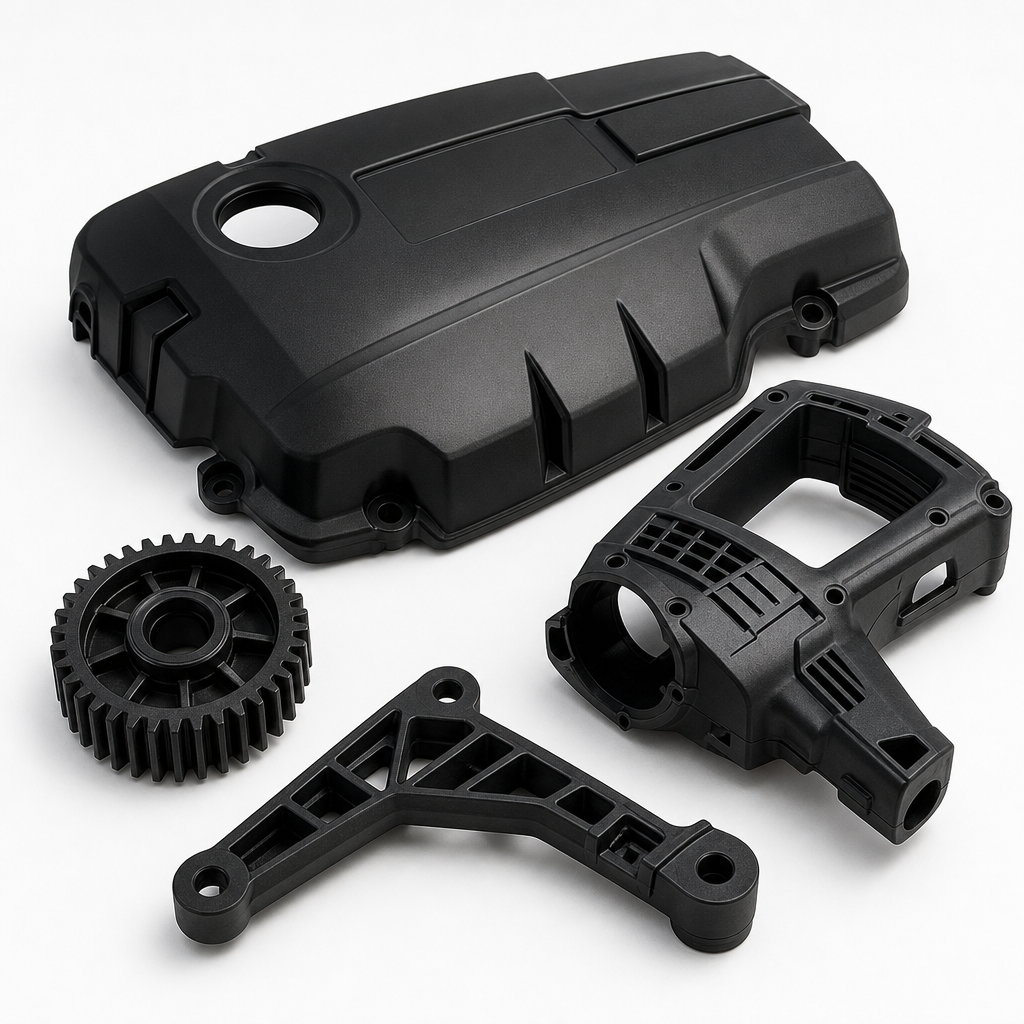
Fan shrouds, structural housings, brackets and selected under-hood components.
Pump bodies, impellers, machine housings and load-bearing supports.
Housings, connectors and supports when the grade meets the required electrical and flammability ratings.
Stiff housings, frames and mechanical components where fiber orientation and surface finish are controlled.
À propos de notre offre de plastiques techniques
As an ISO 9001 certified engineering plastics manufacturer and exporter, we produce PA6 GF30 in heat-stabilized, impact-modified, UV-stabilized and color-matched variants. For the selected formulation, our technical team can provide the matching datasheet, batch-specific certificate of analysis and applicable RoHS, REACH or UL documentation. Send your target properties, annual volume and delivery destination to discuss a standard grade or custom formulation.
Vous avez besoin d'une fiche technique sur le PA6 GF30 pour votre application ou d'un devis pour un approvisionnement ? Contactez notre équipe — specify your volume, delivery destination, and any special requirements (color, certification, impact modification). The current datasheet and quotation scope are confirmed for the selected grade and requirements.
Questions fréquemment posées
Is PA6 GF30 one standardized material?
No. PA6 GF30 identifies a PA6 material family with a nominal 30% glass-fiber level. The additive package, resin viscosity, fiber system and conditioning state vary by commercial grade, so compare the complete TDS and validate the molded part.
Is PA6 GF30 the same as PA66 GF30?
No. Both contain nominal 30% glass fiber, but PA6 and PA66 use different base polymers. They differ in melting and heat performance, moisture response, processing window and grade availability.
Is standard PA6 GF30 flame retardant?
Not automatically. A standard grade and a PA6 GF30 FR grade are separate selections. Confirm the exact UL 94 rating, specimen thickness and certification for the chosen commercial grade.
Quelles sont les caractéristiques essentielles à vérifier dans la fiche technique du PA6-GF30 ?
Check tensile strength, flexural modulus, the named impact method, HDT test load, density, shrinkage and specimen conditioning. As a named example, WHG30A lists 165 MPa tensile strength (ISO 527-2), 6,000 MPa flexural modulus (ISO 178) and 175°C HDT (ISO 75-2/B, 0.45 MPa). Do not treat the cross-supplier ranges as guarantees for WHG30A.
Pourquoi les valeurs de résistance indiquées dans la fiche technique du PA6-GF30 varient-elles d'un fournisseur à l'autre ?
Glass fiber type and length, coupling system, base resin, additives and conditioning can change the result. Compare values measured by the same method and conditioning state; there is no universal percentage allowance that makes two grades equivalent.
Comment dois-je interpréter les valeurs indiquées dans la fiche technique du PA6-GF30 pour ma conception ?
Choose dry or conditioned data to match the part’s actual service environment, then validate critical dimensions and loads on molded samples. The WHG30A PDF does not state conditioning. Set design margins from the part loads, environment and failure consequences; the datasheet alone does not define a universal safety factor.
Quels sont les paramètres de transformation qu'une bonne fiche technique du PA6-GF30 doit comporter ?
Check the selected grade’s drying, melt and mold temperatures, moisture limit and injection settings. The WHG30A one-page PDF provides property data but no processing window; the parameters above are starting points for trials, not guaranteed WHG30A settings.
Technical Review and Data Sources
Technical author and reviewer: WanHan Technical Team
Last Technical Review: September 28, 2026
- WanHan PA6 WHG30A Technical Data Sheet is the source for the named WHG30A values on this page.
- ISO 1183, ISO 527-2, ISO 178, ISO 179, ISO 75-2/B and ISO 2577 are cited as printed in that TDS; noted method inconsistencies must be confirmed before approval.
- Cross-supplier values are reference ranges. Exact properties depend on grade, test method and conditioning; use the current grade TDS and representative testing for qualification.